Today I'm excited to bring you a guest post by my husband the Southern Baron, who shares my passion for snarky film reviews. He's currently finishing his dissertation about martyrdom, execution, and the media in 17th century England, and keeps finding ways current events aren't too different from that time.
In 1681, an English carpenter named Stephen College was executed for treason. He wrote a poem
that “imagined the death of the King,” which by law was just as bad as assassination, since “imagination” meant a lot more than make-believe. The poem suggested that he actually wanted Charles II dead, and that was beyond the pale, especially since “imagining” Charles I’s death had led to his beheading back in ‘49. And the poem said, specifically, “like father, like son.” It didn't take an English Lit PhD to know what that meant. So the carpenter was drawn and quartered publicly in London: not a good way to go.

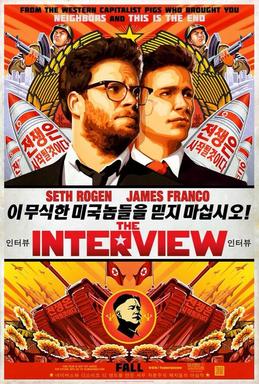
College had bad luck—writers got off fairly often back in the 1680s because the publisher was the first guy the government went after. And this is a key link between that old case and the whole mess around the late 2014 film
The Interview and the now-infamous hack of Sony Pictures by, presumably, North Korea. But this time one state went after a “publisher” in another state. This is like printing a poem imagining the death of the Pope, and having the Swiss Guard ransack your London shop. (
Or that scene in The Man Who Shot Liberty Valance.) Charles II wouldn't have let that happen. Although Sony was hacked, our “king,” President Obama, rightly said that this couldn't intimidate theaters and moviegoers. And while
The Interview is literally guilty of “imagining the death” of Kim Jong-un, it doesn't really encourage viewers to kill him. The film’s underlying message is that the pen beats the sword, though you should keep your sword ready in case they launch the nukes. The movie really just attempts to start a revolution “with nothing more than a camera, and some questions,” as James Franco’s character, Skylark, tells his TV audience, almost too self-referentially. But if it is possible to imagine Kim dead, we could also imagine his regime gone, period.
This is not a great film. But as my advisor told me in our very first meeting, there are a lot of bad poems in history that English majors ignore because they are, well, bad poems—even though they are absolutely important for understanding politics and culture. Bad poems destroy governments. And North Korea knows it.
One of the most important running jokes in the entire film is classic Seth Rogen bathroom humor: the purported belief among North Koreans that Kim Jong-un lacks an anus because, in his awesomeness, he has no need to use the bathroom. This is finally dispelled (spoiler!) when, in the climactic and titular scene of the film, the Supreme Leader literally “sharts” on camera. Ha. A bit childish. Overgrown boy that I am, I admit, I LOL’d. But allow me to defend this scene, and this plot point.
The discovery, as Skylark tells him onscreen, that Kim is “just a flawed man with a big old butthole,” who “has to pee and poo just like the rest of us,” is rather profound—it destroys the constructed majesty surrounding Kim. And since it appears on live state sponsored television, all the people have to see it. The joke is similar to a case I found in which a man was in trouble for saying “The King knows no more about salvation than my arse.” The King is as dumb as a butt. And Kim, to his people’s surprise, has a fully functioning one. They are struck with disbelief—it must be a joke, they think—there must be some mistake, they say—Kim is not like us, Kim does not go to the bathroom, Kim would never soil his trousers on television! But as they see Kim weep about a Katy Perry song, in the kind of news segment that would embarrass everybody involved (demonstrating some of the dangers of live TV), they realize that he is as capable of error as anyone else. Kim, of course, still does not believe it, and from here we work our way to the infamous uber-climax, the death by exploding head of Kim, as he attempts to destroy our heroes—escaping in a Soviet tank from Stallone, er, Stalin—by helicopter, while making obscene gestures and launching nukes at the United States. That primetime celebrity gossip show just got serious like 60 Minutes.
Other details silently comment on deeply valid points about how North Korea and the US see each other. The opening scene has a smiling child, adorably dressed, singing about how “arrogant and fat” Americans should “drown in their own blood and feces.” A guard in Kim’s palace watches the interview at a security desk with a mural of an exploding Statue of Liberty behind him. This shot appears within a broader montage of people watching the interview in the two countries. Skylark’s staff are in their sleek New York office, wearing expensive suits; the CIA agents are in theirs in D.C. These shots are interspersed with North Korean viewers, who are depicted in grim, dusty rooms, wearing dull clothing, and—horror of horrors!—watching on old CRT monitors, even one with a
manual dial, instead of the flat screens that have been a mark of western progress since the early aughts. Clearly North Korea is impoverished because its people lack western goods!
And while this may be an overly materialistic view, it’s one that Americans get, and it continues a timeworn but valid tradition of contrasting communist and capitalist worlds by who has cars that run. (Notably, Kim’s collection, in the film and in reality, consists of Audis and other luxury imports—the only commie car is that Soviet tank, and Kim drives it for fun while listening to...Katy Perry’s “Firework.” The entire movie might be a riff on the song.) Kim, of course, loves western goods and western entertainment, which is why he brought Skylark to his country in the first place. Skylark even shows Aaron (Rogen) on his Wikipedia app that Kim likes his show. Seeing this on the encyclopedia that anyone can edit, and on a phone, is a clever contrast with the state-imposed knowledge that North Koreans receive.
But the most obvious example of this dichotomy is the very real shortage of food in North Korea. When Skylark discovers a false grocery with wax vegetables, just after a lavish dinner with the generals, and realizes he must have seen a “fake fat kid” outside it the day before, it drives our hero over the edge, convincing him that his newfound margarita-and-babe-enjoying buddy Kim is really just, well, the male version of “honeypotting” him and screwing over his country.
Again, this is not a great film;
as one review noted,
Dr. Strangelove it ain’t. There are more F-bombs than nukes. It is easy to forget the prescient butt jokes because there are so many others that exist solely for the purpose of being butt jokes. Some scenes are pure filler. It is heavy on classic American male “yellow fever,” objectifying Asian women. It reinforces the idea that happiness is determined by having lots of stuff. Skylark’s excessive interest in partying is not questioned (besides his belief that the CIA’s plan to “take out” Kim must mean dinner and drinks), only the North Koreans’ limited access to the New York club scene. But culture doesn’t consist only of great art. Most people don’t see that every day, but they do see stupid shows like Skylark’s, thinking a lot more about which celebrity slept with whom than which foreign leader is oppressing his country. The film effectively challenges that preoccupation, since first Aaron and then Skylark realize they have to convey something more significant, which they are doing by the epilogue.
So, to have a Rogen-Franco flick take juvenile humor and apply it, in a surprisingly intelligent way, to the serious subject of human rights failings in North Korea, is impressive, and important. The possibility that the movie might make its way via bootleg into the North is also important—indeed, that nauseatingly self-aware implication that a revolution had started with a camera could come true in time, as Pyongyang’s control over the minds of its subjects is constantly undercut by cross-border DVD smuggling (depicted well in the 2014 Frontline episode “
Secret State of North Korea,” by the way). When all you have is state-controlled television, The Interview can have some impact; and when leaders are portrayed as gods, the first step is to demonstrate that they aren’t. The subtext to all this is that propaganda is still crucial—Kim’s own propaganda minister, Aaron’s love interest, has to support them, or the plan won’t work. The TV—and not the original CIA assassination plot—is still the medium through which minds are shaped.
Back in 1681, that carpenter died for “bad art,” and in December North Korea threatened that people might die for “bad art” again. The unrelated Charlie Hebdo murders demonstrate that it remains a possibility.
The Interview is guilty of imagining the death of the Kim, but Rogen and Franco don’t deserve drawing and quartering in the public square (even if they really don’t deserve an Oscar, either). That the North Korean government and its cyber-allies think Sony should suffer is all the more reason that we should watch the movie, and keep making ones that undermine injustice, even if the methods are a bit juvenile. Thoughtcrime is doubleplusungood. Be sure to try some today.