Showing posts with label rants. Show all posts

Monday, February 2, 2015

How About a Shot of Reality with That Juice Box?

Let no one have contempt for your youth, but set an example for those who believe, in speech, conduct, love, faith, and purity. - 1 Timothy 4:12
Earlier this month congressional Republicans cancelled a bill restricting abortions after 20 weeks, a law that would have been a huge victory for the pro-life movement. The recent fallout has seen Catholics assessing their loyalty to the GOP and pondering strategies for the future. Recently Crisis published the latest installment of this, a long rant by Catholic Family and Human Rights Institute (C-FAM) leader Austin Ruse entitled "Abortion, Torture, and the Juice Box Theologians."

Ruse treads familiar ground, worrying that Catholic disenchantment with the GOP will dilute what little political clout we have. He raises a fair point, about torture debates creating "single issue voters." Mostly, though, he channels his political disappointment into personal internet feuds, bringing up 2010 debates about the morality of waterboarding. Although some Catholics are increasingly disenchanted at how neither political party fully represents their values, he denounces those who put too much emphasis on the death penalty or a living wage over the pro-life cause.

Sadly, Ruse talks about abortion like it exists in a vacuum. It's a comic book villain holding America in a tractor beam, and if pro-lifers can finally deal it a death-blow with their unreliable laser guns, everyone will shake off the hypnosis and society will live happily ever after. His personal solution to America's moral woes is the repeal of various taxes coupled with "a national campaign out of the White House encouraging people to finish high school, get married, go to church, and have babies."

How exactly would a nation of high school graduates working low minimum wage jobs afford to feed their babies or pay for child care while they work multiple jobs? That version of the Culture of Life doesn't sound very flourishing, let alone sustainable. Such a short-sighted approach ignores the multitude of social and economic factors that make women think abortion is their best option, none of which will magically disappear if Roe v. Wade is overturned. Unless we address the challenges that make parenthood seem impossible, legal pro-life victory will be superficial and fleeting. As one Catholic mom wisely put it, "Want to save the babies? Save their mothers."

Ruse puts his faith in procreation propaganda rather than a nuanced sense of morality and ethics. Instead of taking a holistic outlook that considers respect for any human life beneficial, whether prisoners or laborers or babies, he insists Catholics should only have a one-track mind. If he had been alive in the 1830s, would he have told people to shut up about the Trail of Tears or working conditions at the Lowell mills because Slavery? Would he have considered a White House campaign saying “Be nice to black people” sufficient for post-Civil War reconstruction?

If Ruse wants an intelligent debate about political loyalties, that's fine, But he doesn't offer that here, just an ad hominem screed. Dredging up an obscure beef with group blog Vox Nova, he calls them "Juice-box theologians, that is, mostly young newly minted but largely unemployed PhDs." Apparently these whipper-snappers too incompetent to handle full-time jobs or adult beverages are somehow also at the heart of a vast and dangerous conspiracy to lure Catholics away from their GOP alliances.

Someone hold my earrings because I need to throw. Down. This kind of name-calling is uncalled for, and I can’t believe the editors of  Crisis were willing to print it. I don't know the terms of Ruse's dispute with Vox Nova, but even if the site is in the wrong, this is a terrible rebuttal on many levels. Saying "my opponent is young and underemployed, and therefore incorrect" is just campaign spin. Such smug self-importance supports the old liberal saw that pro-lifers only care about people until they are born; after that you’re on your own. But that's the thing with babies - after their mothers choose life, they learn to talk, read, and write.

Here’s a group of people who have done exactly what Ruse thinks Americans should do: they finished school, and cared enough about churchgoing to spend years studying theology. But that’s not good enough, because they dared to be born decades after him and enter the workforce during a broken economy and academic system.

My husband and I are among many young Catholic couples who fit this category. We’re church-going, contraception-eschewing people who thought pondering the Good, the True, and the Beautiful was our vocation – and now low-paying adjunct gigs are among our only options. Through blood, sweat, and tears, we’re working hard to build fulfilling lives for our little families. If middle class financial security is the barometer of spiritual legitimacy, please let us know and we can call ourselves radical Calvinists to save time.

This is the dilemma facing my Millennial generation: even if we followed all the rules, we've run into unexpected economic challenges and then are told it’s our own fault and we should know our place. People bemoan how the Kids Today aren't devoted to the Church, but then don't fully engage with those of us who have stuck around. If some of us don't share his political ideas, Ruse would rather we just disappeared into the wilderness. "Let’s have a modern day land-rush for all those Distributists out there who are just itching to fish, farm or make cheese—though one suspects they’ll stay exactly where they are, blogging and adjunct teaching."

While he retains his own career as an online journalist, I presume? Apparently Ruse thinks the generations after him don't deserve to aspire to his urban intellectual life. Considering that he once proclaimed that liberal academics "should be taken out and shot," he’s letting us off pretty easy. Still, his pompous attitude makes me question his moral judgement and frankly, feel a little betrayed.

Once upon a time, when I was just a juice box historian in high school, I wrote a report on the Holy See's permanent observer status at the United Nations. Ruse's articles were a major source for the project, and I looked up to him as a Catholic intellectual. I dreamed that one day I would be like him and get my words published on the internet. Now I realize he'd probably mock me for the 18 months I spent working temp gigs while I endlessly searched for a job in my MA field. Since he doesn't even want me here unless I’m drinking his Kool-Aid, I’ll stick to whiskey. Every grad student knows it's an important tool for surviving a PhD program.

Sunday, February 9, 2014

NFP Subculture: Don't Punish the Obedient

"I wish I liked Catholics more."
"They seem just like other people."
"My dear Charles, that's exactly what they're not--particularly in this country, where they're so few. It's not just that they're a clique--as a matter of fact, they're about four cliques all blackguarding each other half the time--but they've got an entirely different outlook on life; everything they think important is different from other people. They try and hide it as much as they can, but it comes out all the time."
- Brideshead Revisited Book I, Chapter 4
Last week John Zmirak at The Catholic Thing posted a stunningly fed-up rant about "the weirdness, bitterness, crankiness, and the general mediocrity that pervade the Catholic subculture," and how those negative aspects hinder evangelization, especially about Church doctrine on contraception. The Catholic population that actually believes and follows the Church's disapproval of artificial birth control is relatively tiny, and thus "as inbred as a pack of captive cheetahs, with all the dangers of deformity and disease that that implies."

Zmirak warns that "The Church as righteous subculture is unappealing to nearly everyone – including the kids who grow up inside it, who despite all those years of homeschooling and chapel veils frequently flee for what look like saner pastures ... We need to listen to [the secular world's] real questions and objections and do a much better job explaining ourselves. Or else that’s who we’ll go right on talking to – ourselves."

(*Edit: When I included this snarky soundbite, my intention was not to condemn the "homeschooling and chapel veils" set among whom I grew up and greatly respect. I seriously doubt the homeschooler apostasy rate is as high as Zmirak suggests. But I have also seen that no one pious practice is a magic bullet for sanctity and that intelligent young people indeed can be disillusioned by a lack of self-awareness in some traditional Catholic circles.)

It's true; self-righteous dismissal and distrust of Others isn't going to win any converts. It also endangers the few devout believers who do hold fast to beleaguered truths of the faith. Even if you are among the remnant that actually shuns contraception, there plenty of your compatriots ready to warn that you might be Doing It Wrong. Internet discussions about Natural Family Planning and childbearing are notoriously contentious. "Perfect love casts out fear," (1 John 4:18) but there is plenty of "bitterness, crankiness," infighting, and fearmongering in the NFP subculture. Look at any recent article about the morality and ethics of NFP, and you'll see several cliques all blackguarding each other:
  • Dire conspiracy theorists sure most people's reasons for postponing pregnancy aren't good enough 
  • Harried parents paranoid that they should be pregnant again or that they discerned poorly
  • Rival method loyalists engaged in combox brawls
  • Theologians insensitive to the emotional responses their coldly logical syllogisms elicit
  • Infertility martyrs who shame anyone with "lesser" sufferings for complaining
  • Glib spouters of the conventional wisdom that anyone struggling with NFP must be lazy and/or selfish, lustful, lacking in faith, or resisting God's will 
Is this really the alternative we want to offer the secular world? Instead of getting free birth control pills, you can be part of a tiny subculture that bickers about the minutiae of bodily functions and acts as the pregnancy thought police! Doesn't that sound life-giving and awesome? 

My own NFP experience has taught me how toxic fertility scrupulosity can be. Although I've been on board with NFP since I was a teenager, actually using it in my marriage has been a huge test of my faith. I had naively thought that obsessive charting would exempt me from those "lazy" user problems, but in reality the learning curve was steep. In our first months as newlyweds we dealt with much confusion, frustration, and loneliness. Had Theology of the Body cruelly duped us? Irregular charts made my body feel like an enemy and drove me into neurotic data tracking. I worried that God must be punishing us for some secret transgression and that I had failed as a wife. When I mentioned my spiritual conflict in confession, one priest told me this was none of his business and hinted I should just use birth control anyway. 

In reality, our problems were simply practical. Three methods, several hundred dollars of classes, and one minor surgery later, it's finally getting better. I now know what kind of charting works best for my personality and my body's habits. What helped me get through this difficult time was compassion from Catholic friends who acknowledged my suffering. Even if their own NFP stories were different, they trusted my judgement and encouraged me to persevere. I'm eternally grateful to the kind Franciscan confessor  in neon blue Crocs who told me "Yeah, this NFP stuff can be hard. Most priests have no clue."

I also appreciate the conversation Simcha Fisher has started with her hilarious and insightful book The Sinner's Guide to Natural Family Planning. She reminds readers that coming to terms with one's fertility requires spiritual growth, but that doesn't mean the NFP crowd should feel "judged and judgey." Only God can analyze fully a couple's hearts and childbearing decisions. Since Simcha's book came out, it's been heartening to see many other Catholic bloggers reveal their own NFP struggles and concur that there is no one-size-fits-all solution.

The Sabbath was made for man, not man for the Sabbath. (Mark 2:27) It's senseless to be Pharisaical towards Catholics who sincerely believe and practice all the Church's teachings. It's illogical to tell people that following the rules with an imperfect mindset is just as grave a sin as breaking them altogether. If orthodox Catholics are a clique that suspects the worst of its own members, why would anyone in their right mind want to sit with us? 

Thursday, April 21, 2011

The Cross, Conversion, and Chippendale Chairs

I've really enjoyed following the Bright Maidens' Lenten blog series, especially this week's installment about conversion. I've had conversion on the brain lately since I've been following Kassie, Brit, and Kortni's poignant journeys into joining the Catholic Church this Easter. Being a cradle Catholic, I never had the experience of a dramatic leap into the truth, but lately I've been realizing that God requires a change of heart at every stage of life.
Elizabeth's Bright Maidens post really resonated with me since she described the stage that I'm grappling with right now - figuring out how to balance my faith and my professional life. When I interviewed at my grad program, I described my volunteer work with the poor and my love for fancy museums as "two halves of me that I'm trying to reconcile." Two years later, that is still a work in progress.

One of the new lambs on the museum grounds
When you spend most hours cramming information into your brain, there is little energy left to worry about your soul. Sometimes it's hard to see life beyond stacks of books and papers. I feel like to much of academia, my church-going is just a quaint hobby that makes me really good at art history trivia. It's only slightly more relevant to modern society than Civil War re-enacting, and probably less palatable since re-enactors don't ever tell people their choices are immoral. What do my beliefs have to offer modernity except the Cross and self-denial? That's a hard sell, and its discouraging. I've gotten a little too jaded about how crazy and kitchy Christianity must seem to outsiders.

I'm startling to realize that this is another conversion opportunity. I have to decide to be Catholic not because it's what my parents taught me, or because I'm afraid of hell, or even because I loved my college campus ministry community. No, it has to be something I choose myself, today, for the way I live right now. But exactly how do I make that choice?
Lamb of God headstone at my Delaware parish

God gave my jumbled mind and heart a breakthrough this Tuesday as I sat with the daily readings in my local parish. My over-academic brain noticed that there was a lot of material culture in the Gospel accounts of Holy Week - clothes, dishes, donkeys, attic spaces, plants, money. Maybe the two halves of me weren't so separate after all...

I thought about all the reasons why Catholics are supposedly weird:
- We talk about people and things most people have never heard of. Oh wait, that's what my classmates and I do all day long. Normal people don't spend car rides discussing Chippendale chairs, museum ethics, vernacular architecture theories, or Jackson Lears' conception of antimodernism.
- We have goofy rituals and traditions that are off-putting to outsiders. Well, at grad school dinner parties we flip over chairs, climb under tables, and analyze the china. (Seriously, I did that last weekend.)
- Then there's that sticky final issue of poverty and self denial. Frankly, I can't think of a better way to describe getting a master's degree or PhD. Case closed.

late 1800s embroidered Lamb of God burse at Church of the Transfiguration, NYC
Really, the two halves of me work best when they are in tandem. Catholicism has given me an advantage as an historian, and not just in the trivia department. When I look at the world through the eyes of faith, I can see connections everywhere - the hand of Providence in good things, Old Testament allusions in the Mass, words of hymns that pertain to certain moments, experiences that I can compare to events in Christ's life. The entire world is bound together by the love of God, the waters of Baptism, the tangible mystery that is the Eucharist. When I was at Mass tonight, I was connected to thousands of people who lived centuries before me.

There are times when studying history feels similar. Sometimes my mind envisions a timeline of people and events stretching back through the decades, connected by threads of causes and ideas. Good history books weave a complex web of lives and stories to help us understand how the world got the way it is now. The best way I can try to explain it is a kind of 3-D or polarized filter, and you have to make a point to turn it on.

Today, Holy Thursday, I turned in my master's thesis about Episcopal vestments. The whole thing is secretly about the allure of the Eucharist, so it's perfect that it ended on the day Christ instituted that very sacrament. Maybe God is trying to tell me something.

For the rest of the Triduum, I'll be praying for the converts waiting to be Confirmed, and working on my own conversion. I'll be praying for God to open the eyes of my heart, so I can see the connections that have yet to be made.

Wednesday, February 9, 2011

Book Review - Committed: A Skeptic Makes Peace With Marriage by Elizabeth Gilbert

Image Source
This book is a sequel of sorts to Eat, Pray, Love. Elizabeth Gilbert is on another odyssey, this time hanging around south Asia while waiting for US immigration to approve her marriage to a Brazilian man. She met Filipe in Bali at the end of her previous book. Both were divorced and reluctant to get hitched again, but restrictions on temporary visas made the decision for them.

If you think marriage is a profound sacrament, or even just the building block of a healthy society, you will find yourself disagreeing with Committed. To be fair, she told us upfront that she is a skeptic. She’s also quite honest about the independent individualism that modern Americans consider their birthright. How dare a government or church tell her what to do? Refreshingly, though, she admits that much of the world happily functions without this mindset, and that she's often grappled with feeling unfulfilled.

Gilbert read up on the history of marriage during her year of skepticism, but  I found myself yelling “Where are your footnotes, woman?” and grumbling about irresponsible use of anecdotes. Also "How could you not know that emotional intimacy with a person-not-your-spouse can lead to an affair???!" And "Women are the ones who have babies. Parenthood requires sacrifice. Get over it."  And finally "Just marry the guy already!"

But that’s really the appeal of Gilbert’s writing; reading her words is like hearing a friend tell you a story. You are privy to her personal life and feel like you can engage with it. I could even identify with some of her apprehensions about commitment and motherhood. Does raising children really require women to "scrape bare the walls of their own souls"? Can we change our minds all the time and still make a lifelong commitment to someone?

The stories about her relationship with Felipe were more encouraging. That’s when Committed is at its best, telling a story about two people in love trying to make a life together. Besides the whole immigration approval with nomadic lifestyle thing, they had to learn to balance different cultural backgrounds and traveling styles. Her field trip to Cambodia while he read mystery novels by a pool was a nice reminder that your relationship is not doomed if you have some different ideas of fun.
 
It was also interesting to see how Gilbert finds a solution for our modern, post-marriage society. She starts to view marriage as a form of social rebellion. Sure, governments and churches may regulate it, but that is their feeble attempt to control the coupling that would happen no matter what. Couples say vows and sign paperwork, but then, as Felipe put it “We go home and do whatever the hell we want.” Every home is its own little society, and no amount of laws can completely control what happens in those homes.Marriage (and children) implies that you value a particular relationship above the wider community.

In the end, though, Gilbert is willing to admit that her marriage is not an entirely private matter. She realizes how much her family wants to be able to witness her and Felipe’s exchange of vows. She jumps through all the US customs hoops. And when all is said and done, she finds that public commitment to the man she loves was nothing to fear. That alone could calm a few other skeptics.

Edit: Elizabeth Gilbert's personal website reveals that Committed was just released in paperback with the subtitle changed to "A love story" implying that she is still living peacefully ever after.

Monday, December 6, 2010

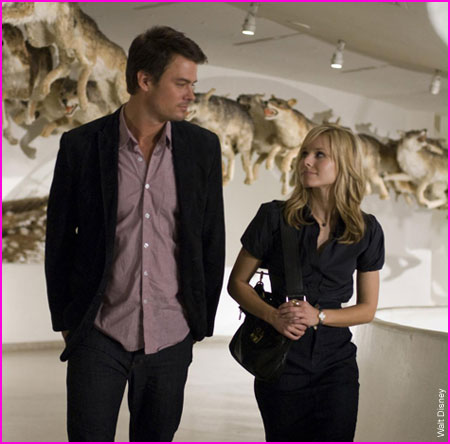
Museums in movies: When In Rome

Ever since I've seen the trailer for When in Rome, I've been curious about the fact that it stars Kristen Bell as a curator at the Guggenheim museum. Could a chick flick present the job accurately?. Now that it's on Netflix I figured I should give it a try and see how realistic Bell was as curator Beth. Here's what the film got right:
  • The Guggenheim website lists 15 curators, not all of whom have PhDs, so its not entirely improbable that Beth could get an assistant position with just an M.A.(Although the film makes no comments on her credentials.)
  • A major part of Beth's job involves extracting large donations from wealthy patrons on the board of trustees. 
  • Beth seems quite familiar with the museum's permanent collection, and gives private tours to potential investors.  
  • Beth fell in love with the Guggenheim visiting it as a child. If you ask any of my classmates they can tell you about fond childhood memories of museums or antiquing. 
  • Beth's boss, a Miranda Priestly clone played by Anjelica Huston, wears statement jewelry and does not tolerate personal lives interfering in work. This uber-curator scowls at the prospect of Beth being out of town for her sister's wedding.
  • Unlike her angelic sister, Beth has not been lucky in love, no doubt because her manic career goals in graduate school sapped her emotional energy and will to be normal. 
Okay, that's about it. Sadly, there's a lot more that doesn't make any sense. This character might as well be a journalist or fashion designer or other generic chick flick job.
  • Despite her low ranking position, Beth makes enough money for a sizable Manhattan apartment. So does her suitor, who works in the even more financially doomed field of print media. 
  • Beth doesn't believe in magic, despite that fact that she has her dream job at the museum she loved as a child. Don't make me hurt you, blonde girl. 
  • Beth does curate an exhibition, but her job really seems to be more event planning than scholarship. Why the heck is she assembling gala programs at her home? That's the development department's job! I also doubt anyone would think 3Oh!3 songs as the soundtrack to an exhibit opening is a good idea .
  • For someone with at least an M.A. in art history, Beth seems pretty oblivious about Europe. In her staff meeting, she has to specify that her sister's warp speed wedding will occur in Rome, Italy. (So... not the one in Texas?) The fact that the Guggenheim has a branch in Venice makes this really inexcusable.
  • To make matters worse, once she gets herself off a plane and into a Roman taxi, Beth takes no interest in scenic views of architecture or statuary. PUH-LEASE. Even my most iPhone addicted colleagues would stop checking email to, I dunno, gawk at the art they have chosen as their life's work
 So, you're probably thinking, whatever Sarah, is this still a fun movie? Um no. It's horrible. It's an accidental satire of romantic comedies. Characters say lines like "He didn't really love you, he was just under a magic spell!"; "I just realized I love Nick more than my job!"; and in the "I love you" reveal - "No, no, you go ahead and say it." Just when I thought things might not be completely predictable, there were both a race through traffic at a critical moment and a runaway bride. What, you didn't have time for someone to dash through an airport?

In the end, I decided to enjoy When In Rome by accepting it as a total slapstick farce, kind of like a really bad Marx brothers movie. After all, Beth's four magic fountain stalkers are like a Chico and three Harpos. Also, the scenes in Italy are about as authentic as this number from the Marx's A Night at the Opera. Hmm, the Marx brothers at the Guggenheim - now there's an exhibit I would curate.

Sunday, November 21, 2010

Introducing Yuletide Tunes (that don't make me want to scream)

True confession time: I hate December's non-stop barrage of Christmas music. To me, the heart-tugging crescendos of O, Holy Night and Silent Night are the hymnodic equivalent of a movie heroine realizing that she does love that guy and must now chase him through an airport. Aww, it's sweet to see and hear once in a while. It's also a tired cliche and totally unrepresentative of what love means to most people's daily lives. My relationship with God is not a constant emotional high, so I'd rather not live through a month of monotonous sentimentality. I don't want to be sick of Christmas by the time December 25 rolls around.

I realized this was a problem on Friday, when I had some business at Bank of America. There were some scarecrow decorations in the teller's window - A+ for seasonal appropriateness. Then I noticed the boom box radio under a lobby table. It was blaring - you guessed it - O Holy Night. The Celine Dion version.

I had to wait in line for 10 minutes, so I heard the whole song, plus some Johnny Mathis. I was really mad the onslaught had started so early this year.Was anyone really listening to this stuff anyway? If there are any non-Christian employees how do they tolerate this for the next month? I thought to myself "If this were a Coen brothers movie I'd up and turn the music off. Better yet, I'd drop-kick that boom box across the room and somehow connect the Advent season to my buddies who died in 'Nam." (
The Big Lebowski is currently streaming on Netflix. Clearly I am too impressionable to watch movies.)

So, to help me keep my sanity this December and enjoy the season, I'm going to post Advent and Christmas songs that I actually like. There will be no emotionally manipulative lyrics about believing in magic or kids buying shoes for their dying mothers. There will be hymns, chants, and even some classic 1990s pop. There will be an Advent focus at the beginning.

To start, here's a fanfare for today's feast of Christ the King, which is the end of the Church year. I learned today that Pope Pius XI established the day in 1925, so it was more a reaction against totalitarianism than a celebration of medieval politics. This feast was a big deal at my high school, and I always loved when the choir sang this song. Many thanks to my friend Steve for leading me to the title and MP3 download.

Choral Fanfare for Christ the King by H. Hamilton Smith

Wednesday, September 29, 2010

Trial and error of an INTJ/ melancholic/ phlegmatic

Lately I've been working on finding my voice. What do I truly think and feel about things? When I was a little kid, I was pretty outspoken and opinionated. I was right, my classmates were ignorant, and that's how it had to be. Over time, I realized that I didn't know everything (duh!) and that being closed minded alienated a lot of people. In college especially, I went through some personal and family hardships that required a lot of patience and flexibility. In my social life, I found myself in the center of conflicts, able to see both sides and wishing they would quit fighting already. Navigating post-grad life, my strategy has been not to openly disagree with others, because then they won't like me and goodness knows it's hard to meet new people out of college.

Patience and meekness are good things, but lately I've been missing the outspoken, principled me of yesteryear. Am I so understanding that I have no original opinions of my own? Do I give a genuine witness to my faith? Can I suggest what to do this weekend instead of waiting for other people to call the shots? Can I at least ask restaurant staff to give me the ingredient info I need to stay gluten free?

So I'm working on that.

Well, today it backfired a little. My history seminar class is amazing and I love it. The professor is fantastic and funny and I really like her. Today's political history discussion was a mental workout. I made a lengthy comment, and this conversation resulted.

Fantastic Prof: "So, what you're saying here is abcdefg. Is that right?"
Me: "I think so" pondering pause (Do I really mean abcdefg? or is it hijklmnop?)
Fantastic Prof: "Are you sure? Do you need to pray about it?"
Me: "What's that supposed to mean??"

Now, if one of my classmates -who know I am the praying sort- had made that comment, I would have a right to be offended. But Fantastic Prof does not know that. She was just trying to make a joke, drawing on her religious history studies. And stupid me had to pick this moment to make a stand, instead of a funny comeback like "Let me say a couple novenas and I'll get back to you." I apologized later, she laughed it off, but still. Oy vey. My voice still needs training. Maybe novenas too.

Monday, September 27, 2010

Better go and get your armor

Do you ever have one of those days that are just no good? (I know one other blogger who did.) You get up on the wrong side of the bed and it's downhill from there. Today I had one of those. The overcast sky, stress about holiday travel planning, and some parking lot issues just put me in a grumpy, no good mood.

Luckily, some wonderful friends and classmates were there to bring me out of it. A couple people even responded to my crabby G-chat status to say that they, too, were having rainy grumpy days. Just admitting it to each other made it not so bad.

It also helped that I just made some hot chocolate.


It also helped that one of my favorite songs came on the radio as I was driving home. Now, it might seem silly to suggest that God has anything to do with the playlists of Top 40 stations, but I like to think that Divine Mercy can manifest itself in many ways. Even much needed power ballads for a cranky grad student.


Please note that there is nothing in my love life that makes me want to wear a fancy dress and killer cocktail ring while singing in front of a burning car. But some days my tempestuous relationship with grad school can do that. Thanks for being my armor, friends.

Tuesday, August 17, 2010

Urban Jungle

After my New York thesis trip, I felt like a total city person. Today's trip to Philadelphia was not so good. After dealing with endless stoplights on Broad Street, I drove in circles for literally half an hour trying to find an open parking space. In this half hour I was honked at once, twice pulled in to spaces only to realize they were restricted, and THEN had some jerkface steal a space from behind me while I was ineptly trying back up into it.

When I arrived thirty minutes late, I found Famous Vestment Designer smoking out front. Thank goodness he had something to do with his time. He had this semi-British accent that made everything I said sound stupid. For example,
"I'm so sorry I'm late, I should have planned this parking situation better."
"Well, one does need to plan these things." (Translation: You are an idiot.)
"I guess I'm so used to Wilmington where not much is going on."
"Yes, this is definitely more of a city. Wilmington is really more of village." (You are an idiot who lives in a podunk town. But he's right about the village thing.)

After that exchange things went better, and I found some fantastic stuff. Hearing about parish histories that actually mention vestments was music to my ears. And then I was helping Famous Vestment Maker close a sticky cabinet I accidentally slammed his fingertip in it. He kept a stiff upper lip - "These things happen" - but I felt like a jerk. A jerk who needs to read up on her embroidery terminology.

Wednesday, April 28, 2010

If Mozart were a curator?

On Sunday I spent a rainy afternoon watching Amadeus for the first time. On Monday I attended a brown bag lunch where a museum director spoke quite candidly about strategies in difficult financial times. He mentioned a theme that we'd heard about the week before - dealing with boards of trustees. It's true; rich people run museums and make them possible. If you want to keep the doors open and the climate control running and the curators fed, you need wealthy people to make generous donations and a few of them to serve on the board of directors/trustees. The same is true for universities.

So really, the patronage system is not dead. Like Mozart and Salieri, museums depend on the upper classes to fund our creative endeavors. We schmooze with them, and in return they give us staging equipment, rent money, and maybe a little fame. If you are lucky you find some forward thinking trustees who will permit crazy stuff like comic operas in German or scrapping tired school tours for something new. Otherwise you are stuck pawning gold snuff boxes. Oh wait, you can't de-accession artifacts for quick cash. Maybe I should switch to composing.