Showing posts with label Pope. Show all posts

Wednesday, July 1, 2015

Junipero Serra, Alexander Hamilton, and Presidency Obsession

Fr. Junipero Serra in Statuary Hall
Image via Architect of the Capitol 
Today is the feast of Blessed Junipero Serra, the 18th century Spanish Franciscan priest who established the California missions. Fr. Serra will have another big day this fall, when Pope Francis canonizes him while visiting Washington, DC. This honor has sparked new interest in his story, including some protests decrying the negative medical and social effects missionaries had on native peoples. The story of Serra's missionary work is indeed complicated, as he both imposed harsh physical discipline but also advocated for native people against abuse by Spanish soldiers. Even if his evangelization techniques were heavy-handed, it’s undeniable that Serra began the legacy of Hispanic peoples in California that continues to this day.

Despite all this publicity, a memorial of Serra is now at risk. California’s legislature is considering a motion to remove Fr. Serra's statue in the US Capitol and replace it with one of astronaut Sally Ride. While the first woman in space deserves recognition too, the statue swap proposal comes at an unfortunate time, particularly since Serra's canonization will coincide with the first trip to America by a Latino pope, and the first time a pope will address Congress. 

The Serra statue situation is not unlike the recent news about Alexander Hamilton’s place on the ten dollar bill. Hamilton is enjoying a surge of recognition too, as the star of a smash hit musical opening on Broadway later this month. Thanks to new biographers, he’s moving out of the obscure historical shadows. As the first Secretary of the Treasury and architect of the US financial system, his face on money seems like an obvious choice. But now he is being removed to make room for the first female figure on American paper currency.

Debates over Serra and Hamilton’s small monuments make it seem like gender recognition in history is a zero-sum game. If we honor significant women, particularly modern ones, that means we must demote the contributions of past centuries’ “great men”. I argue that there is room for both. Sally Ride and Harriet Tubman need not compete with Serra and Hamilton. The real rival here is the over-publicized presidency. Both men are being obscured because Americans like to go with the obvious and recognize presidents over and over again.

Take Serra’s spot in the National Statuary Hall Collection, for example. The collection was established in 1864 as a way to use to the vacant space of the old House of Representatives chamber. Each state could submit two statues of notable citizens. The early 1880s - 1920s roster consisted of Revolutionary War figures, settlers, Civil War soldiers, and now obscure 19th century politicians, plus the odd inventor or two. As the ranks have grown, statue displays have spread throughout the Capitol complex. When I worked the US Capitol Visitors Center, the different figures provided a fun scavenger hunt and conversation starter with visitors.

Since 2003, states may swap out existing statues for new honorees. Subjects must be deceased, and states are responsible for funding and commissioning new artwork. One reason for this new rule was to help diversify and update the collection a bit, swapping out the 19th century politicians no one remembered anymore.

Unfortunately, many states that have changed their statues have gone with the obvious option of, you guessed it, presidents. Dwight D. Eisenhower of Kansas and Gerald Ford of Michigan have joined Statuary Hall. California made a similar switch in 2009, swapping Unitarian abolitionist Thomas Starr King for President Ronald Reagan. That left Fr. Serra's 1931 statue as the only potentially free California spot. So instead of Ride joining Serra to complete California’s exploratory legacy, Statuary Hall will become more like the greatest hits of the 1980s.

Similarly, Alexander Hamilton is on the chopping block because the Treasury is too attached to President Andrew Jackson. A recent grassroots movement called to replace Jackson’s image on the twenty dollar bill with a notable historical women. There was even a poll that selected Harriet Tubman. Instead, the Treasury has decided that women are only worth half that, and offered us a bureaucratic accountant instead of a controversial chief executive.

It’s troubling that our national memory can trend toward simply the most famous, the most powerful. This implies that we’re only smart enough to read history as an “icons” roundup in People Magazine. One of my favorite confused tourist stories was the time I overheard a woman explaining the World War II Memorial while walking down the National Mall. She pointed to the group of columns symbolizing the sacrifices of soldiers from every state and said "Look! That's where all the presidents are buried!" Facepalm.

In my opinion, the Statuary Hall collection is best as a federal pantheon of "lay" citizens and the legislators who served them. The Capitol represents the legislative branch and is meant to be the "house of the people," not a shrine to unilateral power. Likewise, our money isn’t exclusively for presidents. Hundred dollar “Benjamins” celebrate an inventor, author, and diplomat who never lived in the White House.

Later this week we’ll celebrate America’s independence, a feat that was the work of many people. It would not have happened without the George Washingtons and Thomas Jeffersons, but neither would the Revolution have made it without the lesser-known men and women who supported their ideas and did the hard, daily work of fighting for freedom. We don’t have a king on our money, and there is room for all of us in America’s story. 

Thursday, October 9, 2014

That Time the Pope Went to the World's Fair

This year marks the 50th anniversary of the 1964 World's Fair in New York City. Not unlike the modern
The Unisphere on my visit in June
Olympics, the Fair didn't turn a profit, but it hosted months of culturally significant spectacles. The Ford Mustang was introduced, Walt Disney launched the It's a Small World ride, Andy Warhol mocked politicians with some controversial pop art, civil rights activists staged protests blocking highway ramps, the Beatles played in Shea Shadium, and Bob Dylan infamously used an amp.

Like the New York's first World's Fair in 1939, this was the brainchild of infamous urban planner Robert Moses. (Cue chorus of boos from historic preservation fans.) Fading from political power towards the end of his career, he hoped hosting another World's Fair and turning Queens garbage dumps into the Flushing Meadows fairgrounds and park would cement his legacy.

Even though Moses was a jerk to tear down the old Penn station, I'll admit Flushing Meadows is a great park. Some of the fair buildings are still open as museums. The '64 Fair also gave Queens the amazingly topographic Unisphere, which has become an icon of the borough. It's a great example of space age public art that can belong to everyone, not unlike my old boyfriend the St. Louis arch. Plus, you can buy the world a Coke and keep it company while you're there. 

Vatican Pavilion at Flushing Meadows.
Collection of the NYPL
For Catholics, the '64 fair has special significance because it brought the United States its first papal visit ever! We have Robert Moses' ambition to thank for it. The Vatican had a pavilion at the Fair, and even shipped over Michaelangelo's Pieta to display there. Moses hoped his friend Cardinal Spellman could convince the Pope to stop by in a clutch PR move for the World's Fair.

And so on October 5, 1965, Pope Paul VI became the first pope to set foot on American soil. He spent only fourteen hours in NYC, establishing the usual cathedral-stadium-political arena template for future papal visits. After landing at the new JFK Airport in Queens, he spent most of his time in Manhattan at a mixture of modern and old-school locations. He visited St. Patrick's Cathedral and met with President Johnson at the Waldorf Astoria hotel. The Holy Father also addressed the United Nations, warning that "Politics do not suffice to sustain a durable peace." Later he said Mass at Yankee Stadium, not Moses' brainchild Shea Stadium (ooh burn!).Finally, on his way out of town, Paul VI did stop at the Flushing Meadows fairgrounds. Today a marble bench marks where he stood.

Pope Paul VI's whirlwind tour wasn't as substantial as later papal visits, but it was surely a landmark moment
Pope Paul VI window in St. Philomena church,
Livingston, NJ.
for American Catholics. Only a few years before, John F.Kennedy had become the first Catholic president and a beloved political figure. Seeing the Church's leader welcomed as an international dignitary must have cemented the fact that "papists' had been accepted as true Americans, not a dangerous superstitious group swearing loyalty to a foreign power. Also, American Catholicism was no longer just mission territory; it was a major wing of the Church garnering Vatican attention! Eleven years later Paul VI would canonize New Yorker Elizabeth Ann Seton as the first American-born saint, further establishing the United States' role in Catholic history.

I found evidence of this papal euphoria in a parish near me in New Jersey. With its simple yet vaguely colonial style, St. Philomena was probably built in the early 1970s before post-Vatican II modernism had really caught on. The ample stained glass windows depict mysteries of the rosary, local bishops, and ... Pope Paul VI's NYC visit. The window is amazing and bordering on souvenir-store kitch: Paul VI raises his hands in blessing amidst the Stars and Stripes, St. Patrick's, the UN, the Empire State Building, and the Statue of Liberty. (Sadly, the Unisphere did not make the cut.) A panel at the bottom notes the date of the pontiff's visit. Perhaps some parishioners fondly remembered attending the Mass in Yankee Stadium and donated the window? I'll be on the lookout for more Paul VI commemorations in the area. American Catholicism: if it can make it here, it can make it anywhere.

If you want to learn more about the 1964 World's Fair, I highly recommend Joseph Tirella's new book Tomorrow-Land: The 1964-65 World's Fair and the Transformation of America, from which I got much of the information in the post. If you find yourself in Grand Central this fall, you should also check out this free exhibit.

Tuesday, February 18, 2014

St. Joseph Church, Maplewood NJ

Since the Southern Baron and I both enjoy being church tourists, we've had fun scoping out weekday masses at some of the parishes nearby. These pictures of St. Joseph parish in Maplewood are from earlier this winter, back when the sight of snow on the ground was actually a novel idea. Please forgive the iPhone blurriness - I didn't think to grab a "real" camera on our way out for diner breakfast food. (New Jersey diners are practically a religious tradition in themselves, but that's another story for another day ;)

St. Joseph was founded in 1914, so they're celebrating their 100th anniversary this year! The parish complex includes a 1930 brick school building, which is currently up for rent. The current church building dates to 1970, and its design is a good example of the way churches built just after Vatican II were a hybrid of tradition and modern style.

The exterior features simple modernist geometry but still looks "churchy" and pays homage to the patron saint. Brick and concrete are more affordable materials often used by suburban parishes trying to keep up with population growth. The chunky stained glass is rather abstract, but will get more literal inside.


The interior is also heavy on unadorned building materials. Heavy ceiling beams are often a prominent feature in churches of the 70s and 80s, lending gravitas with modernist simplicity. Still, the basic layout is not too different from a gothic cathedral; there are pews facing inward from the side "transepts," and a reredos behind the altar features the crucifixion. The tabernacle is still in the center of the sanctuary, suggesting that separate Eucharistic chapels hadn't caught on yet when this church was built. My overall impression of the space was uncluttered reverence.


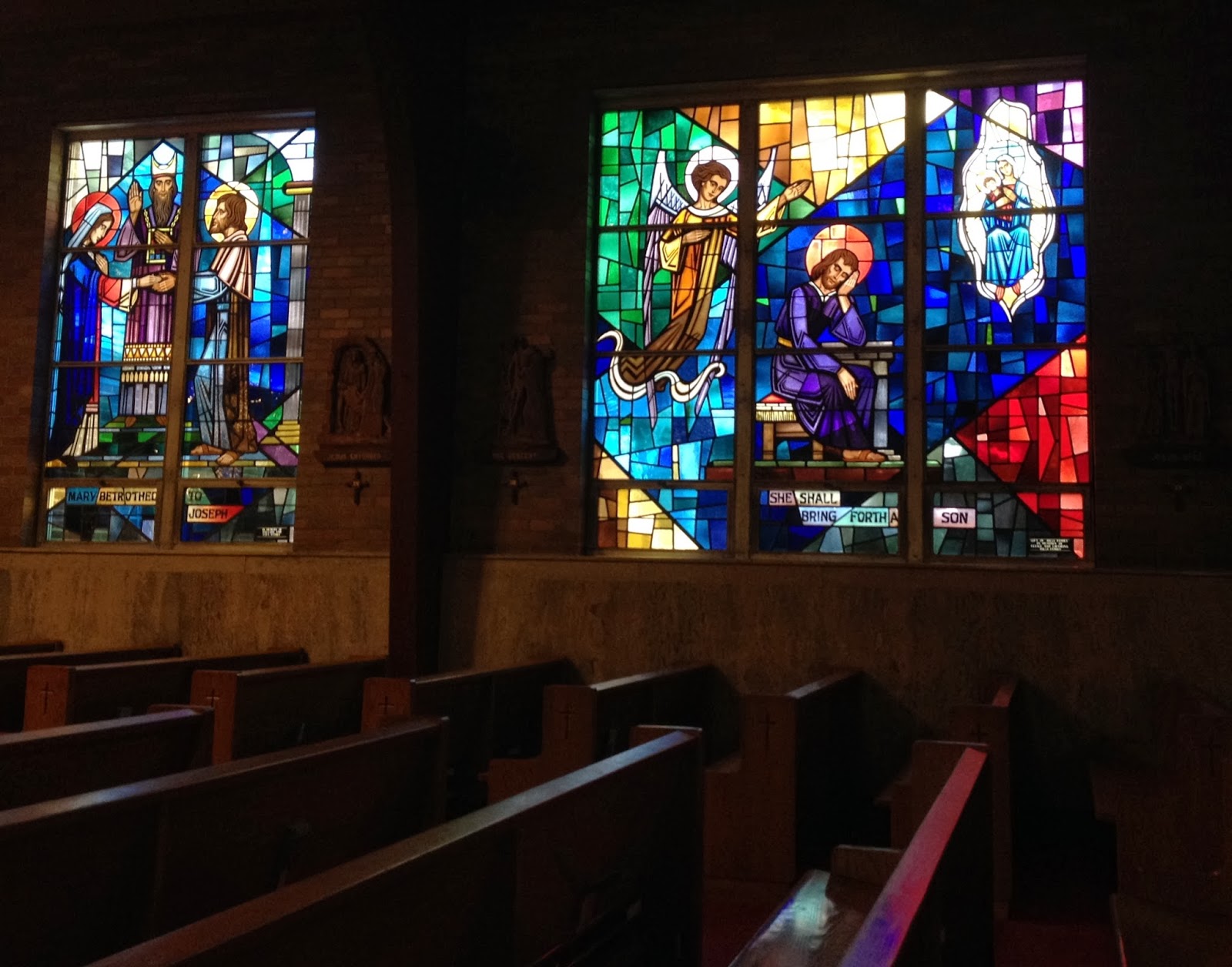
The really unique thing about St. Joseph was its stained glass windows. They told stories from saints and scriptures with a contemporary flair. I really loved these scenes from the life of St. Joseph:

Betrothal of Mary and Joseph, then the angel visiting Joseph in a dream. 

One of the transepts featured St. Paul, St. Therese, and maybe Pope St. Pius X? Facing them were Moses, King David, and Abraham, uniting the Old Testament with the New.


Our favorite though, was this window about the papacy. We're pretty sure that's Pope Paul VI (the current pope in 1970) next to St. Peter. Note the papal tiara above his head, another tradition that still lingered. These windows show a parish aware of its place in the wider Church and in salvation history.

Monday, March 18, 2013

7 Habemus Papam Quick Takes

  1. Where were you when they announced the new Pope? My sister and I had a pact that whoever heard first would text the other. I was determined to keep up my streak of seeing Habemus Papam announcements live, even though there is no TV or video streaming access in my office. So when the words "White Smoke!" exploded across Facebook, I ran for my museum's education computer lab. I watched database training videos with the Vatican YouTube feed on in the background. The only other person in there was watching RuPaul's Drag Race and probably thought I was the biggest loser ever, but I don't care. 

  2. To add to my earlier analogies, I realized that getting a new Pope is like when a new baby is born into a family. Even though you have no idea about this stranger's personality or talents, you love them immediately, and know without a doubt that they belong to you all. There is something about putting on the white cassock that makes a random cardinal instantly beloved.

  3. Or maybe it's the adorable awkwardness. Did you ever notice how nervous a new Pope is at first? It's not like he's a presidential candidate who's been doing photo ops for months beforehand. At Benedict XVI's inaugural Mass eight years ago he looked super tense and unsure of how to bless the cheering crowds. 

  4. So when Pope Francis came out on the balcony and just stood there, I thought "Oh no, he is scared to DEATH." But then he started smiling. And cracking jokes. And talking with his hands. How could we not fall in love? He's going to do just fine.

    L'Ossorvatore Romano
  5. The Betrothed was educated by Jesuits in New Orleans, so of course he's overjoyed that the new pontiff comes from the Society of Jesus. Right now we're  both chuckling over all the Jesuit conspiracy theories coming out of the woodwork. We're also shaking our heads at the Rad Trad internet freak-outs that a Jesuit Pope will start teaching heresy and stripping churches of anything traditional.
  6. With all this talk of humble simplicity and Cardinal Mahony crowing on Twitter about how glad he is to be "LOW Church" again, I have only one very silly concern - *whisper* I really hope the vestments aren't ugly.There is already an entire papal sacristy of beautiful liturgical treasures that give glory to God and were crafted in love and devotion. Papa Francis could "shop his closet" for years without spending a thing.  There's a great Downton Abbey reference in this situation.
  7. Overall I am just thrilled, excited, and overjoyed with goosebumps going down my arms. You can be sure I'll be geeking out for the inaugural Mass on Tuesday, the feast of St. Joseph. We have a new shepherd, and he comes from the Americas. He rides the bus and doesn't put on airs. He took the name of a peacemaker saint, the man to whom Christ said "Rebuild my Church." There is much rebuilding to do, and I can't wait to see how Papa Francis does it.


Thursday, February 28, 2013

Changing Popes

Losing a Vicar of Christ feels like a kick in the gut, a punch in the chest. It's like saying a final goodbye to a grandfather or your favorite teacher/mentor. It makes the Bark of Peter feel like a rickety canoe in a hurricane. It makes you want to call your family, and hug your friends. You can't help feeling a little abandoned. Suddenly, the symbol of your identity is gone, and you don't know how to go forward. 

The day Pope Benedict announced his retirement all I wanted to do was run into every church in New York City. "I need to be with my people!" my heart cried. On my way to the office I stopped at St. Peter's at 22 Barclay in lower Manhattan. (Greek revival 1834, oldest parish in New York.) I couldn't find the words to pray, so I just sat there with Jesus and pondered the papal tiara above the altar. Christ is the One who put it there, and He's the only man who will ever need to be the Church's savior.

St. Peter, St. Paul, and a crucifix painting that St. Elizabeth Seton prayed before
The departure of a pope is also exciting. This only happens a few times in a century. If the Easter Vigil is the Super Bowl of Catholicism, a conclave is the World Cup. Better start gearing up on your College of Cardinal stats. If you are as enterprising as my friend Steve, you can make a bracket. Nothing beats the absolute thrill of hearing "Habemus Papam!"

 It's eerie how The Betrothed and I just spent an evening sorting through his box of World Youth Day mementos. (We were both at Toronto 2012, but sadly there is no secretly prophetic photo where one of us obliviously walks past the other.) As we decided which things to keep in our future home, we talked about what it was like going to see the Pope, and how we had changed since then. Pope John Paul II was the pope of my childhood.  For us kids of the 80s and 90s, he and Mother Teresa were Catholicism. During his papacy I was baptized, received my first communion, and was confirmed (in the Year of the Holy Spirit for an added bonus). I attended Catholic school for 8 years.  I traveled to see him at World Youth Day, the longest and farthest I had ever been away from my family at that point. John Paul II told my generation that the Church loved us, that Christ needed us for His epic plan, and we leaped to the task. His love, joy, and compassion made me proud to be Catholic.

When JPII died, my own health came crashing down with him. I spent the sede vacante period going through medical tests trying to decipher the chronic illness that eventually forced me to drop out of college for a year. The day Benedict XVI was elected, I ran campus errands until a parish staffer found me collapsed from exhaustion in the campus ministry office. My life would never be the same, and that period of suffering would prove to be one of the best things that ever happened to me. Pope Benedict XVI was the pope of my transition to adulthood. During his papacy I bounced from one temporary stage to another - homebound invalid days, finishing college, a volunteer year, graduate school, long underemployment, and finally a real job. I met my future husband and prepared for marriage.

Through these changes, I often felt restless, rootless, and unsure of God's plan. Attending two public universities gave me lots of opportunities to wrestle with how the Church could relate to the questioning modern world. Luckily the Church's leader turned out to be not an attack dog, but a gentle nerd with an amazing analytical mind and stellar footnotes. His writings are always a revelation of eloquent clarity. Pope Benedict has urged my generation to reconsider our religious heritage, and we realized we were hungry for symbolic meaning, not just youth group catch phrases. If you had told my 17-year-old self that the "new springtime" of the Church would involve a revival of the Pre-Vatican II mass, I would not have believed it. The scandals and trials of recent years sometimes make it painful to be Catholic, but Benedict XVI has reminded us how true joy comes from the deep truths of the faith. As The Betrothed often says about him, "What a boss!"

Now this next pontiff will be the pope of my adult married life. Once again, I'll spend the sede vacante period adjusting to major new realities - I just moved 250 miles away from my hometown to start a job in a New York and am living out of boxes in a bare apartment. I don't know what the coming years will bring for me and the Church, but I know God will be with us.

The changing of popes is a reminder that Jesus is all that matters. No one person is the Church. She already found the man who meets all her many needs - the One who redeemed her. All the other vicars are just taking care of the place for a while until He gets back. Was Jesus like all of these men at once? Was He the perfect combination of Peter's passion, John XXIII's kindness, and Pius V's tenacity? He knows the right person for the right time, including this next conclave. 

So godspeed, dear Papa Benny. Thank you for your generous service, your great humility, your deep wisdom, and for putting the papacy on social media. I'll be reading one of your books on the subway today. Stopping in one of New York's many churches sounds like a good idea too.

Wednesday, May 11, 2011

"I want to shine on, in the hearts of men." - The Killers, All These Things That I've Done

(I meant to post this last week, but Osama bin Laden and two academic presentations conspired to distract me.) 

Watching a replay of last weekend's beatification brought back so many memories of how Pope John Paul II influenced my growing up. Even as a small child, I knew he was important and holy. I read was determined to see such an historically significant man in person. (Yep, I was a nerd even then.) So nine years ago I set out with my BFF Stella on a Youth Apostles-led trip to World Youth Day in Toronto.

Looking back, my Dad recently commented "I can't believe we let you go off to a foreign country like that when you were 17." At the time, I couldn't believe it either. It was the longest and furthest I had ever been away from home. It was my first time using a passport, hiking for miles, camping outside, and conversing with nuns or people who didn't know English as a first language. That trip was life-changing on so many levels, particularly the way God decided it was time for me to address the depression and scrupulosity that had plagued my adolescence. On the way to see JPII, I finally confessed my problems to some people I trusted and got some wise, loving advice in return.

Of course I got to achieve my goal of seeing JPII "live and in person." I was perched on some college guy's shoulders watching the Popemobile drive past, taking pictures with the four cameras people had handed to me. After the Holy Father was gone and the crowd started to move towards his speech, the excitement of what happened hit me like a ton of bricks. The other girls and I just started bawling, joyful tears from deep in my gut like I'd never cried before.


Part of my post-WYD photo collage.
So yeah, it was a fantastic adventure. But that was the thing with Pope John Paul - to him following Jesus was always a grand adventure. He appealed to our youthful desire to be part of something exciting and important. Here's part of what he said when he arrived at WYD:

Dear friends, the aged Pope, full of years but still young at heart, answers your youthful desire for happiness with words that are not his own. They are words that rang out two thousand years ago. Words that we have heard again tonight: "Blessed are they ..." The key word in Jesus’ teaching is a proclamation of joy: "Blessed are they ..."

Young people listening to me, answer the Lord with strong and generous hearts! He is counting on you. Never forget: Christ needs you to carry out his plan of salvation! Christ needs your youth and your generous enthusiasm to make his proclamation of joy resound in the new millennium. Answer his call by placing your lives at his service in your brothers and sisters! Trust Christ, because he trusts you.
So much has changed in the nine years since I heard JPII say those words. Back in 2002 the Balkans still made headlines. The wounds of 9/11 were still fresh and the Church's sex-abuse scandals were just coming into the public eye. JPII"s words at WYD addressed both. Today Americans are still facing the threat of terrorism and the tragedy of priests' sins, and Cold-War related violence is a distant memory..

As for me, I'm not 17 anymore. I've been away from my parents' home further and longer still, settling elsewhere for months at a time. I'm still searching to belong to something bigger - there has to be more to life than just building my resume and paying the bills for the next forty years of my life. The Holy Father's call for joyful dedication to the gospel rings truer today than it ever did.

Blessed Pope John Paul II, please keep praying for us.

Sunday, April 3, 2011

Man is a giddy thing

It's Latare Sunday. How is it time to break out the rose vestments already? Didn't Lent just start? Almost every year around this time I start to worry that I don't feel penitential enough, that my Lent needs to be harder, that I should have piled on more things to give up. If I'm not miserable I must be doing something wrong. Does this ever happen to anyone else? I guess it's a sign that I need to involve God more in my thesis drudgery.
A nineteenth-century rose cope at St. Ignatius of Antioch, NYC
Brother #3 is turning 17. How has it been that long since he was born? Wasn't I just 17? It can't have been that long since he was born on a Holy Saturday evening. I still remember the cooing compliments from the nurses when we all came to meet him the next day in our Easter clothes. My sister and I had matching dresses (my idea), but I also remember my 9 year old hair-styling skills being not that great. When Mom and the new baby arrived home the next day, our next-door neighbor kid climbed up on the garage roof to meet them. I'm so proud of the outgoing, ardently Catholic young man my little brother has become since that day.

Yesterday was the 6th anniversary of Pope John Paul II's death. Has it really been that long since I watched all the news coverage of crowds gathering to mourn in St. Peter's Square? That weekend was a very emotional one for me. I've idolized JPII since childhood, and as his sickness and pain ended, my own journey into suffering was just beginning. The circulatory condition that would eventually make me drop out of college for a year was just starting to flare up. Grief over the Holy Father combined with frustration at my body slippping out of my control and I ended up crying in a heap on the laundry room floor. Normally I don't cry when people die, but that day I felt like I was finally getting it right. I'm grateful for what I learned that year about suffering and trusting God, and for how much stronger I've gotten in the past 6 years. I like to thing that JPII may have put in a good word for me up there.

I guess what ties all three of these things together is that since time keeps moving us forward, there will always be more opportunities to keep growing into the people God wants us to be. I love how this song explains that with a little help from Shakespeare.


Sigh no more, no more
One foot in sea, one on shore
My heart was never pure

And you know me
You know me

And man is a giddy thing
Oh man is a giddy thing...

Love that will not betray you, dismay or enslave you,
It will set you free
Be more like the man you were made to be.
There is a design,
An alignment to cry,
Of my heart to see,
The beauty of love as it was made to be

Sunday, September 19, 2010

On England and Popery

In retrospect, it has taken me months to process my class trip to London this January. Now that the memories of stress and exhaustion have faded, I begin to appreciate the wonderful places I saw and feel a real fondness for the city. That has been most apparent this weekend as I've followed Pope Benedict XVI's state visit to the United Kingdom. Not only is the Holy Father making historic speeches and appearances, he's doing so in places I've visited! Westminster Abbey? Been there. Mass in Westminster Cathedral? Done that too! It makes me feel a kinship with "Papa Benny" to know that we've both looked at the London Eye across the Thames.

The papal visit has also caused new reflection on my position as an historian and Anglophile who is also Catholic. When I study or visit England, I am always aware that this was a nation which, for centuries, would have killed or oppressed me for my beliefs. Nowhere did I feel that more keenly than at the Tower of London, where St. Thomas More spent his last days and is buried. He doesn't get a large shrine or elaborate casket, just a space beneath the chapel floorboards and a footnote after the saga of Anne Boleyn. Still, I could feel his presence as I toured the Tower. I wondered what he thought as he faced his death. We carried on a conversation of sorts as I asked his prayers for me and people I love.

Stories like Thomas More's are what make the Pope's UK visit so historic. Any 17th century English person would not believe what happened this weekend. The Pope stood in the place where Thomas More was condemned, addressing Parliament. Not far from the Tyburn, the Pope reflected on the Catholic and Anglican martyrs who died there. At Westminster Abbey, the Pope and Archbishop of Canterbury prayed together. We've come a long way. Former rivals and even enemies find themselves allies and friends in the face of a secular culture.

Which brings me to my thesis. "Late nineteenth early twentieth century Episcopal church vestments." At times it seems so insignificant and pointless. Who really cares about some Catholic girl's bumbling about in Episcopal church history? Rich parishes had pretty vestments, ok moving on! But somehow I think the newly beatified John Henry Newman would care. He spent part of his life as an Anglican, then as a Catholic. He influenced the liturgy and spirituality of both Churches. Both contributed to the man he was.

Speaking of conversion, someone in Salem heard my thesis topic and asked if I was planning on converting to be an Anglo-Catholic Episcopalian. I laughed and answered "No, I really like the Pope, you know?" I do like the idea of a visible head of the Church. I also really like "Papa Benny" in his soft spoken, shy, scholarly demeanor. Under that gentleness is a razor sharp, encyclopedic mind and a good heart. I have been so darn proud this weekend as he bluntly spoke about important things: the horror of sex-abuse scandals, the need for public expressions of faith, the rationality of religion, and the desire for Christian unity.

Maybe my research is a tiny drop in the bucket of that Christian unity. If nothing else, I will understand my "separated brethren" better. I'm also learning more about liturgical history. If I can just tell an interesting story of Christians glorifying God through material culture, I will be happy. Blessed John Henry Newman, pray for me.

(Images are from the Daily Telegraph)

Friday, August 13, 2010

JPII you the illest!

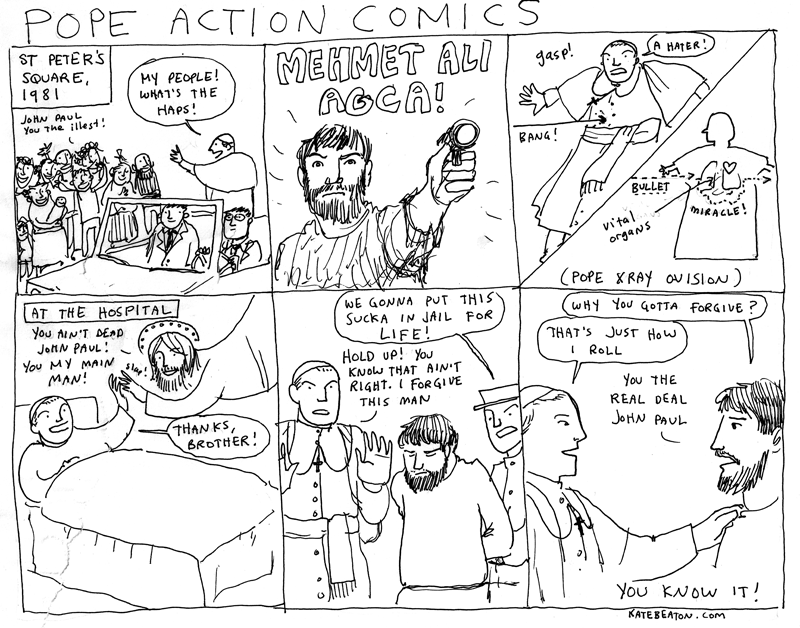
As if I didn't already love Kate Beaton's comics about history and literature, here is one she wrote about Mehmet Ali Agca's assassination attempt on Pope John Paul II. (Click here to see it on her site since my formatting is messed up.)


It's no secret that I am a papal fangirl. I got to see JPII live an in person at World Youth Day in Toronto. I wrote a high school paper on said assassination attempt. And yes, there was the infamous Pope poster that hung on all my dorm walls in undergrad.

He died on my little brother's birthday, as I was about to leave college due to medical issues. It's one of the first deaths that really personally affected me.

Image source