Showing posts with label feminism. Show all posts

Wednesday, July 1, 2015

Junipero Serra, Alexander Hamilton, and Presidency Obsession

Fr. Junipero Serra in Statuary Hall
Image via Architect of the Capitol 
Today is the feast of Blessed Junipero Serra, the 18th century Spanish Franciscan priest who established the California missions. Fr. Serra will have another big day this fall, when Pope Francis canonizes him while visiting Washington, DC. This honor has sparked new interest in his story, including some protests decrying the negative medical and social effects missionaries had on native peoples. The story of Serra's missionary work is indeed complicated, as he both imposed harsh physical discipline but also advocated for native people against abuse by Spanish soldiers. Even if his evangelization techniques were heavy-handed, it’s undeniable that Serra began the legacy of Hispanic peoples in California that continues to this day.

Despite all this publicity, a memorial of Serra is now at risk. California’s legislature is considering a motion to remove Fr. Serra's statue in the US Capitol and replace it with one of astronaut Sally Ride. While the first woman in space deserves recognition too, the statue swap proposal comes at an unfortunate time, particularly since Serra's canonization will coincide with the first trip to America by a Latino pope, and the first time a pope will address Congress. 

The Serra statue situation is not unlike the recent news about Alexander Hamilton’s place on the ten dollar bill. Hamilton is enjoying a surge of recognition too, as the star of a smash hit musical opening on Broadway later this month. Thanks to new biographers, he’s moving out of the obscure historical shadows. As the first Secretary of the Treasury and architect of the US financial system, his face on money seems like an obvious choice. But now he is being removed to make room for the first female figure on American paper currency.

Debates over Serra and Hamilton’s small monuments make it seem like gender recognition in history is a zero-sum game. If we honor significant women, particularly modern ones, that means we must demote the contributions of past centuries’ “great men”. I argue that there is room for both. Sally Ride and Harriet Tubman need not compete with Serra and Hamilton. The real rival here is the over-publicized presidency. Both men are being obscured because Americans like to go with the obvious and recognize presidents over and over again.

Take Serra’s spot in the National Statuary Hall Collection, for example. The collection was established in 1864 as a way to use to the vacant space of the old House of Representatives chamber. Each state could submit two statues of notable citizens. The early 1880s - 1920s roster consisted of Revolutionary War figures, settlers, Civil War soldiers, and now obscure 19th century politicians, plus the odd inventor or two. As the ranks have grown, statue displays have spread throughout the Capitol complex. When I worked the US Capitol Visitors Center, the different figures provided a fun scavenger hunt and conversation starter with visitors.

Since 2003, states may swap out existing statues for new honorees. Subjects must be deceased, and states are responsible for funding and commissioning new artwork. One reason for this new rule was to help diversify and update the collection a bit, swapping out the 19th century politicians no one remembered anymore.

Unfortunately, many states that have changed their statues have gone with the obvious option of, you guessed it, presidents. Dwight D. Eisenhower of Kansas and Gerald Ford of Michigan have joined Statuary Hall. California made a similar switch in 2009, swapping Unitarian abolitionist Thomas Starr King for President Ronald Reagan. That left Fr. Serra's 1931 statue as the only potentially free California spot. So instead of Ride joining Serra to complete California’s exploratory legacy, Statuary Hall will become more like the greatest hits of the 1980s.

Similarly, Alexander Hamilton is on the chopping block because the Treasury is too attached to President Andrew Jackson. A recent grassroots movement called to replace Jackson’s image on the twenty dollar bill with a notable historical women. There was even a poll that selected Harriet Tubman. Instead, the Treasury has decided that women are only worth half that, and offered us a bureaucratic accountant instead of a controversial chief executive.

It’s troubling that our national memory can trend toward simply the most famous, the most powerful. This implies that we’re only smart enough to read history as an “icons” roundup in People Magazine. One of my favorite confused tourist stories was the time I overheard a woman explaining the World War II Memorial while walking down the National Mall. She pointed to the group of columns symbolizing the sacrifices of soldiers from every state and said "Look! That's where all the presidents are buried!" Facepalm.

In my opinion, the Statuary Hall collection is best as a federal pantheon of "lay" citizens and the legislators who served them. The Capitol represents the legislative branch and is meant to be the "house of the people," not a shrine to unilateral power. Likewise, our money isn’t exclusively for presidents. Hundred dollar “Benjamins” celebrate an inventor, author, and diplomat who never lived in the White House.

Later this week we’ll celebrate America’s independence, a feat that was the work of many people. It would not have happened without the George Washingtons and Thomas Jeffersons, but neither would the Revolution have made it without the lesser-known men and women who supported their ideas and did the hard, daily work of fighting for freedom. We don’t have a king on our money, and there is room for all of us in America’s story. 

Monday, June 15, 2015

Museums in Movies - Jurassic World

Claire with dinosaur
Via JurassicWorldMovie.com
Summer blockbuster Jurassic World feels like the perfect choice to continue my Museums in Movies series. The park is a for-profit attraction “selling $7 sodas,” but in essence it’s just a flashy natural history museum. This franchise installment shows us an expanded version of  John Hammond’s original vision for prehistoric thrills. With a larger scale comes even more possibility for disaster, though. For me, the scariest scenes were when a flourishing tourist destination became a visitor services hellscape. A low-ranking ride operator facing an angry mob when he must close a ride for “technical difficulties;” and a waiting area packed with hot, tired people enduring transit delays are the type of things that haunt my nightmares.

The film’s dinosaur danger arises when Jurassic World’s leaders try to combat a problem familiar to many museums: how to stay relevant to the modern world when you keep retelling the same story. Visitors are no longer wowed by “an interactive CD-ROM,” like back in ’93, or even by seeing a live dinosaur. The park has made some admittedly cool upgrades, like adding hologram exhibits or replacing the static Jeep paths with gyroscope pods. Kids can now enjoy hands-on activities like digging for “fossils” or riding a baby triceratops.

The park also may have sold out a bit, relying on corporate sponsor naming rights to fund new “attractions.” This makes the film’s abundant product placement winkingly self-referential, like when main characters enter the Samsung Visitors’ Center. Gone are the days of jello and ice cream in a single dining room; now there’s a Starbucks, a Margaritaville and a … Brookstone? Maybe some 1990s wonders still impress.

The new-and-improved Jurassic World reminded me of my recent visit to the National World War II Museum in New Orleans, which has opened several shiny additional buildings in the past few years. Its impressive airplane display wing is funded by, and named for, Boeing. You can even buy coffee cups with the vintage Boeing logo in the gift shop.  The WWII Museum’s newest exhibit, The Road to Berlin, features interactive touch screen kiosks and several surround-sound battle simulation set pieces. The latter seem to be a trend in museums dealing with military history; even the modest museum at Woodrow Wilson’s birthplace in Staunton, VA invites visitors to walk through a trench amidst explosion sound effects. Similarly, one of the old guard of historic sites, Colonial Williamsburg, recently announced plans for a petting zoo and a flintlock shooting range, which I hope will operate on opposite ends of Duke of Gloucester Street.

Alas, Jurassic World’s innovation efforts are foiled by not just the usual shady bioethics, but an incompetent organizational culture. The park has grown too big and too automated for staff to communicate and collaborate well. Despite sinking millions of dollars into a high-risk new genetically-engineered “asset,” the staff have raised it incompetently. They have failed to consult expert dinosaur handlers about its habitat, and don’t even know the creatures of which it has been composed. Is no one in this place capable of writing a professional email?

Different park authorities view its dinosaurs not as living creatures, but as products or weapons that will bring flashy results. Contrast this with the detailed knowledge and geeky wonder the original Jurassic Park characters display. At the beginning of that film, Dr. Alan Grant brings a grumpy teenage boy from skepticism to fearful awe with dramatic storytelling and just one velociraptor claw prop. That’s the kind of dynamic interpretation that really builds visitor loyalty.

Unfortunately, the screenwriters of Jurassic World show neither understanding nor good storytelling in their treatment of female characters. While Owen (Chris Pratt) gets to swagger around as a funny, brave and generally hunky specimen of red-blooded American manhood, the ladies are either nagging shrews or uptight workaholics. Re-enacting Nobel Laureate Tim Hunt’s infamous recent comments about women in science, they attract romantic overtures from colleagues and even cry in the computer lab. Diligent mission control tech Vivian sensibly pairs a cardigan, tights, and flats with her modest dress, but is still #distractinglysexy to her male colleague Lowery at his messy desk. Spoiler alert: the saucy minx ultimately rejects his advances.
“Uh, I have a boyfriend.”
“Oh! I didn’t know you guys were like, together together. You never mentioned it.”
“Well, I was at work.”

Even though women –including single mothers- are increasingly taking on museum leadership roles, Jurassic World subjects us to the tired Hollywood syllogism that female professionalism is a zero sum game. The more effort a woman movie character puts into her job, the more she will neglect her personal relationships. The Big Meeting must always conflict with boyfriends’ birthday parties and dinner with relatives, because apparently scheduling and vacation time don’t exist.

Sure enough, park operations director Claire (Bryce Dallas Howard) is so busy running things that she ignores her sister’s calls and doesn’t even remember her nephews’ ages, blowing off their visit. The film mocks her for studying prospective donor names and having visitor stats ready for her boss – both of which would be expected of someone in her position. We even get a reminder that Claire should really have kids someday, even though nothing is said about the male staff's family status.

I’ll admit, Claire’s John Hammond-esque white ensemble was lovely, but she couldn’t have ditched the skirt and heels for something more practical for sprinting through the forest?  Jurassic Park's Dr. Ellie Sattler and her khaki shorts would be appalled. That previous heroine also managed to keep her maternal instinct intact doing extensive fieldwork, and didn’t flinch from danger, quipping “We can discuss sexism in survival situations when I get back.” By the end Claire does channel a little of Dr. Sattler, becoming more protective and proactive, but she’s still a poor role model.

Despite its lame characterization, Jurassic World still manages to be a fun, exciting dinosaur thrill ride full of homages to its origin story. It’s a more logical continuation of the Jurassic Park world; let’s ignore the other two lame sequels and call this the reboot. If amidst the summer entertainment, a few kids get inspired to keep learning about paleontology, then the special effects haven’t been in vain. Really, that’s what all museums hope for each vacation season.

Friday, August 22, 2014

Is Courtship Fundamentally Catholic?

The current courtship resurgence is an interesting facet of the Christian "purity culture" that has sprung up in reaction to the sexual revolution and and divorce trends of the 20th century. Joshua Harris' I Kissed Dating Goodbye came out in 1997, and its spouse-finding philosophy has been a cultural and spiritual force ever since. I was 12 when Harris burst into the scene, and his writing influenced me and my friends in our teen years. Harris' antidote to hook-up culture has been around so long that there is now some backlash as my generation assesses its results.

Recently, former courtship advocate Thomas Umstattd wrote Why Courtship Is Fundamentally Flawed, arguing that the system misinterprets scripture and does not safeguard against divorce. Even Harris himself has warned against excessive courtship legalism that makes young couples afraid to even speak to each other. For every couple whose courtship resulted in a happy marriage, there are stories of overly controlling fathers or jerk suitors who masked their toxic personalities with lip service to "biblical marriage."

On the other hand, courtship is more visible than ever, with People magazine covering the Duggars' strict courtship rules. Fundamentalist groups host "purity balls" where girls in formal dresses promise their dads that they will remain virgins until marriage. These father-daughter dances and chastity pledges have garnered much media attention for being "like a wedding, except to your dad."

Swedish photographer David Magnusson's exhibit of father-daughter purity ball portraits is one recent example of courtship in the spotlight. Documenting families in Louisiana, Texas, Colorado and Arizona, he photographed fathers and daughters near their homes in their ceremony clothes. Portraits were done in the early morning, with subjects choosing their poses “in the light of the decisions you have made.” Magnusson's purpose isn't just curiosity, but cultural analysis. "I wanted to create portraits that were beautiful; images that the girls and their fathers would like to see hanging on their walls at home, while someone from another cultural background might experience the very same portraits in an entirely different way."
Pierce and Jasmine Nunley, Grand Cane, Louisiana.
By David Magnusson
At first, the portraits are off-putting. Seeing a gallery of grown men embracing young girls in wedding-like dresses feels really creepy. It's like an incestuous combo of a quincenera or debutante ball. But when you look closer, each pair has unique expressions of their relationship and motivations. You can see determination, courage, tenderness, trust, and protection. Magnusson has successfully worked with his subjects to create a complex work of art.

The Catholic Church doesn't have official dating policies, so the way Catholics view courtship is not unlike the possible reactions to Magnusson's portraits. Some people cringe at the strict rules, some find inspiration to create more boundaries in their dating life, and others are enchanted by the promise of purity and parental love. There's no one best way for finding your spouse, but Catholics should be careful to examine the theology of courtship more closely. Some weird idolatry can lurk under the surface.

To many, the concept of courtship is just shorthand for "pursuing an exclusive, chaste relationship with the intention of discerning marriage while consulting parental wisdom." At its most strict and biblically literal, though, courtship regards marriage as the transfer of a woman from her father's authority to her husband's. A father's permission is required for both courtship and marriage because he has the final say over his daughter's life. By doing so he reflects the role of God the Father giving Eve to Adam in Eden. The will of the dad is the will of God.

Frankly, my brothers and sisters, that is wack. Here are a few reasons why such scrupulosity isn't compatible with Catholicism.

Scripture does not depict strict courtship as mandatory or foolproof. As Umstattd points out, "Just because Jacob had two wives and a seven-year engagement does not mean that God wants all men to have two wives and seven-year engagements." In fact, Rachel and Leah's father abuses his authority to cheat Jacob. In the Book of Tobit, Sarah's father approves her marriage to seven different husbands, but each one ends in disaster anyway. Ruth bypasses courtship by pursuing Boaz, while Esther is sent to the king's harem against her male guardian's will.

The lives of the Saints don't embrace this type of parental control; in fact they often defy it. There are so many examples of holy women whose fathers opposed their desire for a life of celibacy. St. Catherine of Siena even chopped off her hair to keep her parents from marrying her off. The Catechism of the Catholic Church states, "Parents should respect [a child's call to the religious life] and encourage their children to follow it. They must be convinced that the first vocation of the Christian is to follow Jesus." (CCC 2232) Did Mary ask her dad's permission before she agreed to bear the Messiah? Nope, she said yes and then ran off to consult her female relative instead.

The Church teaches that girls should be taught "the right use of their reason and freedom," not protected from the world at all costs. (2228) At baptism, parents make promises of faith on behalf of their kids, but from then on children must cooperate with God's grace on their own. Elders can and should offer and advice and guidance, but your vocation is ultimately between you and God. As the Catechism states:
"Obedience towards parents ceases with the emancipation of the children; not so respect, which is always owed to them ... When they become adults, children have the right and duty to choose their profession and state in life. They should assume their new responsibilities within a trusting relationship with their parents, willingly receiving their advice and counsel. Parents should be careful not to exert pressure on their children either in the choice of a profession or in that of a spouse." (2217 & 2230)
The rite for the sacrament of marriage does not ask the father of the bride to "give this woman," a patriarchal moment that courtship fundamentalists often cite. The father does not take the place of God; we already have ordained priests to act in persona christi. In fact, the couple themselves are the ministers of the sacrament of marriage. "The Church holds the exchange of consent between the spouses to be the indispensable element that 'makes the marriage.'" (1627) Their covenant reflects the wedding feast of the Lamb in heaven, where the victory of Christ the new Adam is complete. 

Even though it appears charmingly old-fashioned and wholesome, strict courtship is neither a magic bullet against sin nor an oracle of God's will. If you need a framework of bureaucratic oversight and final veto power to prevent your daughter from making a bad choice in marriage, then her adult conscience is poorly formed.This doesn't mean that fathers don't have a role in their daughters' choice of a husband. Good male role models are essential to help a girl learn what to look for in a spouse.

I'm grateful for my own dad's example as a smart, generous, hardworking, tender-hearted husband and father. He's one of the people I admire most in the world, and I respect his opinion. I know if I had dated a guy who was a jerk, my dad would have told me his concerns. But after spending the first 18 years under the care of a man who loved me selflessly, why would I settle for anything less in my adult life?

One of my favorite memories of my dad is how he put up with my shy temperament as a little girl. I was too scared to enter school alone, so he would walk with  me to my 1st grade classroom every morning. He knew this couldn't go on forever, though, and he kept encouraging me to have confidence. "Maybe today I can walk with you just until the lobby tile ends, how about that?" he'd say. He took good care of me, but knew part of that care was teaching me to walk out on my own.

Tuesday, May 13, 2014

What is "Biblical Womanhood" Anyway?

The memoir of "a year doing X crazy lifestyle stunt" is a well-established book trend (gimmick?) right now,
and one I'm sure historians of the future will love trying to dissect. Personally, I think we love these stories because we're suspicious that modern life has all the keys to happiness, and it's nice to know that you can test drive other ways of living or find fulfillment by challenging yourself through some project.

Rachel Held Evans' A Year of Biblical Womanhood: How a Liberated Woman Found Herself  Sitting on Her Roof, Covering Her Head, and Calling Her Husband Master definitely fits this trend, and it's one of the best I've  read. It reminded me of Gretchen Rubin's The Happiness Project, with its reading list and monthly themes, but with the added fun of Biblical exegesis. Evens grew up in Evangelical Christianity, a church where the adjective "Biblical" serves as a stamp of approval and as a prescription for proper behavior. Through her year of exploring the women of the Bible, Evans analyzes her religious culture's expectations for women, especially how the domestic maven of Proverbs 31 often serves as an achievement checklist.

Rarely has anyone asked me if my life is "Biblical" enough, but being a Catholic woman comes with its own set of baggage. There aren't many saints who led a "regular" life - most swore off marriage and/or died grisly maiden deaths. You have to navigate modesty dress codes as well as vocation angst and the possibility that all the good men are either taken or discerning the priesthood. May crowning selection can feel like a homecoming  queen competition and then there are the debates over if and how to use things like NFP, homeschooling, and mantillas.

In her Year of Biblical Womanhood, Evans forces herself to tackle some of the feminine practices she's avoided, like learning to cook and sew. She puts coins in a swear jar of sorts every time she's "contentious" and practices silence at a monastery. Some of the more conservative habits, like head coverings and ritual impurity during menstruation, she's glad to abandon, but trying them gives her new-found respect for the more conservative women who embrace them. I loved her email friendship with an Orthodox rabbi's wife in Israel and visits with Amish women. In each new experience there are spiritual lessons and opportunities for humility and grace.

In Evans' own words, she also "subjects common assumptions regarding 'biblical womanhood' to an examination alongside the actual biblical texts and explores how hermeneutical biases are at work in our interpretation of this concept." Contextual analysis, Hebrew vocabulary, and even some goofy satire challenge buzzwords and sacred cows of Evangelical culture. For example, she turns Proverbs 31 on its head, countering that it was meant as a litany of praise for feminine genius, not a benchmark of requirements. The Bible doesn't uphold one master template of womanhood. Rather, its heroines are often outsiders, risk takers, and paradigm challengers.


There were many moments when I looked up from the page and thought, "Geez, I'm so glad I'm Catholic." The Blessed Mother's a lot to live up to, but at least we have a New Eve to balance out womankind's role in the Fall. Evans tells of preposterous sexism, like debates whether female Sunday school teachers violate Paul's order to be silent in church and wedding sermon admonitions that wives mustn't "let themselves go" lest their husbands be tempted to stray. Then there is the radical patriarchy crowd, which translates the Hebrew ezer, or helpmeet, as "personal assistant and comfort woman." Evans examines New Testament verses on marriage and realizes that Christian married sexuality is really about mutual self-giving and service. OMGJPIITOB! That's exactly it.

I'm so glad that I share my spiritual journey with courageous, outspoken women ranging from my namesake, Abraham's wife, all the way to philosopher and martyr Edith Stein.  I'm grateful for the Catholic tradition of celibacy in the religious life, which challenges the notions that women must live under a man's jurisdiction or that men are bundles of animal urges that must be properly satiated. Both scripture and the lives of the saints are packed with women who "prophesy," teach, and give witness.

Evans' book inspired me and also challenged some of my own preconceptions. Just as there is no exact Biblical woman prototype, there is no one papist female paradigm. (I like to call her "Catholic Barbie.") Fears of judgement reflect my own self-criticism, not the spiteful side-eye of ladies who love the rosary more than I. Women who wear veils to Mass or homeschool a large family aren't doing it to condemn me, just as I don't wear dresses to Mass just to spite my friend who shows up in jeans.

I was never enough of a "Little Flower" to be May Crowning material. At my First Communion, I was assigned the first reading instead - apparently my literacy trumped any appearance of delicate piety. And maybe I'm ok with that. Literacy is a gift I have to offer. I still read at Mass, and being a lector makes me feel connected to the life of our parish.

Last week I did another First Reading, this time an excerpt of the Acts Pentecost speech. When I lost myself in the words, I could feel Peter and the Psalmist moving through me. At that moment, I wasn't just my literate self; I was a vehicle for the Holy Spirit, just one of many down the line. That's what God calls all of us women to be. 

Sunday, April 29, 2012

Can Motherhood and Graduate Degrees Mix?


I'm late to the party for this week's Bright Maidens topic, but I've really been enjoying everyone's contributions. The dilemma of stay-at-home mom vs. working mom is one that I wrestle with. I'm still asking God to show me the proper balance between my scholarly goals and my desire for motherhood.

Source
I'm blessed to have a mother who left her physical therapy career to raise her children full-time. My mom hasn't been formally employed for 27 years, but I've always known that she works as hard as any CEO. Creating a loving home and family is her mission in life, and I admire her dedication to it. As the oldest of 5 kids, I was her assistant from an early age. I'm proud of the skills I've learned at home. I can cook for a crowd, grocery shop strategically, hem pants, plant flowers, paint a living room, and jump-start a car.

On the other hand, I can identify with some women's professional angst . Grad school messes with your head in many ways, and that includes how you think about parenthood. After spending years of blood, sweat, and tears on an advanced degree, all you can think about is getting a job that will let you use it. When you make the "terrible life choice" of grad school, you make a commitment to a field you are passionate about. I didn't set out to follow a different path than my mom, it just happened that way.

When I graduated from college with no marriage prospects, I figured I might as well pay the bills doing something I loved. Thanks to Divine Providence, I started a competitive master's program ... and met my future husband two weeks into the school year. The Betrothed's love for history and Catholic family life both made me fall in love with him. I had happy daydreams of us being one of those faculty couples beloved around campus for their dinner parties, cute kids, campus ministry involvement, and banter-filled joint lectures. Here was someone who understood all the things that I valued, both sacred and secular.

It's sad to see how children can be a professional afterthought for academics. Some people in our fields would say to delay kids until tenure or several job promotions. (Waiting for pregnancy until your late 30s always works out well, right?)


That kind of attitude looks at just half the picture. Scholarly publications can feel like birthing a child, but they don't really go on to have developing lives of their own. They sit on shelves collecting dust until someone makes future grad students read them. Academia doesn't love me back, or need me to teach it what life is about. Sitting alone in an archive is cold and lonely. No one coos about how adorable your Chapter 6 footnotes are. (If they do, they need help.)


When I see examples of women writing dissertations while pregnant, I feel like there is hope in the world. It may not be possible to have it "all," but I would love to try to have at least some. I deeply desire to have a family with my historian fiance, but I have also been fighting long and hard to break into the museum field. Both parts of my life are valuable to me.

Making family a priority might be a counter-cultural choice that will keep me from becoming a super-famous and powerful curator, but I'm ok with that.When I freak out the logistics of my future motherhood, The Betrothed is always level-headed. He reassures me that his professor schedule won't be a typical 9 to 5 gig. Sometimes he'll gently chide me, saying "Hey, you're forgetting that there's another adult in the equation here!" It's so encouraging to know that raising a family is a project we'll tackle together. As Jen Fulweiler recently pointed out, fatherhood is a man's vocation, not his career.

So what kind of mom will I be? I have no idea.  Will The Betrothed and I be able to balance our work schedules so one of us is always home? Will I chase after little ones during the day and then work on a journal article after they're in bed? Will I leave my field altogether, or will I go back for a PhD once the kids are school-aged? It's too soon to tell. For now I just have to keep asking God how I'm supposed to serve him with all my abilities.

Any over-educated moms out there? I'd love to know how/if you balance scholarship and parenthood.

Tuesday, April 3, 2012

Girl-Power Bible Movies

This Lent I've had less time for my traditional Jesus film festival, but I have managed to catch a few Biblical epics. Somehow they've all been about Old Testament  heroines. I realized this is completely appropriate considering how prominently women feature in the Good Friday and Easter Gospel accounts.

Giorgio Vasari,
Judith and Holofernes, c.1554.
St. Louis Art Museum.
Those are the ripped shoulders of
a woman saving her people. 
Women are everywhere in the story of Holy Week. For some reason most are named Mary, and they're always present. They have a lot of feelings - there's a lot of crying - but they also get. stuff. done. When they make big displays of foot-anointing emotion, Christ is appreciative, not dismissive.Whether wiping Jesus' pained face, anointing His body, or learning about the Resurrection while the guys cower in fear, these women serve God in powerful ways. Salvation history would not be the same without them.

The ladies of the Old Testament are the same way. It's a shame there aren't more movies about them, because their stories are laden with peril, drama, romance, and even comedic timing. That's Hollywood gold, people! I get why there are no R-rated films where Judith and Jael slaughtering enemy generals, but there's a lot of untapped cinematic potential.

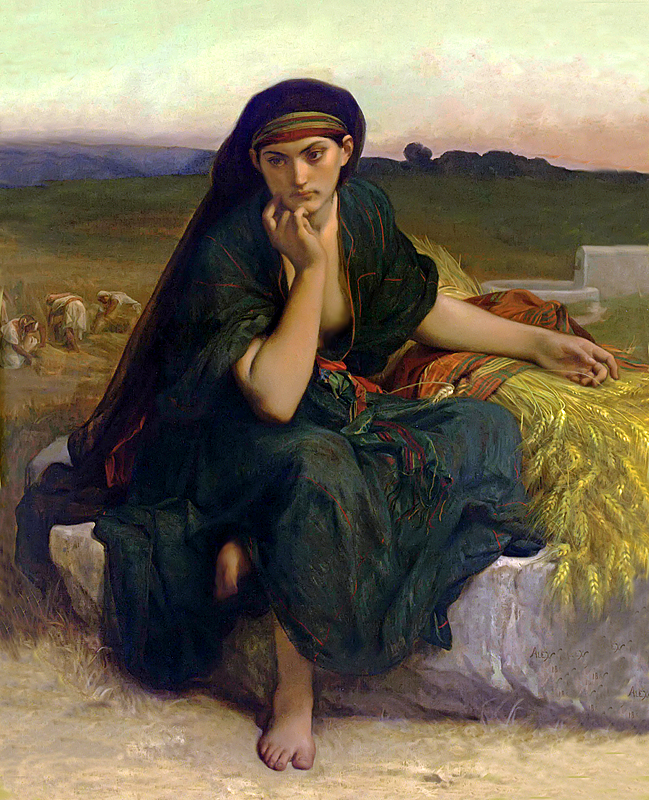
At a church gathering last weekend, I was astonished how many people were unfamiliar with the story of Esther, another brave woman who rescued her people from destruction. So here are recaps of four movies that do exist about Ruth and Esther. Their books of the Bible involve women in unconventional families navigating assimilation, inter-cultural marriages, legal loopholes, family loyalty, deep devotion, and life-and-death situations.

Alexandre Cabanel,
Ruth glanant dans les champs de Booz, (1886),
Musée Garinet, Chalon-En -Champagne.
Ruth dates back to the time of the Judges - she's King David's great-grandmother! She's also the first convert in the Bible. Born in Moab, she marries into an Israelite immigrant family. After famine kills all the men in the family, Ruth sticks by her mother-in-law Naomi, proclaiming "Your people will be my people, and your God will be my God." What are two widows to do? Head back to Bethlehem, where Ruth finds love with grain farmer Boaz. Another distant relative attempts to claim Naomi and Ruth's estate, but God's providence wins out in the end.


Creative License:
This film imitates the epic visual style of The Ten Commandments, and gets very creative with Ruth's backstory. Young Ruth is content living in the temple of Moab's Aztec-like child-sacrificing god, until she engages in some playful theological banter with Malon, a Jewish silversmith. He awakens her heart to God's law, but Moab's rulers are obviously not pleased by her new skepticism of their religion. After the authorities kill the men of Malon's family, Ruth and Naomi set out for Bethlehem. There, they find the kindness of Boaz but also a rival suitor and some neighbors who aren't crazy about the new pagan priestess next door.

Dramatic Themes: 
The Israelites in Moab have assimilated well, perhaps too well. Naomi's son Chilion boasts of how well he and his Moabite wife Orpah are accepted in society. Unfortunately, human sacrifice is accepted in that society. When Malon objects, his family literally says, "C'mon, you know the Moabites are sensitive about their human sacrifice."
The law and its demands are key. Malon gives Ruth a pendant of the 10 Commandments, but later the people of Bethlehem put her on trial for her pagan history. 

Huh? moments: 
Ruth spends her vestal virgin childhood in what is basically a glam convent. Seriously. She and the other girls wear matching outfits borrowed from Katy Perry. Women in long black veils oversee them and teach them to memorize prayers. Is this some anti-Catholic bias? Also, their god looks like a character from the Far Side.
Boaz is sadly less handsome than the ill-fated Malon. His tunics with thigh-high slits don't help matters.

The King of Moab inspects the glam convent. 
Overall rating: 
3.5 out of 5. 1950s silliness aside, the movie has a good pace and draws you in. If you overlook the creative additions, it's not a bad retelling of Ruth's story. I found it genuinely inspiring. 


Creative license:
Grandpa Obed narrates the story of Ruth and Naomi to a teenage David who just can't get his slingshot aim right. Naomi and her family continue to trust God, even though things look bleak and their Moabite neighbors say the gods are cursing them. (Orpah's mom is particularly obnoxious.) Both of Naomi's sons die onscreen, then Ruth and Orpah argue about whether to stay with their mother-in-law.

Dramatic Themes:
This is a matriarchal society, no doubt. Most lines are spoken by female characters, and their relationships are at the forefront. Naomi is the real protagonist of this adaptation, dispensing motherly life advice constantly. The action moves at a glacial pace, mostly because all the women take forever to finish talking about their feelings.
Huh? moments:
Costumes and sets are pretty amateur- a table is clearly a sheet of plywood, "grain" is a straw bale from a farmer's market, wooden spoons came in a 4-pack at Wal-Mart, women are all wearing mascara and mauve lipstick under their makeshift veils.
When Ruth goes off to woo Boaz at the harvest festival, Naomi gives her a "beautiful new dress" that looks like a hideous striped vest.
Pentecostal music artist Carman makes a "celebrity" cameo as Boaz. His 1980s "Sunday's On the Way" album is a cult favorite in my family, but here he looks like a skeezy lounge singer wearing Mardi Gras beads.
Overall rating:
1 out of 5. The sincerity and earnestness of this production cannot, unfortunately, hide its poor production values and bad acting. If I saw this production in a church hall, I'd be impressed; as a feature film it's unwatchable. I had to skip ahead in 20 minute increments so Naomi would get to the point. Maybe a Sunday school class could overlook the glaringly modern language and lip gloss, but they would still get bored. 

Edwin Long,
Esther, 1878,
Private Collection.
The book of Esther essentially tells two stories about Israel's Babylonian exile and diaspora. One involves political scheming and the other reads like a fairy tale.  ived a fairy tale-like story . The tale begins with some flat-out chauvinism: Queen Vasti refuses to appear before the King Ahasuerus' drunk friends, so his advisers have him divorce her. Jewish orphan Hadassah/Esther is among the young women chosen for the "find a new queen" beauty pageant. After a year-long makeover, she captures Ahasuerus' affections, but keeps her Jewish identity secret. 
Meanwhile, her cousin and foster father Mordecai has saved the king from an assassination attempt. Unfortunately, refusing to bow to ambitious courtier Haman has also won him a mortal enemy. For revenge, Haman orders extermination of all the Jews. Esther risks her life by going before Ahasuerus unbidden to expose Haman's plot and plea for mercy. She swoons, the king listens, Haman is defeated with some deliciously poetic justice, and the Jews are saved. The holiday Purim celebrates this every year.  

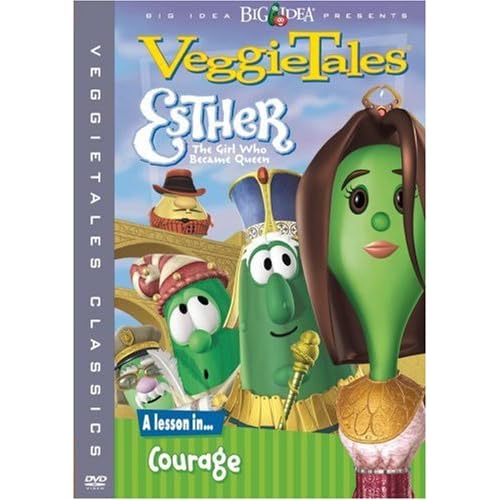
Esther: The Girl Who Became Queen (2000)

Creative license:
Yes, this is a Veggie Tales video. There are singing vegetables. Haman wears a pinstripe suit, Vashti gets thrown out for refusing to make the king a sandwich at 3 a.m, and traitors are banished to the Island of Perpetual Tickling. It's delightful.

Dramatic Themes:
The goodfella narrator starts off by talking about destiny and greatness. Young Esther is confused about her sudden destiny as queen, and begs God to show her what the point of all this is.
Since this is for young kids, the script downplays the romance. Esther is chosen because she sings well in the talent portion of the queen pageant. Her only affectionate moment with the doofus king is when he calls her "Queenie-poo."
Did I mention the gangster accents? Haman's beef with Mordecai is presented as a fight between two "families." The infamous Pea-oni brothers try to kill the King by dropping a piano on him.
Huh? moments:
Again, this is a Veggie Tales video. A scene of Haman and the King playing Trivial Pursuit while eating Chinese take-out at Esther's feast is just one of the apocryphal moments. If this bothers you, there is a chance you might take life too seriously.
Overall rating: 
4 out of 5. The colorful insanity is fun and good-natured, while the plot genuinely sticks to the main events of the Biblical account. The Book of Esther will sound very familiar to kids once they can read it for themselves.

One Night With the King (2006) 

Creative license:
This is a pretty faithful retelling of the Book of Esther that ramps up the political intrigue aspect. Minor characters get much more screen time, like the head eunuch who favors Esther. Many scenes were filmed in India, so there are lots of colorful textiles.
Despite its sensual-sounding title, this film tells a very G-rated love story fraught with the mis-communication common in romantic comedies. Esther longs to visit Jerusalem, but her priorities quickly change when she meets Fabio-like King Xerxes. Then he sees her sneaking off to meet Mordecai and assumes she's cheating, while she worries that he will cast her off like Vashti. (They should have addressed that in Pre-Cana.) Is their love doomed?

Dramatic Themes:
Again, Esther's story evokes musings on destiny and greatness. Our heroine is really named Hadassah, but Morcedai gives her a Persian name to disguise her Jewishness in the palace. Later she observes that Shadrach, Meshach, and Abednego, and even Jacob, were given new names.
The Persian Jews struggle with how much to adopt their country's ways. A visitor from Jerusalem even asks if Mordecai has sold out.
The script links Esther's secret Judaism to her necklace etched with anachronistic stars of David. It's a hokey plot device that distracts from the original drama of Haman's comeuppance.
Huh? moments:
In the biblical account Esther and Mordecai have a friend among the palace eunuchs who delivers messages for them. The script writers achieve this by having Esther's sort-of boyfriend get rounded up and castrated in a palace hiring surge. It's awkward when he begs her to escape with him and she shoos him away. (It's also incredibly awkward to explain eunuchs to your 12-year-old brother during a movie.)
Much is made of Persia's Greek enemies and their dangerous "democracy." Haman warns an angry mob that both Jews and Greeks claim "All men are created equal." I could go on all day about this historic oversimplification, but I'll spare you.
There are several notable cameos, including Omar Sharif and two LOTR alumni. Peter O'Toole gets top billing but only appears for about 30 seconds as the prophet Samuel. He spars with King Saul and then hacks the defeated King Agag apart offscreen. (It's in the Bible. Really.)
There are also some crazy hats. 
Overall rating: 3.5 out of 5. Its has a lower-budget indie feel, a cartoonishly evil villain, and too much narrative padding, but this film is still pretty to look at and heartwarming to watch. All the main elements of the Esther story are there. A confirmation class would not get bored watching.

So this Holy Week, as we sing the Stabat Mater and remember the women who mourned Christ, think of the long line of brave women who prefigured them. We daughters of Eve and of Mary have a rich heritage of love, devotion, and courage. That really ought to be on movie screens more often. 

Sunday, March 18, 2012

7 Quick Takes Volume 19

I just realized I have been numbering these all wrong; I've done way more than I thought. Thanks, Jen for hosting. And for keeping the link-up open all weekend for procrastinators like me.

1. Yesterday I moved to a new desk at my job for the fourth time. Some people are annoyed that 7 of us are sharing a room, but I'm just happy to be within earshot of my department again.

2. I am determined not to pay full price for a gown from a bridal salon, but that didn't keep me from trying on dresses last weekend with my sister and mom in tow. It's funny how things I liked on paper look silly on me in person, and how my attitude toward wedding dresses has evolved now that I am engaged. With every dress, I pondered "Would I want to be the minister of a sacrament in this dress?" What I like to wear to a party and what I want to look like for a life-changing solemn moment are different. Textiles have meaning, you know ;-)

3. Still, wedding dress ads are pretty entertaining for their sheer ridiculousness alone. On my material culture blog I wrote about some that featured zombie models and classic Hollywood references.

4. I've been trying not to focus on the HHS mandate as much, because it's just stressing me out. But I couldn't help laughing at this juxtaposition of articles in my Facebook newsfeed: a piece from the feminist website Jezebel entitled "Law Will Allow Employers to Fire Women for Using Whore Pills." immediately followed by a Human Life International article, "The Assault on Femininity: Is Fertility the Next Down Syndrome?"
Both articles were not afraid of hyperbole, but obviously I'm more inclined to agree with the latter. The politics of fertility - it's a big deal, ya'll.

5. This year's gluten free Irish soda bread turned out pretty well. Baking with teff flour is always weird - things can come out dry and a little greenish. But this loaf is pretty tasty with butter and a schmear of marmalade.


6. I've been a little bummed that The Betrothed isn't around to go see the cherry blossoms, try new restaurants, go to daily Mass etc. But this afternoon I decided "Screw it, I'm going on adventure by myself." So I drove the 30 miles downtown to attend Gregorian chant vespers at St. Matthew's Cathedral. It was awesome. Then I took a long walk down 16th Street, which ends in...the White House! That was also awesome. As were the blossoming trees and the windows-down weather. Solo excursions can be fun.

7. It's the 4th week of Lent - Happy Laetare Sunday! I'll leave you with Matisyahu's reggaeton version of today's responsorial psalm.


Thursday, November 17, 2011

Mormonpalooza Part 2: Housewife Blogs and Evangelization Envy

The past few years have seen the rise of the hip Mormon mommy/housewife blog phenomenon. There seems to be an endless network of them, and good gravy are they popular. Thousands of followers, dozens of sponsors, weekly giveaways popular. Personally, I am hooked on The Daybook, Nat the Fat Rat (Happiness Curator! Lover of Anne of Green Gables!), Rockstar Diaries, and Mormon in Manhattan to name a few.

The stinkin' cute Sydney and Tyson of The Daybook. 
In Salon this January, highly educated journalist Emily Matchar asked the question on many young women's minds (including mine): “Why can’t I stop reading Mormon housewife blogs?” She concluded that, unlike the uber-intense mommy blogosphere, these ladies make marriage and motherhood look like fun adventures.  At VirtuousPla.Net, Julie Rodrigues recently observed that these blogs "give beauty slowly," countering the modern obsession with instant gratification. Jen Fulweiler chimed in that it’s the inherent female nurturing, giving instinct that makes PhD candidates pore over posts about recipes and decorating.

I agree with all these women, and very much identify with Matchar and her friends. Reading cookbooks and stalking other people’s domestic bliss were my main coping techniques while thesis writing. It was a world so comforting, and yet slightly exotic compared to the library stacks.

There's been some discussion in the Catholic blogsphere about what an effective evangelization force these Mormon bloggers are. Such artsy diaries make show that we church-going folk are happy, creative, and normal.  These women blend modernity with faith seemingly effortlessly. They are in the world but not quite of it, often more subtly than we Catholics seem to be. But before we go running out to create knock-off hipster Catholic blogs, there are some key points to consider.

Mormon housewife blogs are up-to-the-minute trendy. 
These women use Instagram, sell handmade accessories on Etsy and dish about makeup trends.  Their trendiness seems authentic, not self-consciously commercial. When readers ask, "What makes Mormons so cool?, they reply that they just look for beauty in everything, and that includes Forever 21.

These blogs are written for a wide general audience – lifestyle first, LDS a distant second.
 “Just frolicking in the city, pushing this stroller in my hipster glasses and red lipstick. Have you tried that new burger place across town? Oh and I’m excited about General Conference and hosting some missionaries for dinner on Sunday.”

via ClothedMuch.com
Similarly, clothing discussions are about fashion, not just modesty. 
You'll never see these stylish girls in tank tops or short skirts, but they don't feel the need to tell you that constantly. Their posts are all "Hey, look at these cute blouses! I found the sweetest necklace on sale!"

I once told my parish priest that he should give up his pipe dreams of a modest clothing line, because the Mormons have that locked down. Three words: Shabby Apple dresses.

By far the expert Mormon fashion blogger is LA-dweller Elaine Hearn at Clothed Much. Her blogroll of Mormon fashion bloggers is comprehensive, and her use of items from both department and thrift stores is brilliant. With nary an ankle length jumper in sight.

They offer artistic quality and positivity, not preaching to the choir
Mormon bloggers' layouts are uncluttered and their photos use natural light, not garish flash. They write about what is good in life, instead of just clutching their pearls about THE CULTURE.

There is a time and place for hashing out the minutiae of theology and liturgy, and then there are times to be more approachable. Endless debates about NFP and homeschooling get tiresome, as does the millionth mediocre rehash of Theology of the Body. This is where Mormon bloggers enchant and inspire me in a way Catholic mommy blogs often do not. It's refreshing to see something practical and beautiful, not just hand-wringing about immorality on TV.

Who cares what horrendous things the kids on Jersey Shore are wearing; what would be a good outfit for work tomorrow? How could I still unleash my creative side once I am chasing after little ones? How do I relate to my secular colleagues? More importantly, how could Catholic life be relevant to them? Women like Sydney and Elaine give me hope that I can participate in modern society but also stay true to my beliefs.

Via The Rockstar Diaries
This is where I as a Catholic blogger/cultural historian do some serious pondering. 
Do we blog to evangelize or to talk amongst ourselves? Should Catholic young women write with our theology more "undercover"? Personally, I love the like-minded community of spiritual support I have found through blogging. Should I put my money where my mouth is and switch to posting recipes and daily outfit photos? Or would that be watering down my faith?

Do any Catholic lifestyle blogs with a large secular following already exist?  Do you think Catholic women should embrace a new online evangelization strategy? What do you think?


Friday, October 28, 2011

Seven Quick Pro-Life Takes


--- 1 ---
True confession time - Pro-Life activism is not a major part of my own Catholic life. I've been to several Marches for Life in my time, and I ardently admire my friends who have done full-time pro-life work, but it's not the issue I get most fired up about. Sidewalk counseling does not appear to be my vocation.
--- 2 ---
But, when my parish started promoting Forty Days for Life, I decided to get off my lazy behind and sign up. One Friday after work I drove to downtown Fairfax and spent and hour praying in front of a clinic. It was in a nondescript concrete medical complex - aren't they all? Except for Planned Parenthood chapters, there are never giant signs saying something like "abortions done here." That's probably half the battle of clinic prayer vigils; helping people realize that a hidden issue is happening in their own neighborhoods.
--- 3 ---
Happily, my "keeping rosaries on your ovaries" shift coincided with that of my parish's young adult group. I met some very nice people, including a couple who recently converted. We got a few friendly honks and thumbs-up, mostly from senior citizens. We also scored a sustained, angry honk with pointing; and a car full of idiot frat guys who yelled "Whoohoo! Abortion!!" I wondered about younger passengers who just gazed with furrowed brows. Did long conversations with their parents ensue?
--- 4 ---
Brother #2's high school class has been participating in the Manassas Forty Days full force. Their best heckler was a man on a motorcycle who gave them the Jersey salute ... and then promptly realized you need BOTH hands to steer a bike.
--- 5 ---
Conversations that only happen in a Catholic family:
Brother #2: "Hey Dad, is it ok if I drive myself to school tomorrow since we're doing Forty Days for Life during first period? And can I give C. (his sweetheart) a ride?"
Me: "So what you are saying is, 'Can I borrow the car to drive my girlfriend to the abortion clinic?'"
Dad: "Sure, that sounds fine."
--- 6 ---
Speaking of Catholic families, my boss' wife just had their third child/first daughter, and so my office has been in the throes of baby fever. It's great to see so many people excited about new life, and so supportive of a woman in the tough final stretch of pregnancy.
My cousin's wife recently delivered an adorable little boy, and it's becoming clear that baby obsession runs deep in my genes. My Dad's parents are beside themselves with glee over their first great-grandbaby. Already they have bragged to Walgreen's checkers and threatened to buy out the entire infant section of a department store.
--- 7 ---
One pro-life topic that does get me excited is discussion of how our society deals with fertility and how it accomodates pregnant women. Somewhat surprisingly, Slate often presents such studies, such as this
analysis of he new dystopian sci-fi thriller, In Time. The article proposes that increased longevity (and therefore a larger population) need not be a zero-sum game.  Or how about this piece on the economic fertility divide - upper class women have few offspring later in life, while poorer women have many children. When I worked at a non-profit for at-risk babies, I definitely saw many inner-city mothers who had 3 or more kids by their early twenties. Then in grad school I noted the convention of delaying children until tenure - often well into one's 30s. I was pleased to see that the article's author agreed with me that our culture needs to offer more support and resources for pregnant women, especially those who are working mothers.  Even if abortion were illegal tomorrow, the personal difficulties and social pressures that drive women to such a destructive choice would still exist. We must also fight for a world where children don't seem like a burden, and motherhood doesn't make someone a bad employee. 
One of the tiniest clients I met in St. Louis

For more Quick Takes, visit Conversion Diary!

Tuesday, March 29, 2011

Jane Eyre: feminist chastity warrior?

Part of my Virginia weekend was seeing the new Jane Eyre film with one of my best girlfriends from high school. I hadn't read the book since we were in plaid uniform skirts, so I'd forgotten what a killer heroine Jane is. This time around I was really impressed by her moral fiber. I'm a big Elizabeth Bennett fan, but Jane has Lizzie's wit plus spiritual depth. I loved how Cary Fukanaga's adaptation prominently featured the novel's different religious ideas.  We even get to see Jane and the housekeeper saying grace over lunch! Here's how I found Jane Eyre an inspiring example of spiritual strength.

  • She is mistreated by many people during her horrible childhood, but she doesn't let their wrongs destroy her. As a child, she rightly calls out Aunt Read for hypocrisy and cruelty, but eventually forgives her. 
  • At Lowood school and later at the Rivers family home, she turns to her female friends for support and encouragement. 
  • She doesn't need a man to survive - she's happy to work hard and support herself, even in a humble job at a country school. 
  • When she does settle down, it's for a relationship of mutual self-giving and improvement. She won't settle just for being someone's assistant, no matter how noble his life goals. 
  • Experiences with insanely dogmatic Christians doesn't turn her off from religion entirely. In fact, she leaves the man she loves rather than violate her moral code. 
It's on that last point that I found this version of Jane Eyre most inspiring. The scene where she refuses to live in bigamy with Mr. Rochester is so poignant, and I loved how this film depicted it. In the 2006 Masterpiece Theater version, Rochester is in control, actually lying on top of Jane in an attempt to persuade her by making out. It seemed too over-the-top for me. In Fukunaga's version, Jane is the stronger one. She holds her head up high and keeps Rochester at arm's length while he clings to her, broken down by his past mistakes.  It's obvious she desperately wants to be with him, but, as she so wisely puts it, "I must respect myself." With a cry of "God help me!" she flees the room of temptation and heartbreak.

As a single Catholic twenty-something, I was heartened by her determined fidelity to what Rochester called "some arbitrary man's law." On the surface, it might seem like she needlessly destroyed her own happiness, but staying at Thornfield would have cost the integrity that made her so attractive to Rochester in the first place. Her self-respect is what made her a survivor; she certainly would not have been happy if she compromised it. Jane's moral courage in turn brought out the best in Rochester; he stayed loyal and compassionate to his first wife to the end of that woman's life. I was heartened to see Jane not let her emotions get in the way of her values since, let's be honest, chastity can be hard when you genuinely love someone. 

source


All in all, it's no surprise Jane Eyre continues to be a feminist icon to generations of readers. She's brave, long suffering, intelligent, self-sufficient and hardworking, a warrior for true virtue, but also capable of great love. 

    Wednesday, February 9, 2011

    Book Review - Committed: A Skeptic Makes Peace With Marriage by Elizabeth Gilbert

    Image Source
    This book is a sequel of sorts to Eat, Pray, Love. Elizabeth Gilbert is on another odyssey, this time hanging around south Asia while waiting for US immigration to approve her marriage to a Brazilian man. She met Filipe in Bali at the end of her previous book. Both were divorced and reluctant to get hitched again, but restrictions on temporary visas made the decision for them.

    If you think marriage is a profound sacrament, or even just the building block of a healthy society, you will find yourself disagreeing with Committed. To be fair, she told us upfront that she is a skeptic. She’s also quite honest about the independent individualism that modern Americans consider their birthright. How dare a government or church tell her what to do? Refreshingly, though, she admits that much of the world happily functions without this mindset, and that she's often grappled with feeling unfulfilled.

    Gilbert read up on the history of marriage during her year of skepticism, but  I found myself yelling “Where are your footnotes, woman?” and grumbling about irresponsible use of anecdotes. Also "How could you not know that emotional intimacy with a person-not-your-spouse can lead to an affair???!" And "Women are the ones who have babies. Parenthood requires sacrifice. Get over it."  And finally "Just marry the guy already!"

    But that’s really the appeal of Gilbert’s writing; reading her words is like hearing a friend tell you a story. You are privy to her personal life and feel like you can engage with it. I could even identify with some of her apprehensions about commitment and motherhood. Does raising children really require women to "scrape bare the walls of their own souls"? Can we change our minds all the time and still make a lifelong commitment to someone?

    The stories about her relationship with Felipe were more encouraging. That’s when Committed is at its best, telling a story about two people in love trying to make a life together. Besides the whole immigration approval with nomadic lifestyle thing, they had to learn to balance different cultural backgrounds and traveling styles. Her field trip to Cambodia while he read mystery novels by a pool was a nice reminder that your relationship is not doomed if you have some different ideas of fun.
     
    It was also interesting to see how Gilbert finds a solution for our modern, post-marriage society. She starts to view marriage as a form of social rebellion. Sure, governments and churches may regulate it, but that is their feeble attempt to control the coupling that would happen no matter what. Couples say vows and sign paperwork, but then, as Felipe put it “We go home and do whatever the hell we want.” Every home is its own little society, and no amount of laws can completely control what happens in those homes.Marriage (and children) implies that you value a particular relationship above the wider community.

    In the end, though, Gilbert is willing to admit that her marriage is not an entirely private matter. She realizes how much her family wants to be able to witness her and Felipe’s exchange of vows. She jumps through all the US customs hoops. And when all is said and done, she finds that public commitment to the man she loves was nothing to fear. That alone could calm a few other skeptics.

    Edit: Elizabeth Gilbert's personal website reveals that Committed was just released in paperback with the subtitle changed to "A love story" implying that she is still living peacefully ever after.

    Wednesday, October 27, 2010

    My feminism is acting up again

    Today in my awesome history seminar we discussed a really dense, intimidating, intelligent book that is in many ways a diatribe about how other historians got things wrong. A couple of guys in my class really didn't like it. Before discussion started I overheard them wondering how the female author pulled it off. "She must have been like, sitting in the library for hours every day. Geez, she needed to get a boyfriend or something."
    Really? Really? When you read her mentor's equally intense tome you didn't question his love life. Is it so painful to have your small mind challenged by a woman, Mr. Sweatpants and energy drink?

    Granted, I'm not crazy about her style either. She seems like the kind of person who is such a Type A overachiever they give everyone around them hypertension. If she put work over family, I pity her decision to ignore the important things in life. Being a woman in academia is an especially hard balance - all of us aspiring girl professors worry at times when, if, and how having a family will fit into the equation. (Not gonna lie, at times I feel like I am waiting out grad school until I can just get married and have babies.)

    But don't you dare imply that girls can't be or shouldn't be intense scholars. Whether we have boyfriends has nothing to do with it.

    Saturday, October 9, 2010

    Material Culture Alert: Pants are evil!

    Pants are evil. At least that's what my classmate N-slice and I have decided. Pants never do what you want. If you fail to conform to their shape, they either sag and droop or compress your internal organs. Skirts, on the other hand, are forgiving and flexible. Skirts are our friends, especially in a fancy-pants museum school.

    Now, you may be aware that there are some conservative religious groups wherein pants on women are evil. My fave Arkansas family the Duggars are an example of this, as are some Catholic homeschooling factions. In their eyes, pants undermine modesty, chastity, the role of women in the family, and the natural complementary differences between the sexes. Those are big issues, so I respect their worrying about them. The worry can lead to some extreme ideas, though. Naturally, if you look around the internet, you can find people in crazy arguements about this topic. For instance:

    This article I found today is well meaning, heartfelt ... and totally nuts. When the author suggested that you take your husband shopping with you so he can pick out your clothes, I had to laugh out loud. It also seems to imply that pants simultaneously make you look too fat, too sexual, and too "cheap." Dude, which is it?

    This post in response is snarky, skeptical, and full of female common sense. I laughed out loud more than once. Basically it says "I am a busy mom chasing after my kids - PANTS!"

    All day I've been hashing out what I would write in response to these ideas about modesty and gender roles. Why can't I stop thinking about it? Here's my own itemized pants/skirt manifesto.

    1. This is a material culture issue - clothing has both individual and social meaning. Clothing can assert control, reinforce a group affiliation, express individual creativity, and yes, offend those around you.
    2. Longing for the "good old days" of modest clothing is bad history scholarship. Have you ever seen a Hogarth engraving from the 1700s? Not much modesty there. Granted, immodesty may be much more visible and diverse now, but it always existed within the social constructs of its time. That's another thing - clothing culture is a language that evolves. In Jesus' time, everyone wore long robes. Was that blurring the sexes too much?
    3. There is extreme immodesty in our culture, but you don't have to go to opposite extremes to combat the cultural poison of, say, Jersey Shore.
    4. Last night I read Ira Levin's novel The Stepford Wives. That book is a worst case scenario of caricatured gender relations, but the first article has some similarities. In both worlds, men admire women for their beauty, and want to direct how that beauty is displayed and idealized. The Stepford husbands wanted impossible women who would do endless chores with no personal needs; the other author appears to want the impossibility of never remembering that women are sexually attractive.
    5. I'm the kind of person who takes spiritual advice much too seriously, especially when it is strict. Last year I read Colleen Hammond's Dressing With Dignity, and it troubled me for weeks. Was I really buying into a modern conspiracy of Marxism, Freemasonry, and the downfall of civilization as we know it? Padre Pio, a profoundly holy man, wouldn't even hear the confessions of women in pants. Was he looking down from heaven ashamed of me and my wide leg dress trousers? But then I remembered - that was one holy man's opinion. He was not infallible and he was influenced by the context of his time.
    6. Lastly, having itemized lists of rules or forbidding entire genres of garments outright is not an adult moral approach. This is a lesson I'm learning myself, since I tend to like structure and direction. But I'm not in my high school anymore with its regulation of shirt collars and prom dress straps. There is no papal checklist approving or condemning every item of clothing you might ever try on in a store. As adults in a mature relationship with God, we must take our properly formed consciences and apply them to the unpredictability and diversity of daily life.
    So that's my rant. No, I don't think skirts are evil signs of patriarchal oppression. I like wearing skirts and how they make me feel feminine and polished. I like when The Beau tells me I look pretty or my female classmates compliment me on a new dress. Some colleagues are bigger fans of pants, but they still look feminine.