Showing posts with label Catholic. Show all posts

Friday, March 27, 2015

Richard III Remembered With Embroidery

Yesterday the body of England's King Richard III was reburied in Leicester cathedral, over 500 years after his defeat and death at the Battle of Bosworth Field. Archaeologists found his makeshift first grave under a parking lot in 2012. (It's deliciously ironic how "found under a carpark" is now the phrase that must appear in all news coverage of a man who once wore a crown.) Although Shakespeare and history books have focused on Richard's bloody role in the War of the Roses, the proceedings this week were about his historical significance and also his vulnerable humanity.

Perhaps most poignantly, earlier this week Roman Catholic Cardinal Vincent Nichols said a special requiem mass for the dead king. A moment of remarkable Anglican-Catholic cooperation, it also symbolized how even the most powerful people on earth still need God's redemptive grace.

Better still, Cardinal Nichols wore an historic chasuble believed to be from Richard III's royal wardrobe. Dating to the late fifteenth century, the embroidered robe is now in the collection of former Catholic seminary Ushaw college. The UK Catholic Herald described its embroidery detail:

The Westminster Vestment is an example of Opus Anglicanum (English work), the rich, complex and beautiful works of ecclesiastical embroidery for which England was famous during the Middle Ages. It has been made from velvet cloths of tissue linked together with silver-gilt brocading thread, with the figures cut from coloured silks and attached to a golden background. The chasuble depicts the Crucified Christ with the Roman soldier Longinus expressing his belief that Jesus is the “Son of God”. It features depictions of St Nicholas, St Catherine and St Pancras, the teenage Roman martyr whose relics were brought to England by St Augustine of Canterbury.
Image via Catholic Herald

It's truly magnificent, and a great example of church vestments of its era. Velvet, metallic thread, and highly symbolic embroidered scenes are all hallmarks of opus anglicanum. The motif of angels collecting Christ's blood in chalices while He hangs on the cross is a particularly popular recurring image, emphasizing the Eucharist's connection to calvary.

Intricate chasubles and copes fell out of favor after the English Reformation. Centuries later, as I discovered in my master's thesis research, Anglicans and American Episcopalians would rediscover the beauty of medieval English needlework and try to replicate its prestige in their own churches. 

It's interesting how the black pall covering Richard's simple coffin while it was on view this week also featured embroidered figures, including a six-winged seraph. It appears that opus anglicanum has come full circle, once again an important element of royal religiosity in England. As Cardinal Nichols pointed out in his homily, Richard III lived and died as a Catholic, whatever his sins. While some of his successors would have cringed to see such liturgical ceremony, he would have acknowledged the symbolic significance of copes and chasubles.

Whether Richard and his Gilded Age imitators were using that liturgical beauty to pad their own egos is definitely possible. But in the end, everyone dies and ends up helpless under a liturgical cloth.    

Via Getty Images
Today opus anglicanum pieces are treasured artifacts in museums, including the V&A in London and from the same time period, like this elaborate velvet chasuble, at The Cloisters in New York City.If you ever visit the Metropolitan Museum of Art's castle on the upper West Side, be on the lookout for this velvet chasuble and other amazing vestments.


Thursday, February 28, 2013

Changing Popes

Losing a Vicar of Christ feels like a kick in the gut, a punch in the chest. It's like saying a final goodbye to a grandfather or your favorite teacher/mentor. It makes the Bark of Peter feel like a rickety canoe in a hurricane. It makes you want to call your family, and hug your friends. You can't help feeling a little abandoned. Suddenly, the symbol of your identity is gone, and you don't know how to go forward. 

The day Pope Benedict announced his retirement all I wanted to do was run into every church in New York City. "I need to be with my people!" my heart cried. On my way to the office I stopped at St. Peter's at 22 Barclay in lower Manhattan. (Greek revival 1834, oldest parish in New York.) I couldn't find the words to pray, so I just sat there with Jesus and pondered the papal tiara above the altar. Christ is the One who put it there, and He's the only man who will ever need to be the Church's savior.

St. Peter, St. Paul, and a crucifix painting that St. Elizabeth Seton prayed before
The departure of a pope is also exciting. This only happens a few times in a century. If the Easter Vigil is the Super Bowl of Catholicism, a conclave is the World Cup. Better start gearing up on your College of Cardinal stats. If you are as enterprising as my friend Steve, you can make a bracket. Nothing beats the absolute thrill of hearing "Habemus Papam!"

 It's eerie how The Betrothed and I just spent an evening sorting through his box of World Youth Day mementos. (We were both at Toronto 2012, but sadly there is no secretly prophetic photo where one of us obliviously walks past the other.) As we decided which things to keep in our future home, we talked about what it was like going to see the Pope, and how we had changed since then. Pope John Paul II was the pope of my childhood.  For us kids of the 80s and 90s, he and Mother Teresa were Catholicism. During his papacy I was baptized, received my first communion, and was confirmed (in the Year of the Holy Spirit for an added bonus). I attended Catholic school for 8 years.  I traveled to see him at World Youth Day, the longest and farthest I had ever been away from my family at that point. John Paul II told my generation that the Church loved us, that Christ needed us for His epic plan, and we leaped to the task. His love, joy, and compassion made me proud to be Catholic.

When JPII died, my own health came crashing down with him. I spent the sede vacante period going through medical tests trying to decipher the chronic illness that eventually forced me to drop out of college for a year. The day Benedict XVI was elected, I ran campus errands until a parish staffer found me collapsed from exhaustion in the campus ministry office. My life would never be the same, and that period of suffering would prove to be one of the best things that ever happened to me. Pope Benedict XVI was the pope of my transition to adulthood. During his papacy I bounced from one temporary stage to another - homebound invalid days, finishing college, a volunteer year, graduate school, long underemployment, and finally a real job. I met my future husband and prepared for marriage.

Through these changes, I often felt restless, rootless, and unsure of God's plan. Attending two public universities gave me lots of opportunities to wrestle with how the Church could relate to the questioning modern world. Luckily the Church's leader turned out to be not an attack dog, but a gentle nerd with an amazing analytical mind and stellar footnotes. His writings are always a revelation of eloquent clarity. Pope Benedict has urged my generation to reconsider our religious heritage, and we realized we were hungry for symbolic meaning, not just youth group catch phrases. If you had told my 17-year-old self that the "new springtime" of the Church would involve a revival of the Pre-Vatican II mass, I would not have believed it. The scandals and trials of recent years sometimes make it painful to be Catholic, but Benedict XVI has reminded us how true joy comes from the deep truths of the faith. As The Betrothed often says about him, "What a boss!"

Now this next pontiff will be the pope of my adult married life. Once again, I'll spend the sede vacante period adjusting to major new realities - I just moved 250 miles away from my hometown to start a job in a New York and am living out of boxes in a bare apartment. I don't know what the coming years will bring for me and the Church, but I know God will be with us.

The changing of popes is a reminder that Jesus is all that matters. No one person is the Church. She already found the man who meets all her many needs - the One who redeemed her. All the other vicars are just taking care of the place for a while until He gets back. Was Jesus like all of these men at once? Was He the perfect combination of Peter's passion, John XXIII's kindness, and Pius V's tenacity? He knows the right person for the right time, including this next conclave. 

So godspeed, dear Papa Benny. Thank you for your generous service, your great humility, your deep wisdom, and for putting the papacy on social media. I'll be reading one of your books on the subway today. Stopping in one of New York's many churches sounds like a good idea too.

Thursday, November 15, 2012

Gluten-Free Communion Update!


I've written before about the difficulties of receiving the Eucharist now that I am gluten-intolerant. There has been some misunderstanding of the issue by both celiac groups and parish clergy. Last year I was concerned that preference for the more traditional communion under one species would further limit my sacramental access. 

So I was overjoyed to see Fr. Z's blog announcing a new USCCB statement on the appropriate pastoral response to celiac disease. Here is the text of the document. (My emphasis added.)

From the United States Bishops Committee on Divine Worship newsletter, October 2012.
Celiac disease is an immune reaction to eating gluten, a protein found in wheat, barley, and rye. For those with the disease, eating gluten triggers an immune response in the small intestine. Over time, this immune reaction damages the small intestine's lining and hinders absorption of some nutrients. The intestinal damage often causes stomach pain, diarrhea, and weight loss, and can lead to serious complications. A Mayo Clinic-led analysis published in 2012 estimates that roughly 1.8 million Americans have the disease, but around 1.4 million of them are unaware that they have it.Given the serious health risk for those suffering gluten intolerance, it is important for pastors and other Church leaders not only to be aware of the reality, but prepared to address the situation of Catholics with celiac disease who come to parishes and seek to receive Holy Communion in a safe, sensitive, and compassionate manner. 
The Risk of “Cross-Contamination”For those members of the faithful with gluten intolerance, even trace amounts of gluten can be damaging. It is important, therefore, to be mindful of “cross-contamination” when using either low-gluten hosts or when offering Holy Communion to someone only under the species of wine. It might be best, for example, for the communicant to prepare a pyx with the low-gluten host before Mass, in order to avoid the situation of a sacristan who has handled the other hosts also to handle the low-gluten ones. At Communion time, then, they could approach the sanctuary together with any Extraordinary Ministers of Holy Communion and receive the pyx from the celebrant with the words “The Body of Christ” (or, if possible, they could be given the pyx within the normal Communion line, provided “contamination” from handling of the pyx is avoided). Similarly, it might be necessary for someone who has permission to receive Holy Communion under the species of wine alone to prepare before Mass a chalice, which will not be part of the commingling rite and from which either they alone will receive or from which they will be the first to receive. Such precautions are not only medically necessary, but they demonstrate compassion to avoid singling out those who want to receive Communion, but are unable to receive one or the other species. 
Low-Gluten Hosts and MustumThe most recent Church teaching on the use of mustum and low-gluten hosts at Mass remains the letter from then-Cardinal Joseph Ratzinger on July 24, 2003 (Prot. n. 89/78-17498), which was addressed to the Presidents of Conferences of Bishops. In that letter, pastors and the faithful are reminded that for bread to be valid matter for the Eucharist, it must be made solely of wheat, contain enough gluten to effect the confection of bread, be free of foreign materials, and unaffected by any preparation or baking methods which would alter its nature. The amount of gluten necessary for validity in such bread is not determined by minimum percentage or weight, though hosts which have no gluten are considered invalid matter for Mass. (In the Roman Rite, the bread prepared for the Eucharist must also be unleavened.)Mustum is defined as grape juice in which fermentation has begun, but has been suspended with the result that its alcohol content (usually less than 1.0%) does not reach the levels found in most table wines. It should not contain additives and may be stored through freezing or other means. The process used for the suspension of fermentation must not alter the nature of the juice in any way. The amount of alcohol needed for validity in mustum is not determined by a minimum percentage or weight. Pasteurized grape juice in which all alcohol has been evaporated through high temperature preparations is invalid matter for Mass. In the United States, it is forbidden to sell wine without the addition of sulfates as preservatives. The Church has determined that the very small amount of sulfates is acceptable and does not make the matter invalid.The lay faithful who are not able to receive Holy Communion at all under the species of bread, even of low-gluten hosts, may receive Holy Communion under the species of wine only, regardless of whether the Precious Blood is offered to the rest of the faithful present at a given celebration of Mass.Permission for priests, deacons, or the lay faithful without distinction to use mustum or low-gluten hosts is within the competence of the diocesan Bishop. The authority to permit the lay faithful to use mustum and low-gluten hosts in the reception of Holy Communion may be delegated to pastors under canon 137 §1 of the Code of Canon Law. Medical certification of a condition justifying the use of mustum or low-gluten hosts for Holy Communion is not required. Such permission, once granted, stands for as long as the condition persists which occasioned the request for the original permission.As a best practice, it is recommended that individuals with gluten and/or alcohol intolerance arrange through their parish the purchase any low-gluten hosts or mustum. This facilitates the oversight and good stewardship of the pastor who is responsible as mentioned above. It also “normalizes” the practice for the communicant, as well as keeping the purchase of liturgical supplies together in the parish budget.It is also worth recalling that, through the doctrine of concomitance, the Church teaches that under either species of bread or wine, the whole Christ is received (cf. General Instruction of the Roman Missal, no. 282; Catechism of the Catholic Church, no. 1390). Thus, the faithful may be confident in the Real Presence of Christ in the Eucharist they receive, even under only one or the other species. 
Obtaining Low-Gluten Hosts and MustumIn the dioceses of the United States, there are three approved distributors of low-gluten hosts and two of mustum known to the Secretariat of Divine Worship. (Any additional low-gluten host and/or mustum distributors are strongly encouraged to contact the Secretariat so that an up-to-date listing may be maintained.) 
Low-Gluten HostsBenedictine Sisters of Perpetual AdorationAltar Breads Department31970 State Highway PClyde, MO 64432-8100Phone: (800) 223-2772E-Mail: altarbreads@benedictinesisters.orgWeb: www.BenedictineSisters.orgGluten Content: 0.01% 
Parish CrossroadsP.O. Box 84Zionsville, IN 46077-0084 Phone: (800) 510-8842 E-Mail: admin@parishcrossroads.comWeb: www.ParishCrossroads.comGluten Content: 0.016% 
GlutenFreeHosts.com Inc.100 Buckley RoadLiverpool, NY 13088Phone: (800) 668-7324 ext. 1E-Mail: info@glutenfreehosts.comWeb: www.GlutenFreeHosts.comGluten Content: 0.002% 
MustumMont La Salle Altar Wines605 Trancas Street, Suite DNapa, CA 94558Phone: (800) 447-8466E-Mail: info@montlasallealtarwines.comWeb: www.MontLaSalleAltarWines.comMonks Wine & CandlesP.O. Box 681248 Schaumburg, IL 60168 Phone: (800) 540-MONK (6665) E-Mail: info@monkswineandcandles.comWeb: www.MonksWineAndCandles.com 
Conclusion“Any baptized person not prohibited by law can and must be admitted to Holy Communion” (can. 912). It is important for pastors to make every effort to accommodate and normalize the experience of Communion for the faithful, including those suffering from celiac disease. As this article points out, such can certainly be done within the norms of Church teaching.

I will always be grateful to the many kind priests and altar servers who have set aside low-gluten hosts for me or saved a few last drops of the Precious Blood in a chalice. When the Eucharist is a potential health risk, such understanding is a huge relief. This morning I went to daily Mass, and no one batted an eye when I skipped ahead to the chalice line. God is good. 

Wednesday, May 9, 2012

How Not to Talk About Underemployed People

There's been a lot of backlash to the Obama campaign's "The Life of Julia." This slick little slideshow shows a woman going through life relying on government funding, even though mean ol' Mitt Romney wants to rip those benefits from her hands. Like all campaign literature, it oversimplifies things and sounds slightly condescending.

One recent response to it really burned me up, though. Sure, I agree with "The Life of Emily" as a rebuttal of government paternalism. I bet if I met the author, Emily Stimpson, in person, we'd have a lot in common. Her story of success as a professional young woman is inspiring. Making it as a free-lance writer is hard, and she's totally convinced me to open a health savings account.

But her tales of job success hit too close to home for me. It felt like the name-dropping and insensitive boasting of a smug class valedictorian. Sure, she's smart and diligent, but she also got many lucky breaks. One of those was being born 7 years before I was. Right now, there aren't enough merit scholarships and entry-level jobs to go around for even the hard-studying A-students. This sentence in particular burned: "It would never occur to her to still be on her parents’ plan, even if she could. After all, she’s 26—an adult." Well yahoo. I guess that makes me an infant.

Via Economic Policy Institute
To top it off, Emily's readers decided that I and other underemployed people who commented were whiny morons lacking American values. Their kids could pay for insurance straight out of school, what's wrong with us? "A master's degree does not entitle you to a job with benefits," scolded one person. He implied I should have gone to trade school instead. The flurry of "dislikes" felt like a spit in the face. These pharisees pointed at me, the 27-year old living with her parents, and said "I thank you, O Lord, that I am not like that."

I know, I'm talking about internet comments from strangers here. It doesn't really matter. But this was on a Catholic website. For the first time, I felt attacked personally by my own kind. I couldn't believe the ignorance and lack of compassion.


The "American Dream" is not in the Apostles' Creed, people. Our economy is in flux right now - a college degree doesn't ensure a job anymore. People are relying on their parents for longer into adulthood. The recession is not over. Who knows what career path advice kids will get in five or ten years.

If I were to write "The Life of Sarah," it would read like Emily's, but with more ups and downs. Mine is just one story, and I know there are many people worse off than I. But I am an example of how fortunes can unexpectedly change, and how hard work and good grades don't always win you success. My odyssey into adulthood also shows how sometimes, you need a helping hand.

I went to a state university for the lower tuition, taking out loans and working part-time jobs. At age 20 I contracted a chronic circulatory condition and had to take a year of leave from school. For the next 5 years, this "pre-existing condition" would prevent me from getting coverage outside of my parents' insurance plan. If I didn't have insurance, I couldn't get the medication I needed to function. So yes, I relied on my parents into adulthood.

At age 23 I spent a year with the Vincentian Service Corps in St. Louis. There I saw firsthand how government aid could help some people, like the mom of 5 who used housing assistance money to move away from her abusive meth-addict husband. I also saw the heavy costs of family decline and sexual irresponsibility. I learned how some people just wanted a handout, but all the money in the world couldn't replace the value of caring, challenging mentors. All this time I made $300 a month, so obviously I wasn't building a nest egg. It was worth it.

Source
At age 25 I was in a competitive master's program that provided a tuition fellowship and stipend. I could not have afforded grad school any other way. When my Dad lost his job, I emptied my "wedding dress slush fund" savings into COBRA fees to extend my insurance coverage. A generous gift from a relative helped me pay these fees and buy a very sensible, very used car. My cardiologist declared me mostly free of symptoms, and so I could finally purchase basic insurance through my university.

At age 26 I got my master's, but not a job like most of my classmates. I moved back in with my parents and worked odd jobs all summer. In a stroke of luck I got an entry-level temp job, replacing an accounting department's college intern. My hourly wage job allows me to pay for my insurance, as well as out-of-pocket treatments for a back injury.

Now at age 27 I know I must help pay for my wedding, but have no idea where I'll be working in a month. A lot of my peers save money by shacking up with significant others, but obviously we won't do that. I'm determined to have Depression-era pluck, looking for whatever gigs I can find. Substitute teaching? Museum volunteering? A temp agency? I'm also going for the novena mother-load, the 54-day rosary. My path is not what I envisioned at age 20, and I do not wish it for my younger siblings. But I refuse to condemn myself for circumstances in some part beyond my control.

So if you want to talk to the Kids Today about their jobs, realize that it's always more complicated than it looks. Here are a few tips.

  • Don't conflate individuals with economic trends. Should we have a national conversation about how college is overpriced and maybe not worth it for everyone? Absolutely. But that doesn't mean you should point at a deep-thinking liberal arts major and tell him he should have been a mechanic instead. Don't grill him about whether it's time to "give up" on his field. 
  • Read this recent piece about the surprising number of PhDs on public assistance.  Realize that not everyone on food stamps is a welfare queen - sometimes ambitious, intelligent people turn to welfare as a last resort. 
  • Don't tell a recent grad "Oh, but aren't there lots of companies in your field where you live?" Yes, we know, as does everyone else with our degree. This is like telling a single woman "Oh, but there are lots of cute guys in your area. Have you tried going to bars?"
  • Don't yap about how you or your kids or cousin or brother was a wild success right out of school. 
  • Do refer underemployed young adults to job openings or to people who might be good professional connections. Whom you know matters, more than ever. 
  • Do offer practical interview advice based on your own experience. Express sympathy when they get turned down after an interview. Assure them that they are just as capable as their peers; that a lot of this is mysterious luck.
  • Do cheer them on with small successes, like part-time retail jobs. Don't lecture them about counting their blessings. They know. 
  • Do tell them about sales on professional wear at the local outlet mall. 
  • Do offer to pray for them. Only God knows how we'll get out of this recession mess. 
Any other job-seekers reading this? What would you add to my list? 


Thursday, December 8, 2011

Immaculately Ahead of Schedule

Happy feast of the Immaculate Conception, and happy patron feast day, United States of America. Somehow it's wryly fitting that in a nation where Catholics have been so often misunderstood, and where we sometimes don't even understand ourselves, the patroness is one of the the most frequently confused theological concepts. Just to be clear, we're talking about the beginning of Mary's life here.

 It's also fitting that in the land that celebrates self-made success, today we remember how no one can redeem themselves - we need God's grace and redemption. God chose to redeem Mary ahead of schedule, before her Son had even been incarnate. Only one other person got this privilege. Tradition states that John was cleaned of original sin in utero, when he danced for joy at the approach of his infant savior cousin.

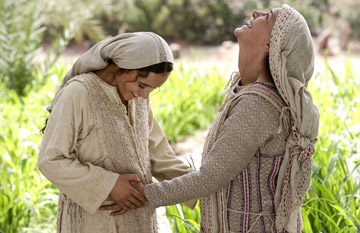
Visitation scene from "The Nativity Story" Via Groucho Reviews
Mary is the "first fruits" of Christ's redemption, the morning star before the sunrise, the coming attraction trailers that signal the start of the feature film. Her sinlessness is a glimmer of hope representing what Christ can do for us and what we can become.

Tuesday, November 1, 2011

I can see your halo, halo, halo

The Calling of St. Matthew; Caravaggio; 1599-1600; San Luigi dei Francesi, Rome
Today is the day to think about All the Saints, and I am reflecting on the many patrons to whom I owe thanks, some old and some new.

St. Jude and St. Therese have been unexpected novena friends. Today I realized that St. Matthew is the patron of accountants, and thus my pal now too. I always loved his conversion story.

Then there are the English martyrs that The Beau has been researching, like priest and poet Robert Southwell. Blessed John Henry Newman is more connected to my own "scholarship," and their spiritual descendant.

And then of course the strong women whose names I share. St. Philomena, the idealistic and brave teenager whom I claimed in Confirmation. Sarah, the patriarch's wife who laughed when God told her His plans. I like to think she regretted her hard-headed mistakes.

Also the Elizabeths - a queen of Hungary and an Episcopalian convert. Ms. Bayley Seton and I should be better friends - she lived in the early republic! She was a Vincentian! My high school is named for her! She's totally historically significant! Elizabeth Ann, please pray for your fellow American down here.

Since I'm a historian, the Communion of Saints is one of my favorite Catholic concepts ever. Those who went before us are not just words on a page - they're alive! We can talk to them, they can help us out just as if they lived down the street and sat a few pews over at Sunday Mass. There is such a tangible sense of power knowing I can make personal connections with the past.

All you holy men and women, pray for us. 

Wednesday, October 19, 2011

Living with Scapulars

Bright Maidens Topic 18: Scapulars.
Props to Julie for that picture of poor wretched Mel Gibson that I cannot unsee.

My well-worn crocheted scapular,
and a dainty plastic one. 
Talking about scapulars makes me think of Swimming With Scapulars, a fun little young adult Catholic memoir by Matthew Lickona. He talks about growing up Catholic, entering adulthood at Thomas Aquinas College, and married life with the wife he met there. Along the way Lickona dishes about things like prayer, penance, bourbon, first kisses, NFP, and of course, wearing a scapular to the beach.

I never take mine swimming; I'm always afraid I'll lose it in the deep end. Neither does my scapular make appearances in the neckline of formal dresses. But my high school scapular certainly had souvenirs of its adventurous life, including paint from the trailer home I helped repair on a summer service trip. I prefer the sturdy, crocheted cords that moms at my high school make. Those dainty little plastic scapulars are cute but their strings seem fragile.

This week's topic got me thinking - why do I wear a scapular? Because I got enrolled in sixth grade at school? Because it's a handy holder for a Miraculous Medal? Or is it because I'm afraid of dying in a car crash and going to hell?

When I was a young teen, there was definitely some attachment to the "get into heaven free" card. At worst, this is superstition, but at best the scapular promise is peaceful assurance. If you're going to bother to wear the Mother of God around your neck, there's a pretty good chance that faith is important to you, and that you'll make peace with her Son in your final moments. So stop fretting about salvation and live a holy life.

Today, I don't think about my scapular much, except when it flops out and some well-meaning colleague gets confused when she offers to tuck in "the tag from my blouse." I should think about it more often. When I do, those little wool tags feel like a badge of honor, part of my uniform as a soldier of Christ. It's just a little way to show my allegiance to Our Lord and His Mother. It also gives a feeling of solidarity with the many religious orders who wear the full-sized version. I don't go around telling people they should wear one too; I'm very hesitant to market anything as the magic bullet of sanctity. For me, though, my scapular is a comforting, familiar reminder of the type of person I want to be.


Epic Intercession: Now with 50% more novenas!

St. Jude Novena


Earlier this month I raved about the blog Pray More Novenas and how its email reminders got me through all nine days with St. Therese. Starting today, I am back on the novena bandwagon, joining over 5,000 Catholics to pray the St. Jude Novena, leading up to St. Jude's feast day on October 28.

 Do you have any ‘impossible causes’ to pray for? St. Jude is the patron saint of the impossible, and his intercession has helped people through tough times for centuries. On a personal level, I have some good friends who are particularly grateful to St. Jude, so I feel like he would be a good saint to get acquainted with. You can sign up for handy email reminders to get the the novena prayers here: St. Jude Novena

Wednesday, October 12, 2011

Alien species: Life as a Gluten-free Catholic


via Scientific American
I've lived gluten-free since summer 2006, when an antibody test confirmed my doctor's suspicion that gluten was the reason for my debilitating stomach cramps. So I reluctantly eliminated wheat, barley, rye, spelt, and most oats from my diet. Since then, my stomach problems have never returned and I've never felt better.

At first, giving up conventional pasta, bread, pizza, and baked goods seemed impossible. But really, it's not so  bad being GF in the 21st century. There are far more GF products and menu items available today than ten years ago. Still, as with any food intolerance or allergy, you have to be very aware of everything you eat. When I read a restaurant menu or enter the office break room, I do a visual scan and mentally flag anything that is off limits -  hamburger buns, sandwiches, muffins, frozen dinners, condensed canned soup, flour thickened gravies, etc. This survival technique is second nature to me now, and the memory of weekends curled up on the couch in pain keeps me from cheating.

Unfortunately, there is one other food on my off-limits list: the Eucharist. I'm not sure what one little host would do to me, but I'm positive that a Sunday habit of ingesting the "gift of finest wheat" would be bad for my body. There are some alternative options, praise God, but they all make receiving Communion a complicated operation.

Gluten-free Eucharist Option 1: Low-gluten hosts
Parishes can now offer Communion in the form of Vatican approved, extremely low-gluten hosts made by Benedictine sisters. This eliminates the need for any more kerfuffles about rice crackers. (Hallelujah). If you're curious, low-gluten hosts are lumpier, denser, and tougher than regulation altar bread, with a vague potato chip flavor. They take a long time to dissolve on your tongue.

Keeping the LG wafers in a separate pyx during Mass prevents cross-contamination. Of course, this means I need to alert the priest or sacristan to fill that pyx ahead of time.  I always feel awkward poking my head in the sacristy before Mass - it's basically an ecclesiastical men's locker room in there. My home parish in Virginia distributes LG hosts before the general distribution of Communion- this means I usually spend the Agnus Dei worrying that the priest will remember and that I'll stand in the correct place this time.Maybe this all is God's way of teaching me to trade shyness for assertiveness.

Gluten-free Eucharist Option 2: Chalice only

I've found that if I ask, a priest is happy to save a sip of the Precious Blood for me. (The only exception was my first Extraordinary Form Mass, but that's a long story of liturgical red tape.) When I'm in a parish that offers Communion under both forms, I just make a beeline for the chalice line. I've developed a series of near-dance steps that allow me to skip out of the initial host line without tripping anyone. I've gotten a few dirty looks from confused extraordinary ministers, and I probably throw off the host line's momentum. Still, it's a practical solution, especially when I am visiting a new parish. So if you see someone jump the line next Sunday, don't freak out. Ditto if you see someone eyeing the priest's chalice warily to ensure she doesn't ingest the speck of Host floating about.

Will Both Species Be a Thing of the Past?

Chalice by A.W.N. Pugin, 1851, via the V&A
Lately the distribution of the Eucharist under both forms has gotten a lot of press. I had no idea this was a trad vs. liberal issue, but it seems that way.

The Dioceses of Phoenix and Madison recently declared that Communion under both kinds would be reserved for special occasions only, such as First Communions, Confirmations, etc. Their bishops made this decision to align liturgical practices with the current General Instruction for the Roman Missal (GIRM). Bishop Morlino of Madison has stated that the Papal indult for both species on a regular basis expired years ago.

I'm certainly not going to rebel against the GIRM, but I'm still slightly baffled by the attitude that a valid form of the Eucharist is too Protestant, too progressive. This detailed post at Chant Cafe helped me understand a little bit. Essentially, the Council of Trent reaffirmed the Medieval practice of offering only the Host to the laity. This reminded the Reformation world of the Catholic belief that Christ is fully present in both the host and the chalice - the Eucharist is not just some memorial meal in courses.

Chant Cafe makes a fascinating point that the Mass and the Eucharistic Sacrament are two distinct co-existing entities; one should not be confused for the other. It's absolutely true that a Novus Ordo Mass can get reduced to a Host assembly line staffed by an army of Extraordinary Ministers. The faithful show up to "get" their weekly wafer, not unlike the perennially popular ashes and palm branches. At times the concept of the Mass as divine sacrifice gets lost.


The Church's evolving customs for reception of Communion suggest that we are always readjusting, trying to find that Eucharistic sweet spot where everyone has the right blend of piety and theological understanding. Swing too much one direction, and the Real Presence/sacrifice/Christian unity equation gets unbalanced. In one extreme, pew sitters don't dare approach the Eucharist, receiving once a year and peeking a the priest through rood screens. On the other end, the Body of Christ gets passed around willy-nilly, lacking particular reverence and ignoring the significance of an ordained priesthood.


I would counter that intense catechesis is the key to sacramental understanding, not semi-condescending manipulation of the laity's experience. Drastic changes of customs do not always work out. For example, after Vatican II, the USCCB document Environment and Art in Catholic Worship promoted reservation of the Eucharist in a chapel separate from the sanctuary and main worship space. Why? To help the folks in the pews understand the difference between "active" liturgy and "passive" private adoration. Decades later it's clear that this compartmentalizing decreased reverence, often relegating tabernacles to closet-like annexes. Without pulpit emphasis on Eucharistic devotion, genuflection and holy hours fell by the wayside. In the same way, reverting to single-form Communion won't have the desired theological effects without clear explanations and much discussion of the theology at hand. Simply reviving the Council of Trent won't do; we can't rewind to the Church of the 1500s.

The Gluten-Free Bottom line: Compassion

While the American Church is figuring out Eucharistic rubrics, please don't forget those of us with a special dietary cross to bear. If both species again become a rarity, don't be unwilling to make exceptions when necessary. I don't want us GF Catholics to sound like a rabid special-interest group or high-maintenance devotees of a fad diet. We're just ordinary people whose own bodies can prevent us from receiving the Body of Christ. It's a painful experience to sit through a wedding or Confirmation wondering if the Sacrament will be accessible at this parish, or to look at a full ciborium and feel your mental danger signals going off. Jesus in the Eucharist will always be more elusive for me, and I'm eternally grateful to the patient and conscientious priests who have brought Him to me. Parishes don't mind the "extra trouble" of bringing Communion to the sick. Please remember those of us who can make it to Mass, but still need a little extra help approaching the Eucharist.

Friday, September 30, 2011

7 Quick Takes, Vol. 11


--- 1 ---
I just discovered the amazingly useful blog Pray More Novenas. It emails you the novena prayers every morning - idiotproof prayer. If you are like me and can never remember to keep up all 9 days, you should give this a try.
--- 2 ---
I blame these cute but sappy books. 
The novena I've been praying is for St. Therese's feast day tomorrow. To be honest, I have never been a big fan of hers. Usually she's portrayed as a saccharine ingenue, ringlets bouncing as she skips through life scattering rose petals. She charmed her parents, her sisters, even the Pope! Gag me with a spoon.

Honestly, her life wasn't really like that, so I should give her a break. This novena has been a surprisingly profound experience. I feel more at peace about life, more aware of God's presence. There are signs of the same thing happening for some of my novena intentions, too.

--- 3---
The accounting department at my office moved to a bigger room, which means I get my own desk! No longer am I perched on a 2.3' segment at the end of my boss' desk. I even have my own stapler and tape dispenser now. Feels like I am moving up in the world. 
--- 4 ---
Awesome - getting a pretty silver silk blouse as a swanky "hand me down" from my aunt. Awkward - tearing a seam in the slightly snug sleeve, and repairing it with said tape dispenser in a corporate restroom.
--- 5 ---
Yesterday I think I put 100 miles on my car driving to the chiropractor, work, and then a cocktail reception at an historic house in Georgetown. Even though the traffic here is ridonkulous, I still love driving toward DC. It feels like all of us commuters are headed somewhere exciting and important. Also, once I have crossed the Potomac I can start drooling over historic architecture.If I could hug an Italianate townhouse, I would.
--- 6 ---
If you've ever tried to look up Mass times online, you probably discovered that most parish websites are even more insufficient than the church's restroom facilities. For every visually appealing, user friendly site, there are ten thousand Web 1.0 monstrosities with tiny print, weird scrolling messages and the confession schedule buried deep in the menu under "community" or "about us."

You know what can be even worse? Catholic bookstores. This week I consulted one that described the store inventory as "appropriate gifts." Another had online purchasing, but no mentions of store hours. They received the wrath I normally reserve for job applications that require me to physically mail in a copy of an unsavable PDF form.
--- 7 ---
The liturgical calendar for October always makes me happy - woah, how did all these awesome saints get scheduled in the same week? In my own calendar there are tons of birthdays, too. Happy birthday to my BFF K.D. tomorrow, and to my Mom on Sunday!
For more Quick Takes, visit Conversion Diary!

Tuesday, September 27, 2011

Homeschool Conference Bingo

For the record, I was never homeschooled myself. My early education was a patchwork of public and independent Catholic schools, driven by my parents' determination to get me the best education possible. Once I was settled at a tiny yet awesome Catholic high school, my Mom did homeschool two of my siblings for a few years. She's getting back in the saddle homeschooling Brother #3 this fall, and so that is how I found myself at a  homeschooling conference this June.

If you live in the DC area, you may know that the IHM conference is the biggest Catholic homeschool event of the year. There are tons of notable speakers, and the people watching is amazing. I felt like some sort of anthropological participant observer. I understand who these people are, and I can speak their language, but I am still not quite one of them. Nevertheless, I made sure to layer several modesty tanks under my v-neck shirt and wear my flowiest skirt, lest I be pegged as an outsider. Nobody sniffed out that I have two degrees from heathen public universities, and I had a great time. I found some good books at vendor tables, and now I am kicking myself for not inventing Piusmedia, a Netflix-like service for Catholic movies.

A gathering this huge showcases how Catholic homeschooling is its own subculture, and thus a huge business market. Parents this dedicated to their children's education invest plenty of time, money, and energy, and it's encouraging to meet others doing the same thing. Just walking through the parking lot makes you realize how many like-minded people are jostling around the hotel ballrooms and vendor booths. Large families and ankle-length skirts are just the beginning. If you'd like to give home education a closer look, try this Bingo game next time you go curriculum shopping.


Friday, September 23, 2011

Evelyn Waugh blog alert!

As I have mentioned on this blog before, I like Evelyn Waugh's writing. A lot. A crotchety, snarky English convert to Catholicism, he alternates between withering criticism of modern society and flowery episodes of spellbinding beauty. 


I'm always excited to find Waugh devotees online - there are even some other blogs with Brideshead Revisited as their namesake! 


The Black Cordelias ( "Send five bob and ask your friends to do the same.")  cites young Cordelia's hilarious enthusiasm for sponsoring babies in the foreign missions. Kudos to this blog's group of authors for finding such adorable pictures of kids in nun costumes.


Sacred Monkeys of the Vatican is a lovely collection of "The Strange, the Random, and the Beautiful." Its author gets a million bonus points for mentioning Cordelia's pranking of half-hearted convert Rex Mottram. That poor unsuspecting Canadian. Teenage little sisters make the worst RCIA instructors.


Earlier this week Why I am A Catholic posted about the convert's prayer in Helena, one of Waugh's loveliest but more obscure works. In that passage, recently-baptized St. Helen prays to the Magi, reflecting on how she and they were late-arriving pilgrims. 


Another of my favorite passages in Helena is her exchange with the peddler who helps her locate the true Cross. (There are some unfortunate twinges of "wandering Jew" anti-Semitism in that character, but that's another story.) Their discussion of relics and kitsch is so marvelously full of material culture. (Emphasis mine.)
"'How I see it, this new religion of the Galilean may be in for quite a run. A religion starts, no one knows how. Soon, you get holy men and holy places springing up everywhere, old shrines change their names, there's apparitions and pilgrimages. There'll be ladies wanting other things besides the cross. All one wants is to get the thing started properly. One wants a few genuine relics in thoroughly respectable hands. Then everyone else will follow. There won't be enough genuine stuff to meet the demand. That will be my turn. I shall get paid. I wouldn't take anything from you now, lady. Glad to see you have the cross. It won't cost you a thing.' 
Helena listened and in her mind saw, clear as all else on that brilliant timeless morning, what was in store. She saw the sanctuaries of Christendom become a fair ground, stalls hung with beads and medals, substances yet unknown pressed into sacred emblems; heard a chatter of haggling in tongues yet unspoken. She saw the treasuries of the Church filled with forgeries and impostures. She saw Christians fighting and stealing to get possession of trash. She saw all this, considered it and said:'It's a stiff price'; and then: 'Show me the cross.'"


Excessive materialism is the ironic flipside of a faith steeped in sensory beauty and physical reminders of the divine. If there are beautiful cathedrals, there can also be glow-in-the-dark Jesus ashtrays, crusaders bickering over bones of saints, and near hoarder-levels of holy card collecting. But is tangible connection to God worth with risk? Oh yeah. 


Wednesday, September 21, 2011

Long Advent Season of the Heart


“I am the Savior of all people, says the Lord. 
Whatever their troubles, I will answer their 
cry, and I will always be their Lord.”
 - Mass entrance Antiphon for September 18

It is a fact universally acknowledged that the road to romantic happiness can be a long one. Ask any single person in their twenties, and they'll tell you of lonely wonderings when/if they will find "true love." I think this is especially true for young Catholics. If you place a high value on self-giving love and marriage as a sacrament, it's hard to feel somewhat powerless in your wait for that vocation to become reality.

Sometimes there is the temptation to complain "Why me?" or "Why not me?"
"Hey God, I go to daily Mass, I'm chaste. So why am I still waiting for true love while everyone on my Facebook feed gets married and has babies?"
"Why is my relationship hampered by distance, while that couple lives in the same town and get to see each other every day?"
"Why do I see friends zip to the altar through whirlwind courtships, only to have graduate school and finances delay my dreams?"
(Edit: I took out that last hypothetical sentence about break-ups, because it gave the very false impression that The Beau and I are through.)

It's possible to rejoice in friends' happiness and still feel a cruel twinge of sorrow that your turn hasn't come yet. For me, social media updates can be a slippery slope into envious comparisons. This Sunday's readings were a good reality check. Look at the parable of the vinyard workers - does it matter what God gives to other people? No.

The lesson of that parable in Matthew's Gospel is clear - stop looking around to check out what everyone else has. That makes you forget what you do have. Life is not a race, or a competition. God will give you what He has promised, and that is all you ever need.

This first reading, from Isaiah 55, had a similar sentiment.


For my thoughts are not your thoughts,nor are your ways my ways, says the LORD.


That statement is not a boast, but a reassurance. God has a plan beyond what our feeble minds and hearts can see at the moment.


Tuesday, May 17, 2011

The Morning Star

This week the Bright Maidens are considering the topic "Mary Our Guide." I've only got time for a quick post this week, but here's what that phrase immediately think of: Mary's title as the Morning Star


In astronomy, the morning star refers to Venus, a planet named for the goddess of love, fertility, and femininity. Venus travels close to the sun inside the earth's orbit, and so sometimes the planet is traveling ahead of the sun in earth's range of visibility. When that happens, the "morning star" appears very bright to us on earth just before the sunrise.

Christians adapted this mythological astronomy to describe Mary, the mother of God. It really makes perfect sense: the woman whose femininity and fertility are forever connected to God travels close to her Son; her bright sinless life heralding His arrival.

There's even a great line in the Mass propers for Mary's birthday on September 8.
"Your birth, O Virgin Mary, gives joy to the whole world, for from you arose the glorious Sun of Justice, Christ our Lord."

Mary always points to Christ, showing us the Way, the Truth, and the Life.

And like any friend's mom eager to tell stories about your friend's childhood, she also can help us understand her Son's life. Especially through the mysteries of the rosary, she can help us ponder things in our hearts just like she did. Pope John Paul II's letter Rosarium Virginis Mariae really helped me understand this. The rosary is not about tediously pronouncing 50+ prayers, it's about contemplating the face of Christ. "This is the task of every follower of Christ and therefore the task of each one of us."
May Mary the Morning Star help us to do that every day.

Shrine to Mary at St. Francis Xavier College Church, St. Louis University

Wednesday, May 11, 2011

"I want to shine on, in the hearts of men." - The Killers, All These Things That I've Done

(I meant to post this last week, but Osama bin Laden and two academic presentations conspired to distract me.) 

Watching a replay of last weekend's beatification brought back so many memories of how Pope John Paul II influenced my growing up. Even as a small child, I knew he was important and holy. I read was determined to see such an historically significant man in person. (Yep, I was a nerd even then.) So nine years ago I set out with my BFF Stella on a Youth Apostles-led trip to World Youth Day in Toronto.

Looking back, my Dad recently commented "I can't believe we let you go off to a foreign country like that when you were 17." At the time, I couldn't believe it either. It was the longest and furthest I had ever been away from home. It was my first time using a passport, hiking for miles, camping outside, and conversing with nuns or people who didn't know English as a first language. That trip was life-changing on so many levels, particularly the way God decided it was time for me to address the depression and scrupulosity that had plagued my adolescence. On the way to see JPII, I finally confessed my problems to some people I trusted and got some wise, loving advice in return.

Of course I got to achieve my goal of seeing JPII "live and in person." I was perched on some college guy's shoulders watching the Popemobile drive past, taking pictures with the four cameras people had handed to me. After the Holy Father was gone and the crowd started to move towards his speech, the excitement of what happened hit me like a ton of bricks. The other girls and I just started bawling, joyful tears from deep in my gut like I'd never cried before.


Part of my post-WYD photo collage.
So yeah, it was a fantastic adventure. But that was the thing with Pope John Paul - to him following Jesus was always a grand adventure. He appealed to our youthful desire to be part of something exciting and important. Here's part of what he said when he arrived at WYD:

Dear friends, the aged Pope, full of years but still young at heart, answers your youthful desire for happiness with words that are not his own. They are words that rang out two thousand years ago. Words that we have heard again tonight: "Blessed are they ..." The key word in Jesus’ teaching is a proclamation of joy: "Blessed are they ..."

Young people listening to me, answer the Lord with strong and generous hearts! He is counting on you. Never forget: Christ needs you to carry out his plan of salvation! Christ needs your youth and your generous enthusiasm to make his proclamation of joy resound in the new millennium. Answer his call by placing your lives at his service in your brothers and sisters! Trust Christ, because he trusts you.
So much has changed in the nine years since I heard JPII say those words. Back in 2002 the Balkans still made headlines. The wounds of 9/11 were still fresh and the Church's sex-abuse scandals were just coming into the public eye. JPII"s words at WYD addressed both. Today Americans are still facing the threat of terrorism and the tragedy of priests' sins, and Cold-War related violence is a distant memory..

As for me, I'm not 17 anymore. I've been away from my parents' home further and longer still, settling elsewhere for months at a time. I'm still searching to belong to something bigger - there has to be more to life than just building my resume and paying the bills for the next forty years of my life. The Holy Father's call for joyful dedication to the gospel rings truer today than it ever did.

Blessed Pope John Paul II, please keep praying for us.

Thursday, April 28, 2011

#TradPickupLines, the prequel

Yesterday the Catholic Twitter community came up with some great jokes about super-traditional dating, and Elizabeth has graciously chronicled all the Trad Pickup Lines that emerged. It was great to see everyone's creativity. Patrick Madrid's Top Ten Orthodox Catholic Pickup Lines are funny, but that list has been around since I was in high school, and new awkward advances continue to be made in the field of religion/romance.
Don't get me wrong, dating someone who shares your faith is a wonderful thing. On our first date as a "Facebook official" couple, The Beau and I went to Sunday Mass and then took photos of headstones in an historic churchyard. It was awesome. But along the way to finding a person who will share your doubts, joys, and prayers, you will have probably have some awkward conversations. There's meeting new people, and then there's going up to every girl in the confession line and saying "Are you my vocation?" like a lost Dr. Seuss character.

For example, how this all started was that the other day someone told brand-new convert Kassie that she had a face made for a mantilla and tiny piano player hands. Seriously.

She, Jackie and I then speculated what this Latin-Mass-loving young man was really trying to say:

Would you like to glorify God through traditional gender roles with me?
Excuse me, I think you have the rib I'm missing. Would you like to help me promote the culture of life?
You were created to be my helpmeet. Let's subdue the earth together
Let's raise a quiver full of traditionalist culture warriors.
Would you like to break the bread that you baked with me?
Would you like to not practice NFP with me?
Let's change your headcovering from white to black.(Married women wear black mantillas.)

and my personal favorite...
"I'm bringing Latin back. Them new mass boys don't know how to act....[yeah]."

Thursday, April 21, 2011

The Cross, Conversion, and Chippendale Chairs

I've really enjoyed following the Bright Maidens' Lenten blog series, especially this week's installment about conversion. I've had conversion on the brain lately since I've been following Kassie, Brit, and Kortni's poignant journeys into joining the Catholic Church this Easter. Being a cradle Catholic, I never had the experience of a dramatic leap into the truth, but lately I've been realizing that God requires a change of heart at every stage of life.
Elizabeth's Bright Maidens post really resonated with me since she described the stage that I'm grappling with right now - figuring out how to balance my faith and my professional life. When I interviewed at my grad program, I described my volunteer work with the poor and my love for fancy museums as "two halves of me that I'm trying to reconcile." Two years later, that is still a work in progress.

One of the new lambs on the museum grounds
When you spend most hours cramming information into your brain, there is little energy left to worry about your soul. Sometimes it's hard to see life beyond stacks of books and papers. I feel like to much of academia, my church-going is just a quaint hobby that makes me really good at art history trivia. It's only slightly more relevant to modern society than Civil War re-enacting, and probably less palatable since re-enactors don't ever tell people their choices are immoral. What do my beliefs have to offer modernity except the Cross and self-denial? That's a hard sell, and its discouraging. I've gotten a little too jaded about how crazy and kitchy Christianity must seem to outsiders.

I'm startling to realize that this is another conversion opportunity. I have to decide to be Catholic not because it's what my parents taught me, or because I'm afraid of hell, or even because I loved my college campus ministry community. No, it has to be something I choose myself, today, for the way I live right now. But exactly how do I make that choice?
Lamb of God headstone at my Delaware parish

God gave my jumbled mind and heart a breakthrough this Tuesday as I sat with the daily readings in my local parish. My over-academic brain noticed that there was a lot of material culture in the Gospel accounts of Holy Week - clothes, dishes, donkeys, attic spaces, plants, money. Maybe the two halves of me weren't so separate after all...

I thought about all the reasons why Catholics are supposedly weird:
- We talk about people and things most people have never heard of. Oh wait, that's what my classmates and I do all day long. Normal people don't spend car rides discussing Chippendale chairs, museum ethics, vernacular architecture theories, or Jackson Lears' conception of antimodernism.
- We have goofy rituals and traditions that are off-putting to outsiders. Well, at grad school dinner parties we flip over chairs, climb under tables, and analyze the china. (Seriously, I did that last weekend.)
- Then there's that sticky final issue of poverty and self denial. Frankly, I can't think of a better way to describe getting a master's degree or PhD. Case closed.

late 1800s embroidered Lamb of God burse at Church of the Transfiguration, NYC
Really, the two halves of me work best when they are in tandem. Catholicism has given me an advantage as an historian, and not just in the trivia department. When I look at the world through the eyes of faith, I can see connections everywhere - the hand of Providence in good things, Old Testament allusions in the Mass, words of hymns that pertain to certain moments, experiences that I can compare to events in Christ's life. The entire world is bound together by the love of God, the waters of Baptism, the tangible mystery that is the Eucharist. When I was at Mass tonight, I was connected to thousands of people who lived centuries before me.

There are times when studying history feels similar. Sometimes my mind envisions a timeline of people and events stretching back through the decades, connected by threads of causes and ideas. Good history books weave a complex web of lives and stories to help us understand how the world got the way it is now. The best way I can try to explain it is a kind of 3-D or polarized filter, and you have to make a point to turn it on.

Today, Holy Thursday, I turned in my master's thesis about Episcopal vestments. The whole thing is secretly about the allure of the Eucharist, so it's perfect that it ended on the day Christ instituted that very sacrament. Maybe God is trying to tell me something.

For the rest of the Triduum, I'll be praying for the converts waiting to be Confirmed, and working on my own conversion. I'll be praying for God to open the eyes of my heart, so I can see the connections that have yet to be made.

Friday, April 15, 2011

Seven Quick Jesus Movie Takes

For this week's linkup to 7 Quick Takes at Conversion Diary, I thought I'd mix it up and do some short movie reviews. Religious films are a mainstay of my family's Lenten season, and it feels like I've seen dozens of cinemative Jesuses over the years.
Putting the Gospels on screen is a daunting task, since the 4 Evangelists didn't give us much narrative detail. Also, there's a lot to live up to. How can an actor portray the Son of God, who is all things to all men? Does the man on screen match our own imaginings of Christ? Yet filmmakers and audiences return again and again to the well known story. It's probably because we wish we had been there, and film is the closest we'll ever get to time travel.

So here are some of my favorite imaginings of the past, in semi-chronological order.

1.The Robe (1953) 

Marcellus Gallio is a bored, dissolute centurion until he crucifies Jesus and the memories haunt him. He decides to track down his runaway Greek slave Demetrius, who became a Christian and possesses Christ’s robe. This is an action-packed yet spiritual costume piece. Brother #3’s teacher showed it in class and all the 5th graders were hooked. Fun fact: the first film released in Cinemascope.
Pros: The people Richard Burton’s Marcellus meets on his quest for Demetrius are an excellent representation of Christian community. In the second act, the film deals with martyrdom as Burton returns to Rome to hang out in the catacombs and challenge Emperor Caligula. Redemption, miracles, courage. Also Richard Burton being Richard Burton.
Cons: Richard Burton being Richard Burton – it can get distracting. His swooning girlfriend is annoying too.
Notable performances: Victor Mature gives Demetrius an air of quiet dignity, while Caligula gives Richard Burton a run for his money in the dramatics department.
Favorite Scenes: Marcellus meets St. Peter, who shares about betraying Jesus and then basically hears his confession. I also really like the crippled girl who teaches Marcellus about the redemptive value of suffering.
Jesus rating: 4 out of 5 He’s never really visible, but still very present. You can see why the other characters find him so compelling.

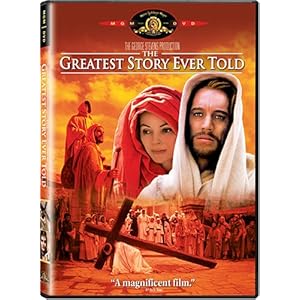
The original all-star cast Jesus epic, based on a book by Fulton Ousler.
Pros: Old Hollywood epic scale, plus cameos by nearly every actor working at the time. Sidney Poitier as Simon the Cyrene? Why not. George Stevens arranged each scene like a painting, making dramatic use of light and color.
Cons: The desert landscape is pretty obviously Arizona. There’s a surprising amount of artistic liberty in the plot, like the random Temple massacre that leaves you saying “Huh?” The carefully arranged set pieces can feel like the set of a school play.
Notable performances: Charlton Heston is a no-brainer to play firey John the Baptist. There’s also John Wayne’s infamous “Truly this man was the son of Gawd.”
Favorite scenes: Jesus heals the man born blind, who remembers knowing Him as a child. In the temptation scene Satan is a wiley old guy hanging out in a cave. Mary Magdalene travels with the disciples after her conversion.
Jesus rating: 3 out of 5. Max von Sydow is nice enough, but seems too calm and unrumpled.

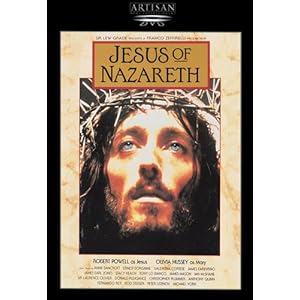
Franco Zefferelli’s longer, more star-studded version of the Jesus epic. This is the Easter time cable tv special I grew up with. (Seriously, I can recite entire scenes of dialogue.)
Pros: The miniseries format allows Zefferelli to expand the Nativity story and really flesh out characters, especially the Apostles and the Sanhedrin. Miracles and preaching get extended sequences too.
Cons: It is reallllly long. The plot loses steam in the final hour, relying on fictional scribe Zerah (Ian Holm) to explain Jesus’ arrest. The final resurrection is anti-climactic.
Notable performances: It’s really hard to pick from such a killer cast, but Peter Ustinov and Christopher Plummer are very entertaining Herods. James Farentino and Michael York and the reasons I love St. Peter and St. John the Baptist.  You also won’t forget Anne Bancroft’s Mary Magdalene, who chews up the scenery on Easter morning.
Favorite scenes: Jesus tells the story of the Prodigal Son at a party thrown by tax-collector Matthew; it inspires Matthew to abandon his decadence and reconcile with Peter. The last episode has extended scenes in the Temple, where Jesus argues with Pharisees, preaches to children, and even meets Barabbas.
Jesus rating: 3 out of 5. Amidst such a stellar crowd, it’s hard for Robert Powell to stand out. His Jesus has Shakespearean gravitas, but also detached otherworldliness. As my middle-school math teacher quipped “Half the time he looks like he’s stoned.”

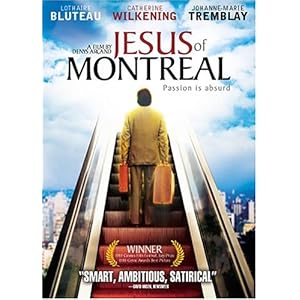
When a motley troup of Montreal actors puts on an unconventional Passion play, church authorities are skeptical but the cast find their lives transformed. Actors begin to emulate the characters they portray.
Pros: I learned about this film when a professor showed it for extra credit, and was amazed at what it said about compassion and how God can work through sinful humanity. It addresses modern life with critical eyes. Also, it’s fun to try to catch all the Biblical allusions in the plot.
Cons: Just a general disclaimer that adult maturity is needed. There’s some iffy 1980’s theology and biblical criticism in the play’s script. Also, the film is honest about the characters scandalous pasts, but that raunchy film dubbing scene was pretty gratuitous. In true European cinema fashion, there are some very brief flashes of non-erotic nudity. Basically, you might not show this to your Sunday school class, but your young adult Bible study could get a lot out of it. FYI there are subtitles.
Notable performances: Gilles Pelletier as Fr. Leclerc, the jaded priest who needs ministering to himself.
Favorite scenes: “Money changers in the Temple” – when one of the actresses is mistreated while auditioning for a skeezy beer commercial, Daniel/Jesus takes matters into his own hands. It’s a powerful testament to human dignity. The final scenes in a train station are also incredibly moving.
Jesus rating: 4 out of 5. Daniel’s performance really makes you think about Christ’s suffering and selfless love.


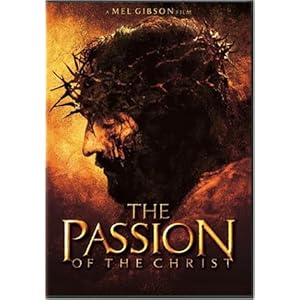
Mel Gibson’s controversial film depicts only the final day of Jesus’ life, laced with some important flashbacks.
Pros: The intense scenes are ripe for theological discussions about the ugliness of sin and the sacrificial nature of the Eucharist. The film’s steady, even pace invites a meditative mindset. The dialogue is only in Aramaic and Latin, forcing viewers to concentrate more closely. (Plus it lets you practice your high school Latin, or maybe that’s just me.)The soundtrack is exquisite.
Cons: There was hope that this would be a great evangelical tool, but without any contextual understanding non-believers are just turned off by the gore. Even for devout Christians it can be excessive, and some of the most horrific parts come from private revelations, not scripture. I think I can have a meaningful Good Friday without Gibson’s signature spurting blood for shock value.
Notable performances: Maia Morganstern is hands down the best virgin Mary I have ever seen on film. Her heartfelt yet understated performance actually made me want to pray the rosary.
Favorite scenes: There are many great vignettes: Mary watching Jesus fall, flashbacks of their life in Nazareth, the final Pieta shot. A defeated Satan and a triumphant resurrection give the story the dramatic conclusion it deserves.
Jesus rating: 5 out of 5. It’s clear that Jim Caviziel put his heart and soul into this role. In the flashbacks especially, his Jesus is joyful, loving, and sincere.

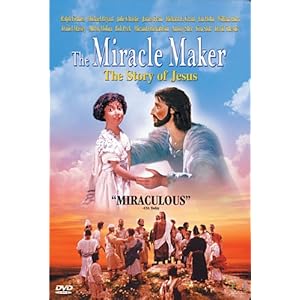
6. The Miracle Maker (2000)

An animated take on the all-star epic, told through the eyes of Jairus' daughter Tamar. This is what I'm sending my godson and his sisters for Easter this year. 
Pros: This animated film is approachable for kids, but still interesting for adults. Tamar's central role gives the narrative a family focus, and shows how Jesus inspired his followers. Claymation gives the film a great physicality, while flashback and parables in regular animation allow for some creative storytelling.
Cons: Stop motion animation isn't for everyone (even though it should be.) Mary Magdalene being freed from 7 demons might be too scary for very young children.
Notable performances:  Really great all around. The all-star British cast was actually in the same room when they recorded dialogue, so there is a real conversational tone. I liked how John the Baptist had a Scottish accent, showing his nonconformity.
Favorite scenes: When Tamar falls very ill, Jairus has to decide if going to Jesus is worth the wrath of his synagogue colleagues. I won't spoil the road to Emmaus scene, but it's wonderful. 
Jesus rating: 5 out of 5. He's confident, compassionate, and friendly.  We even get to see Him doing carpentry work and weeping at the death of John the Baptist.  Tamar has a real relationship with Him; she's not just a prop in the "suffer the little children" scene. Ironic fun fact: Ralph Finnes previously did biblical voice acting as pharaoh in The Prince of Egypt.

7. The ultimate Jesus film has yet to be made, and probably never will. Movies will never completely replicate the real thing. What really matters is how each of us individually relates to the Gospel story. The Church has a long tradition of live theater to help us mentally place ourselves within the Passion drama. This Holy Week, go to Stations of the Cross or the Liturgy of the Lord's Passion, and connect with the real Jesus, who lives beyond the movie screen.

(Update: This afternoon The Pulp.It featured this post in their daily digest of Catholic blogs. If you've come here from them, thanks for visiting!)
(Another update: holy schlamoley, New Advent featured this too! This has pretty much made my week. If I've left out a favorite film of yours, please leave a comment about it. I'd love to review a new set of films next Lent.)

All images are from Amazon.com