Showing posts with label review. Show all posts

Thursday, April 24, 2014

Noah Review - A Bible Epic for the 21st Century

 When I went to see Noah, the discount Tuesday night showing was pretty well attended. As the final credits started to roll, one person burst into applause. Then a woman two rows back yelled out, "Biggest lie I ever heard! Didn't even read the Bible!"

That pretty much sums up the two kinds of reactions people have had to this year's Old Testament epic "from the director of Black Swan," Darren Aronofsky. (If he has a thing for morality tales involving birds I hope he does The Ryme of the Ancient Mariner next.) The Catholic blogosphere has had the entire gamut of opinions. Since Noah is not strictly a verse-by-verse recitation of Genesis nor made purely for evangelistic purposes, some people are disappointed.

Noah's very modern feel is a red herring distracting audiences from its true spiritual merit. Yes, the wardrobe is heavy on ankle boots and skinny jeans, evoking Urban Outfitters more than the Stone Age. Russell Crowe's Noah is a vegan who stages funerals for dead animals and has visions of the ark thanks to hallucinogenic tea. Production values are slick; there are plenty of splashy CGI explosions and mythical creatures. At times I was reminded of The Hunger Games, Lord of the Rings, and Terrence Malick's sweeping landscapes. Unlike Son of God, Noah uses contemporary cinematography in a convincing way. Some of the images are truly stunning and worth seeing on the big screen. If Aronfsky's film feels like a blockbuster and not an indie flick, does that mean it's just a callous commercial grab?

Really, all Biblical movies are artistic reflections of their own time. Looking back to the golden age of mid-20th century Bible films, those weren't literal recitations either. Screenwriters added love triangles, pagan glam convents, and imagined conversations. As I mentioned earlier this week, Cecil B. DeMille's The 10 Commandments, arguably the greatest Bible epic ever made, certainly feels like the 1950s. Moses' vamping ex-girlfriend is a major plot device - where was she in the Bible? Anne Baxter's mad side eye may be not that different from angel/rock monster Ent knock-offs.

Even though Aronfsky pads out the slim Genesis account of Noah with his sometimes ridiculous imagination, he has still made a deeply religious movie that grapples with the big questions of human existence and its relationship to God. This isn't a 1990s self esteem pep talk about how everybody is special - it's a meditation on how we are all damaged by Original Sin. Aronfsky said as much in a recent interview: "Hearing the story of Noah [as a child], I thought about, "What if I was not one of the good ones to get on the boat? And I recognized that there’s wickedness in all of us." The God of Noah is very real and what He has to tell people matters.

Aronofsky positions Noah in a pre-history no man's land between Eden and God's chosen people of Israel. People have no image or name for God - they only know him as the very real Creator who also punishes. His will is often inscrutable, and there is no formal religion. The Fall of Adam and Eve looms large as Seth's descendants cling to a few relics and oral traditions from their ancestors' paradise. Now they are just trying to survive in a chaotic society where people's greed and appetites run out of control. The brutal, anarchic pre-flood world of Noah puts the rest of salvation history in perspective. Here, a covenant with God would be a welcome relief. If God gave, say, a list of ten ground rules for human behavior, that would be even better. God actually becoming a man to be punished for our sins? An unthinkable miracle.

The only time Noah flounders is when Aronofsky changes actual details of the Biblical account. In Genesis, all three sons Shem, Ham, and Japeth are married. The Noah movie makes procreation of the human race much more precarious, with Emma Watson's presumably barren character as the only young woman aboard the ark. Since the initial conflict of surviving the murderous hordes and the flood is over, this fertility drama takes over the third act of the film. Noah loses his marbles and becomes a scrupulous misanthrope while everyone else cowers in fear. [SPOILERS] Eventually he relents, and later gets wasted because he thinks he has failed God. Meanwhile Ham flounces off to be a celibate nomad and tween Japeth presumably joins Team Jacob and imprints on his newborn niece.

But I'm willing to forgive Russell Crowe's tedious extermination rage because it resolves in an incredibly pro-life story arc, discussing what being "made in God's image" really means. Noah and his family have just escaped a world where human life has little value. People were traded for food and dead bodies left to rot in open pits. Villain Tubal-Cain argued with God, shouting "I create life and destroy it, just like you!" Blinded by his outrage at this wickedness, Noah ignores his family's pleading and signs of God's clemency. Discernment fail. He stubbornly plows ahead doing his own will, until compassion reminds him to protect the lives in his care. In the end, family and the chance for new life win out.

Aronfsky took this angle to reinforce the Divine Mercy lesson of the Great Flood. "So what we decided to do was to align Noah with that character arc and give Noah that understanding: He understands what man has done, he wants justice, and, over the course of the film, learns mercy. What’s nice about that is that is how I think Thomas Aquinas defined righteousness: a balance of justice and mercy."

If a director quotes Thomas Aquinas as a source, that's probably a good indication that yes, he did read the Bible as well and spent a good bit of time pondering its lessons. Noah doesn't have the formal reverence of a Sunday School pageant, but it still tells a powerful story of the world longing for God's salvation. Its excellent performances take the Old Testament beyond cute animal pairs towards the old catechism question "Why did God make me?" Its themes stuck with me long after I left the theater, and have helped me appreciate the mercy God has shown His people in a new way.


Tuesday, April 22, 2014

The Ten Commandments Drinking Game

Source
If you're looking for some festive entertainment this Passover/Easter season, there's one Bible movie that stands as the benchmark of all others. Cecil B. DeMille's The Ten Commandments is 58 years old, but is still just as engaging and impressive as when it first toured as a road show feature. Clocking in at over three hours, it still never drags. Every shot, every set, every throwaway line by an extra is carefully arranged.

The Ten Commandments is the boss because it has gravitas to spare. Characters move like reverent statues and yet are believable and interesting. DeMille already had Bible cred because his 1927 silent film King of Kings basically invented the Jesus movie. Even so, he added an author's forward before the credits to assure audiences he was super serious about the Exodus story. It's the only movie I know of where the director parts curtains to explain both his thesis statement and his bibliography. DeMille's stated goal is "Not to create a story, but to tell a story". To prove his scholarly cred he references ancient historians Philo and Josephus, and the credits list consultations with the Metropolitan Museum of Art, the University of Chicago's Oriental Institute, and Egyptian antiques officials. The decadent set design and attention to material culture detail show that DeMille did do his homework. Moses' final wig and beard  even imitate Michelangelo's famous Moses statue.

But is The Ten Commandments really a factual account plucked from the sands of time? Not quite. Like all historical narratives, it reflects the concerns of its own era. In DeMille's case, his final movie tells us a bit about all-American post-WWII enthusiasm.His title is non-sectarian, emphasizing the moral rules that are the basis of generic Judeo-Christian values. By the 1950s Jewish Americans were no longer viewed as a suspicious foreign Other. Instead, they had been grafted into the American ideal of patriotic, God-fearing folks who defend freedom against enemies like Communism. The Cold War echoes in DeMille's prologue: "This is the story of the birth of freedom: are men the property of the state or are they to be ruled by God's law?"  Moses' final line quotes the Leviticus verse that's on the Liberty Bell: "Proclaim Liberty throughout all the land, and to all the inhabitants thereof!" Just as 1850s abolitionists invoked Moses in their work against slavery, this 1950s movie hints that Moses would  favor democracy over totalitarian governments. 

Politics aside, The Ten Commandments is a classic because it's a spectacle, full of mid-century artistic style. Cited alongside museum collections are several contemporary novels about the Bible: Dorothy Clarke Wilson's Prince of Egypt (1949), Rev. J. H. Ingraham's Pillar of Fire (1859), and On Eagle's Wings by A. E. Southan (1937). Romanticized novelizations of Bible stories were an enduring part of American pop culture from the nineteenth century, and DeMille continues that tradition with his dramatic posing, jealous triangles and star-crossed lovers. The Luxor-inspired costumes were designed by Edith Head, the queen of Old Hollywood hourglass silhouettes who outfitted practically every movie star.

I'm not complaining; the Hollywood glamour makes it a blast to watch. Thanks to the rival male leads, there is  more fierceness than the screen can handle. If you get tired of looking at awesome stuff, the dialogue is consistently epic. My current favorite is the constrat between Moses' and Ramses' management styles. Charlton Heston is inherently a mensch, negotiating enemies into friendship and worrying about slave morale. "Blood makes poor mortar." Meanwhile Yul Brynner leans in so hard he might as well be ski jumping: "Envy is for the weak." He makes it clear what he wants from his subordinates."You have a rat's ears and a ferret's nose. Add to these the eyes of a weasel." Ancient Egypt is a man's world, and these guys are basically two business suits glaring at one another across a board room.

The Ten Commandments was one of the Easter staples of my childhood, and my siblings and I realized early on that the gravitas is more fun when you're the interactive peanut gallery. We often spent those three hours counting how many times Charlton Heston denounced the slaves' "bondage." Here's an expanded version of our drinking game, for your adult beverage or grape juice and matzoa enjoyment:

Take a sip for: 
  • The words "bondage," "stiff-necked," or "Goshen."
  • Restatement that Nefreteri must marry the future Pharoah
  • Either Prince of Egypt wearing a skirt/sandal combo that you could imagine buying from J. Crew
  • Restatement of how smoking hot Liliah is
  • The phrase "held me in his arms" to refer to some form of hooking up
  • Dathan talking smack about Moses
  • References to Ishmael or Priam of Troy
  • "Ai-yah baskets!"
  • "Are you a master builder, or a master butcher?"
  • "So let it be written, so let it be done!"

Take a long drink when:
  • Seti implies he prefers Moses to his own son
  • Memnet is a total mood-killer
  • Moses' hair changes
  • The scene opens on a gaggle of women chattering about men
  • Sephora is an smart and confident feminist. "I will not be displayed like a caravan's wares, for Moses, or any other man."
  • Nefreteri tries to seduce Moses with a long speech about garlic and pomegranates
  • DeMille intones another pseudo-Biblical dramatic narration
  • Nefreteri becomes a heinous nag. "Do you hear laughter, Ramses?"
  • Fire or snake special effects clearly start out as drawn animation. 

Anxiously chug when:
  • Yochabel almost gets crushed by that stone.
  • Rameses and Nefreteri have their dramatic hate-kiss.
  • Moses gets exiled and has a long thirsty walk through the desert.
  • Risk-loving Joshua decides to hang around outside watching the Angel of Death arrive. 
  • The chariots look they're going to trample everyone at the Red Sea.
  • The adorable kids and old people who left Egypt disappear, and the entire Israelite population becomes lusty twenty-somethings ready to worship the golden calf. Plus Aaron. 
  • Sephora's last conversation with Moses is about how much she loves him, and he says NOTHING. Gets me every time. 
If you're still not convinced, here's a trailer.


Friday, April 4, 2014

Son of God review - Jesus Movies 2014 Edition

Read my prior roundup of Jesus movies here. 

This year's new life of Christ film is derived from Roma Downey and Mark Burnett's television miniseries The Bible. I hadn't seen the series, so I was curious to check out the feature-length version. There hasn't been a full-fledged Gospel theatrical release since The Passion of the Christ a decade ago. Does Son of God further advance the genre?

Pros: The story is narrated by aging St. John in exile on Patmos. His gospel's "In the beginning was the Word..." intro leads us through an Old Testament montage before diving straight into Jesus' public ministry. This is a great contextual and theological set-up.

Cons: Sadly, the initial Incarnation focus gets lost as the narrative tries to be as generic and uncontroversial as possible. Other reviews have aptly compared it to a greatest hits montage played by a cover band. It's really an amalgamation of History Channel footage, and it shows.

Notable performances: As usual, the villains are often the most interesting. Judas is a straightforward creep who becomes Caiaphas' flunky. The high priest is in turn pushed around by Pilate, whose retribution he fears. Pilate is a stone-cold meany spilling Israelite blood in between massages and reclining dinners, but deep down he's worried about his own career too. In the Sanhedrin's negotiations with Pilate about Jesus' execution, he seems to view them with the exasperation one reserves for that particularly annoying co-worker. "Why are you bothering me about this guy when he's your problem? Oh, and now you're gonna nitpick how I wrote that sign?"

There's a token pharisee who initially gets annoyed when people ditch him for Jesus, and then somehow manages to be in the peanut gallery of every scene. His escalating outrage and jealousy are pretty fun. After each miracle I expected him to blurt out a Gob Bluth "Oh, COME ON!" Speaking of obnoxious people, Thomas is among the most vocal of the Apostles, whining with doubt about everything. At one point Peter just has to tell him to shut his trap and act in faith already.

Favorite scenes: Most of the scenes are pretty paint-by-numbers, but sometimes there are creative insights. For example, the woman caught in adultery has a small child who's upset by her mother's possible stoning. This perfectly emphasizes the human dignity Jesus is defending, and shows how the woman's  sinful life was still important to others. There are some interesting Eucharistic references, like Judas gagging on unleavened bread as he flees the Last Supper or Peter rushing to say Mass as soon as he realizes Jesus is alive and they better remember him like he asked.  Possibly my favorite parts were the innovative scenes during Christ's agony in Gethsemane. The camera cuts from his anguished prayers to the Sanhedrin reciting Psalms to Pilate and his wife burning incense to their ancestors, all praying with different motivations.

What The Frankincense: Complaining that the holes in Jesus' hands didn't look "real" enough sounds really pedantic, so I'll just mention this - Cee Lo Green does the closing credits song. Which is the theologically suspect "Mary Did You Know." Umm ok? I'll take Cee Lo's tunes however I can get them.

Jesus rating: 1 out of 5. This Jesus is not only bland, he's annoying. His perfect beachy waves of hair and knowing closed-mouth smile reminded me of another resurrected TV character - Alison, the leading Mean Girl and possibly dead frenemy on Pretty Little Liars.

I mean, look at this.  
Despite the smug grins, this Jesus is surprisingly ignorant. He gets telepathic flash-forward knowledge of future events at the last minute. For instance, only after embracing Peter at his promise of loyalty does Jesus get a precog vision of denial and roosters crowing.

Even worse, this Jesus spouts trite inspirational slogans. It's like the screenwriters had to abridge the already straightforward dialogue of the Gospels. In his first scene, Christ recruits Peter not with the clever "fisher of men" line, but by saying they will "change the world." It's the worst during the Passion scenes. Instead of prophecies and the epic Last Supper soliloquy of John's gospel, Jesus speaks in glib phrases that belong on a cat poster.  John bursts into tears at predictions of Jesus death; the Master tells him to "Trust in God." When Mary meets her Son carrying the cross, he says "All things are possible with God!"

Mary was probably thinking "What things exactly? How about you not dying, is that possible? Or is this a really bad hint at the resurrection?" The Passion of the Christ did it better. Jim Caviezel's Jesus tells Mary, "See mother, I make all things new," actually explaining the purpose of his suffering. Despite his title, Son of God  doesn't offer any real answers to life's big questions of suffering, sin, and redemption. 

Cinematic value: This brings me to my final point - this movie's greatest value was how it made me better appreciate its predecessors. Son of God's knock-off imitations show the endurance of Passion of the Christ's artistic legacy. Whether it inspired you or grossed you out, PoTC did offer some innovative visuals. Son of God's Passion sequence pulls out the same set pieces but doesn't execute them as well. There's the slow-mo dramatic music for the Sanhedrin so you know they are baaaaaad guuuuuuuuuys. There's Mary watching the scourging from afar and Jesus kissing the cross before he lifts it. There's the copious blood that makes gravel stick to Jesus' unrecognizable face. Unfortunately, instead of Jim Caviezel's poignant facial expressions we just get close-ups of the bloody drool streaming from Diogo Morgado's' lower lip.

Extreme close-ups and other distracting camera tricks are really the film's undoing. Only the most hipster bar in Williamsburg is this focused on beards. By the end  I was well-acquainted with every character's facial hair follicles as well as the state of their pores. The constant zooming may have been to compensate for lackluster sets, or to lend gravitas. When scenes finally do pan out, there are indiscriminate lens flares and amateurish GCI of Jerusalem. Again, there is another film predecessor that did this better: Jesus of Nazareth. Franco Zefferelli's Jesus flick was also a made-for-TV miniseries, but that didn't stop him from shooting sweeping landscapes, dramatically lit sets, and an impressive temple courtyard.

Bottom Line: While it would be fine to show in a classroom or as a TV Easter special, this is not a Jesus movie I would go out of my way to purchase and rewatch. There's been some critical discussion of whether it's disingenuous to charge audiences big screen prices to see a previously aired television program plus deleted scenes. Downey and Burnett have responded that it's an evangelization effort; they want to get the message of Jesus out to as many people as they can. Unfortunately, their Jesus is too much of a bland nice guy to inspire lifelong devotion. 

Tuesday, April 3, 2012

Girl-Power Bible Movies

This Lent I've had less time for my traditional Jesus film festival, but I have managed to catch a few Biblical epics. Somehow they've all been about Old Testament  heroines. I realized this is completely appropriate considering how prominently women feature in the Good Friday and Easter Gospel accounts.

Giorgio Vasari,
Judith and Holofernes, c.1554.
St. Louis Art Museum.
Those are the ripped shoulders of
a woman saving her people. 
Women are everywhere in the story of Holy Week. For some reason most are named Mary, and they're always present. They have a lot of feelings - there's a lot of crying - but they also get. stuff. done. When they make big displays of foot-anointing emotion, Christ is appreciative, not dismissive.Whether wiping Jesus' pained face, anointing His body, or learning about the Resurrection while the guys cower in fear, these women serve God in powerful ways. Salvation history would not be the same without them.

The ladies of the Old Testament are the same way. It's a shame there aren't more movies about them, because their stories are laden with peril, drama, romance, and even comedic timing. That's Hollywood gold, people! I get why there are no R-rated films where Judith and Jael slaughtering enemy generals, but there's a lot of untapped cinematic potential.

At a church gathering last weekend, I was astonished how many people were unfamiliar with the story of Esther, another brave woman who rescued her people from destruction. So here are recaps of four movies that do exist about Ruth and Esther. Their books of the Bible involve women in unconventional families navigating assimilation, inter-cultural marriages, legal loopholes, family loyalty, deep devotion, and life-and-death situations.

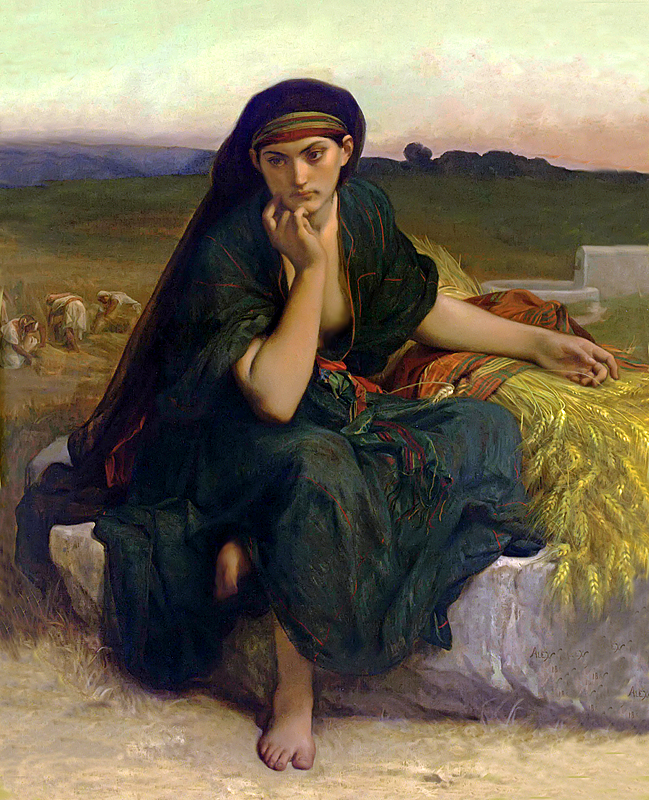
Alexandre Cabanel,
Ruth glanant dans les champs de Booz, (1886),
Musée Garinet, Chalon-En -Champagne.
Ruth dates back to the time of the Judges - she's King David's great-grandmother! She's also the first convert in the Bible. Born in Moab, she marries into an Israelite immigrant family. After famine kills all the men in the family, Ruth sticks by her mother-in-law Naomi, proclaiming "Your people will be my people, and your God will be my God." What are two widows to do? Head back to Bethlehem, where Ruth finds love with grain farmer Boaz. Another distant relative attempts to claim Naomi and Ruth's estate, but God's providence wins out in the end.


Creative License:
This film imitates the epic visual style of The Ten Commandments, and gets very creative with Ruth's backstory. Young Ruth is content living in the temple of Moab's Aztec-like child-sacrificing god, until she engages in some playful theological banter with Malon, a Jewish silversmith. He awakens her heart to God's law, but Moab's rulers are obviously not pleased by her new skepticism of their religion. After the authorities kill the men of Malon's family, Ruth and Naomi set out for Bethlehem. There, they find the kindness of Boaz but also a rival suitor and some neighbors who aren't crazy about the new pagan priestess next door.

Dramatic Themes: 
The Israelites in Moab have assimilated well, perhaps too well. Naomi's son Chilion boasts of how well he and his Moabite wife Orpah are accepted in society. Unfortunately, human sacrifice is accepted in that society. When Malon objects, his family literally says, "C'mon, you know the Moabites are sensitive about their human sacrifice."
The law and its demands are key. Malon gives Ruth a pendant of the 10 Commandments, but later the people of Bethlehem put her on trial for her pagan history. 

Huh? moments: 
Ruth spends her vestal virgin childhood in what is basically a glam convent. Seriously. She and the other girls wear matching outfits borrowed from Katy Perry. Women in long black veils oversee them and teach them to memorize prayers. Is this some anti-Catholic bias? Also, their god looks like a character from the Far Side.
Boaz is sadly less handsome than the ill-fated Malon. His tunics with thigh-high slits don't help matters.

The King of Moab inspects the glam convent. 
Overall rating: 
3.5 out of 5. 1950s silliness aside, the movie has a good pace and draws you in. If you overlook the creative additions, it's not a bad retelling of Ruth's story. I found it genuinely inspiring. 


Creative license:
Grandpa Obed narrates the story of Ruth and Naomi to a teenage David who just can't get his slingshot aim right. Naomi and her family continue to trust God, even though things look bleak and their Moabite neighbors say the gods are cursing them. (Orpah's mom is particularly obnoxious.) Both of Naomi's sons die onscreen, then Ruth and Orpah argue about whether to stay with their mother-in-law.

Dramatic Themes:
This is a matriarchal society, no doubt. Most lines are spoken by female characters, and their relationships are at the forefront. Naomi is the real protagonist of this adaptation, dispensing motherly life advice constantly. The action moves at a glacial pace, mostly because all the women take forever to finish talking about their feelings.
Huh? moments:
Costumes and sets are pretty amateur- a table is clearly a sheet of plywood, "grain" is a straw bale from a farmer's market, wooden spoons came in a 4-pack at Wal-Mart, women are all wearing mascara and mauve lipstick under their makeshift veils.
When Ruth goes off to woo Boaz at the harvest festival, Naomi gives her a "beautiful new dress" that looks like a hideous striped vest.
Pentecostal music artist Carman makes a "celebrity" cameo as Boaz. His 1980s "Sunday's On the Way" album is a cult favorite in my family, but here he looks like a skeezy lounge singer wearing Mardi Gras beads.
Overall rating:
1 out of 5. The sincerity and earnestness of this production cannot, unfortunately, hide its poor production values and bad acting. If I saw this production in a church hall, I'd be impressed; as a feature film it's unwatchable. I had to skip ahead in 20 minute increments so Naomi would get to the point. Maybe a Sunday school class could overlook the glaringly modern language and lip gloss, but they would still get bored. 

Edwin Long,
Esther, 1878,
Private Collection.
The book of Esther essentially tells two stories about Israel's Babylonian exile and diaspora. One involves political scheming and the other reads like a fairy tale.  ived a fairy tale-like story . The tale begins with some flat-out chauvinism: Queen Vasti refuses to appear before the King Ahasuerus' drunk friends, so his advisers have him divorce her. Jewish orphan Hadassah/Esther is among the young women chosen for the "find a new queen" beauty pageant. After a year-long makeover, she captures Ahasuerus' affections, but keeps her Jewish identity secret. 
Meanwhile, her cousin and foster father Mordecai has saved the king from an assassination attempt. Unfortunately, refusing to bow to ambitious courtier Haman has also won him a mortal enemy. For revenge, Haman orders extermination of all the Jews. Esther risks her life by going before Ahasuerus unbidden to expose Haman's plot and plea for mercy. She swoons, the king listens, Haman is defeated with some deliciously poetic justice, and the Jews are saved. The holiday Purim celebrates this every year.  

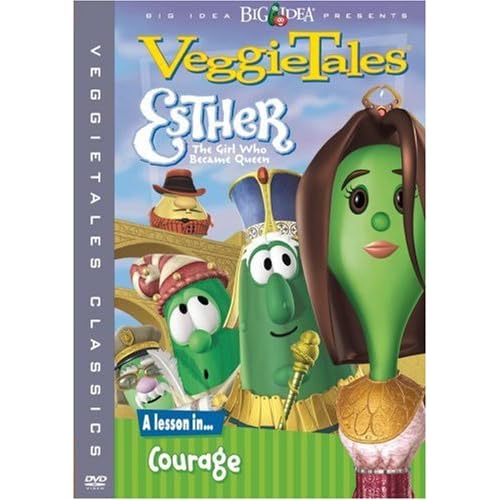
Esther: The Girl Who Became Queen (2000)

Creative license:
Yes, this is a Veggie Tales video. There are singing vegetables. Haman wears a pinstripe suit, Vashti gets thrown out for refusing to make the king a sandwich at 3 a.m, and traitors are banished to the Island of Perpetual Tickling. It's delightful.

Dramatic Themes:
The goodfella narrator starts off by talking about destiny and greatness. Young Esther is confused about her sudden destiny as queen, and begs God to show her what the point of all this is.
Since this is for young kids, the script downplays the romance. Esther is chosen because she sings well in the talent portion of the queen pageant. Her only affectionate moment with the doofus king is when he calls her "Queenie-poo."
Did I mention the gangster accents? Haman's beef with Mordecai is presented as a fight between two "families." The infamous Pea-oni brothers try to kill the King by dropping a piano on him.
Huh? moments:
Again, this is a Veggie Tales video. A scene of Haman and the King playing Trivial Pursuit while eating Chinese take-out at Esther's feast is just one of the apocryphal moments. If this bothers you, there is a chance you might take life too seriously.
Overall rating: 
4 out of 5. The colorful insanity is fun and good-natured, while the plot genuinely sticks to the main events of the Biblical account. The Book of Esther will sound very familiar to kids once they can read it for themselves.

One Night With the King (2006) 

Creative license:
This is a pretty faithful retelling of the Book of Esther that ramps up the political intrigue aspect. Minor characters get much more screen time, like the head eunuch who favors Esther. Many scenes were filmed in India, so there are lots of colorful textiles.
Despite its sensual-sounding title, this film tells a very G-rated love story fraught with the mis-communication common in romantic comedies. Esther longs to visit Jerusalem, but her priorities quickly change when she meets Fabio-like King Xerxes. Then he sees her sneaking off to meet Mordecai and assumes she's cheating, while she worries that he will cast her off like Vashti. (They should have addressed that in Pre-Cana.) Is their love doomed?

Dramatic Themes:
Again, Esther's story evokes musings on destiny and greatness. Our heroine is really named Hadassah, but Morcedai gives her a Persian name to disguise her Jewishness in the palace. Later she observes that Shadrach, Meshach, and Abednego, and even Jacob, were given new names.
The Persian Jews struggle with how much to adopt their country's ways. A visitor from Jerusalem even asks if Mordecai has sold out.
The script links Esther's secret Judaism to her necklace etched with anachronistic stars of David. It's a hokey plot device that distracts from the original drama of Haman's comeuppance.
Huh? moments:
In the biblical account Esther and Mordecai have a friend among the palace eunuchs who delivers messages for them. The script writers achieve this by having Esther's sort-of boyfriend get rounded up and castrated in a palace hiring surge. It's awkward when he begs her to escape with him and she shoos him away. (It's also incredibly awkward to explain eunuchs to your 12-year-old brother during a movie.)
Much is made of Persia's Greek enemies and their dangerous "democracy." Haman warns an angry mob that both Jews and Greeks claim "All men are created equal." I could go on all day about this historic oversimplification, but I'll spare you.
There are several notable cameos, including Omar Sharif and two LOTR alumni. Peter O'Toole gets top billing but only appears for about 30 seconds as the prophet Samuel. He spars with King Saul and then hacks the defeated King Agag apart offscreen. (It's in the Bible. Really.)
There are also some crazy hats. 
Overall rating: 3.5 out of 5. Its has a lower-budget indie feel, a cartoonishly evil villain, and too much narrative padding, but this film is still pretty to look at and heartwarming to watch. All the main elements of the Esther story are there. A confirmation class would not get bored watching.

So this Holy Week, as we sing the Stabat Mater and remember the women who mourned Christ, think of the long line of brave women who prefigured them. We daughters of Eve and of Mary have a rich heritage of love, devotion, and courage. That really ought to be on movie screens more often. 

Tuesday, December 20, 2011

Unicorns in Our Midst: 21st Century Virgins

"Being a Virgin in this day and age is something to be proud of; you're like a unicorn."  - Shirley to Annie in Season 1 of Community

This week the Bright Maidens blogging group is reviewing TLC's new series "The Virgin Diaries." I have only two positive things to say about the show.

First, the historian in me is pleased TLC has documented so many subculture groups, religious and not, for posterity. In a century or so, someone will give a conference paper about how agnostic post-modernity liked to gawk at Mormon polygamists, Muslims in Michigan, homeschooling Arkansas residents with 20 kids, and those rare 5-10% of American adults who have never had sex. Did these Millenial viewers lump such fringe groups in with little people, toddler beauty queens, and wedding dress consultants?

Second, watching the trailers for this show made me very grateful for Theology of the Body. Normally I resist the Catholic cliches chastity explanations that are basically OMGJP2TOB!!1!11! But when I got nauseous seeing that newlywed couple awkwardly chewing each other's faces off, I couldn't help but think they needed to read some Love and Responsibility.

Our lips, our hands, our bodies, and our sexuality are part of our God-given human dignity. They are not dangerous, uncontrollable temptations to keep at a ten-foot distance so we can brag about how careful our courtships are. Marriage is more than just a license for intercourse, just as chastity is more than keeping one's legs crossed until vows permit unbridled release of all that pent-up tension.

So yeah, I was a little annoyed at TLC's editing that found drama in every facial expression and double entendres in playground equipment. But mostly I was angry at the yahoos who decided to broadcast their most personal lives on television, making a mockery of something that is precious, and sadly, rare.

I'm 26, and I am part of that virgin 5-10%. You might not realize when we unicorns (or mermaids) walk among you, because most us don't act like maladjusted circus freaks. Neither do we walk around wagging disapproving fingers at our peers who haven't made the same life choice. We have social lives, creative interests, and affectionate dating relationships. The only thing that makes us different is our commitment to a difficult spiritual and physical goal that challenges who we are at our very core.

Chastity is something I have to choose every day. I don't choose it because I am afraid of sex, or of getting pregnant or an STD. I don't choose it just because it's honorable, or how my parents raised me, or because I've been told it's a sin. I don't choose it just so my wedding night (a few brief hours of my life) will be special. As Bing Crosby says in White Christmas, "That's not good, but it's a reason."

Ultimately, I have to make this choice for myself, because I believe it will make me a happier, holier person in the long run. It has a to be a lived acknowledgement of the divine transformation I believe happens in the Sacrament of Marriage. It has to be an integral part of my relationship with God, who loves me first and most.


As  agnostic-turned-Jew-turned Episcopalian-turned-chastity enthusiast Lauren Winner described it,

"Remember that God desires your person, your body, more than any man or woman ever will."


Friday, April 15, 2011

Seven Quick Jesus Movie Takes

For this week's linkup to 7 Quick Takes at Conversion Diary, I thought I'd mix it up and do some short movie reviews. Religious films are a mainstay of my family's Lenten season, and it feels like I've seen dozens of cinemative Jesuses over the years.
Putting the Gospels on screen is a daunting task, since the 4 Evangelists didn't give us much narrative detail. Also, there's a lot to live up to. How can an actor portray the Son of God, who is all things to all men? Does the man on screen match our own imaginings of Christ? Yet filmmakers and audiences return again and again to the well known story. It's probably because we wish we had been there, and film is the closest we'll ever get to time travel.

So here are some of my favorite imaginings of the past, in semi-chronological order.

1.The Robe (1953) 

Marcellus Gallio is a bored, dissolute centurion until he crucifies Jesus and the memories haunt him. He decides to track down his runaway Greek slave Demetrius, who became a Christian and possesses Christ’s robe. This is an action-packed yet spiritual costume piece. Brother #3’s teacher showed it in class and all the 5th graders were hooked. Fun fact: the first film released in Cinemascope.
Pros: The people Richard Burton’s Marcellus meets on his quest for Demetrius are an excellent representation of Christian community. In the second act, the film deals with martyrdom as Burton returns to Rome to hang out in the catacombs and challenge Emperor Caligula. Redemption, miracles, courage. Also Richard Burton being Richard Burton.
Cons: Richard Burton being Richard Burton – it can get distracting. His swooning girlfriend is annoying too.
Notable performances: Victor Mature gives Demetrius an air of quiet dignity, while Caligula gives Richard Burton a run for his money in the dramatics department.
Favorite Scenes: Marcellus meets St. Peter, who shares about betraying Jesus and then basically hears his confession. I also really like the crippled girl who teaches Marcellus about the redemptive value of suffering.
Jesus rating: 4 out of 5 He’s never really visible, but still very present. You can see why the other characters find him so compelling.

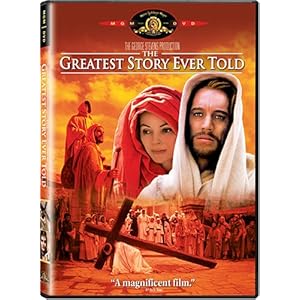
The original all-star cast Jesus epic, based on a book by Fulton Ousler.
Pros: Old Hollywood epic scale, plus cameos by nearly every actor working at the time. Sidney Poitier as Simon the Cyrene? Why not. George Stevens arranged each scene like a painting, making dramatic use of light and color.
Cons: The desert landscape is pretty obviously Arizona. There’s a surprising amount of artistic liberty in the plot, like the random Temple massacre that leaves you saying “Huh?” The carefully arranged set pieces can feel like the set of a school play.
Notable performances: Charlton Heston is a no-brainer to play firey John the Baptist. There’s also John Wayne’s infamous “Truly this man was the son of Gawd.”
Favorite scenes: Jesus heals the man born blind, who remembers knowing Him as a child. In the temptation scene Satan is a wiley old guy hanging out in a cave. Mary Magdalene travels with the disciples after her conversion.
Jesus rating: 3 out of 5. Max von Sydow is nice enough, but seems too calm and unrumpled.

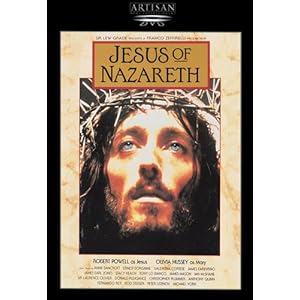
Franco Zefferelli’s longer, more star-studded version of the Jesus epic. This is the Easter time cable tv special I grew up with. (Seriously, I can recite entire scenes of dialogue.)
Pros: The miniseries format allows Zefferelli to expand the Nativity story and really flesh out characters, especially the Apostles and the Sanhedrin. Miracles and preaching get extended sequences too.
Cons: It is reallllly long. The plot loses steam in the final hour, relying on fictional scribe Zerah (Ian Holm) to explain Jesus’ arrest. The final resurrection is anti-climactic.
Notable performances: It’s really hard to pick from such a killer cast, but Peter Ustinov and Christopher Plummer are very entertaining Herods. James Farentino and Michael York and the reasons I love St. Peter and St. John the Baptist.  You also won’t forget Anne Bancroft’s Mary Magdalene, who chews up the scenery on Easter morning.
Favorite scenes: Jesus tells the story of the Prodigal Son at a party thrown by tax-collector Matthew; it inspires Matthew to abandon his decadence and reconcile with Peter. The last episode has extended scenes in the Temple, where Jesus argues with Pharisees, preaches to children, and even meets Barabbas.
Jesus rating: 3 out of 5. Amidst such a stellar crowd, it’s hard for Robert Powell to stand out. His Jesus has Shakespearean gravitas, but also detached otherworldliness. As my middle-school math teacher quipped “Half the time he looks like he’s stoned.”

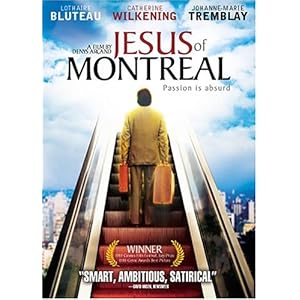
When a motley troup of Montreal actors puts on an unconventional Passion play, church authorities are skeptical but the cast find their lives transformed. Actors begin to emulate the characters they portray.
Pros: I learned about this film when a professor showed it for extra credit, and was amazed at what it said about compassion and how God can work through sinful humanity. It addresses modern life with critical eyes. Also, it’s fun to try to catch all the Biblical allusions in the plot.
Cons: Just a general disclaimer that adult maturity is needed. There’s some iffy 1980’s theology and biblical criticism in the play’s script. Also, the film is honest about the characters scandalous pasts, but that raunchy film dubbing scene was pretty gratuitous. In true European cinema fashion, there are some very brief flashes of non-erotic nudity. Basically, you might not show this to your Sunday school class, but your young adult Bible study could get a lot out of it. FYI there are subtitles.
Notable performances: Gilles Pelletier as Fr. Leclerc, the jaded priest who needs ministering to himself.
Favorite scenes: “Money changers in the Temple” – when one of the actresses is mistreated while auditioning for a skeezy beer commercial, Daniel/Jesus takes matters into his own hands. It’s a powerful testament to human dignity. The final scenes in a train station are also incredibly moving.
Jesus rating: 4 out of 5. Daniel’s performance really makes you think about Christ’s suffering and selfless love.


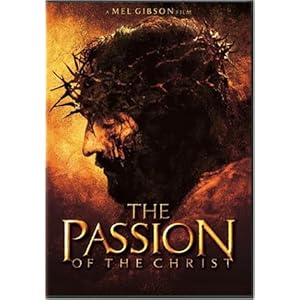
Mel Gibson’s controversial film depicts only the final day of Jesus’ life, laced with some important flashbacks.
Pros: The intense scenes are ripe for theological discussions about the ugliness of sin and the sacrificial nature of the Eucharist. The film’s steady, even pace invites a meditative mindset. The dialogue is only in Aramaic and Latin, forcing viewers to concentrate more closely. (Plus it lets you practice your high school Latin, or maybe that’s just me.)The soundtrack is exquisite.
Cons: There was hope that this would be a great evangelical tool, but without any contextual understanding non-believers are just turned off by the gore. Even for devout Christians it can be excessive, and some of the most horrific parts come from private revelations, not scripture. I think I can have a meaningful Good Friday without Gibson’s signature spurting blood for shock value.
Notable performances: Maia Morganstern is hands down the best virgin Mary I have ever seen on film. Her heartfelt yet understated performance actually made me want to pray the rosary.
Favorite scenes: There are many great vignettes: Mary watching Jesus fall, flashbacks of their life in Nazareth, the final Pieta shot. A defeated Satan and a triumphant resurrection give the story the dramatic conclusion it deserves.
Jesus rating: 5 out of 5. It’s clear that Jim Caviziel put his heart and soul into this role. In the flashbacks especially, his Jesus is joyful, loving, and sincere.

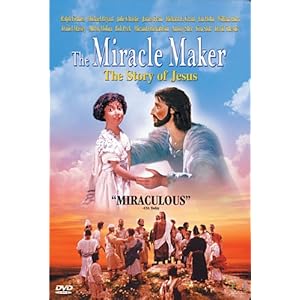
6. The Miracle Maker (2000)

An animated take on the all-star epic, told through the eyes of Jairus' daughter Tamar. This is what I'm sending my godson and his sisters for Easter this year. 
Pros: This animated film is approachable for kids, but still interesting for adults. Tamar's central role gives the narrative a family focus, and shows how Jesus inspired his followers. Claymation gives the film a great physicality, while flashback and parables in regular animation allow for some creative storytelling.
Cons: Stop motion animation isn't for everyone (even though it should be.) Mary Magdalene being freed from 7 demons might be too scary for very young children.
Notable performances:  Really great all around. The all-star British cast was actually in the same room when they recorded dialogue, so there is a real conversational tone. I liked how John the Baptist had a Scottish accent, showing his nonconformity.
Favorite scenes: When Tamar falls very ill, Jairus has to decide if going to Jesus is worth the wrath of his synagogue colleagues. I won't spoil the road to Emmaus scene, but it's wonderful. 
Jesus rating: 5 out of 5. He's confident, compassionate, and friendly.  We even get to see Him doing carpentry work and weeping at the death of John the Baptist.  Tamar has a real relationship with Him; she's not just a prop in the "suffer the little children" scene. Ironic fun fact: Ralph Finnes previously did biblical voice acting as pharaoh in The Prince of Egypt.

7. The ultimate Jesus film has yet to be made, and probably never will. Movies will never completely replicate the real thing. What really matters is how each of us individually relates to the Gospel story. The Church has a long tradition of live theater to help us mentally place ourselves within the Passion drama. This Holy Week, go to Stations of the Cross or the Liturgy of the Lord's Passion, and connect with the real Jesus, who lives beyond the movie screen.

(Update: This afternoon The Pulp.It featured this post in their daily digest of Catholic blogs. If you've come here from them, thanks for visiting!)
(Another update: holy schlamoley, New Advent featured this too! This has pretty much made my week. If I've left out a favorite film of yours, please leave a comment about it. I'd love to review a new set of films next Lent.)

All images are from Amazon.com

Sunday, January 30, 2011

Live-blogging Breakfast at Tiffany's

I said I think I remember the film
And I recall I think we both kind of liked it
And I said hey, that's one thing we got.

I've never seen this movie, even though I loved that song about it back in middle school. So tonight I snuggled up with pajama pants  and Netflix to experience a permanent fixture of American pop culture. There was no one around to hear my snide comments, so you get to read them. 

10:00 Wait. Truman Capote wrote the novel? Interesting.
Where is Tiffany's anyway? I better visit next time I'm in New York.
10: 04 That column dress, updo, and jewelry are so iconic, but it's a very non-curvy silhouette. Why is this the first thing that comes to mind for elegant femininity?
10:07 Audrey looks good in anything, even a baggy tuxedo shirt. The way her hair is piled up on her head reminds me of my VSC roommate K. 
10:11 Her couch is a claw-foot bathtub cut in half with purple cushion and pink pillows.I want to try that in my next apartment.
10:23 Perfume in the mail slot. Genius. She must never get utility bills.
10:26 Sugar-mama decorator is an aspiring Dorothy Draper, what with all that damask and rococo statuary.
10:30 So our protagonists are two lost souls, trying to make their way in the urban jungle of New York.
10:32 A lesser actress would not be able to pull of this corny monologue about raising horses in Mexico with her brother Fred.
10:34 Ah, the mandatory baguette sticking out of every movie grocery bag.
10:35 Dorothy Draper wannabe (let's caller her DDW) has a crazy awesome apartment with a gloriously tacky painted Greek frieze.

10:39 This discussion of phoniness brought to you by JD Salinger?
10:43 Brazilian party guest wants to learn about Stuff White People Like
10:46 How did anyone think those fake teeth on Mickey Rooney were a good idea?
10:49 There's something Gatsby-esque about a cocktail party left by its host as the cops arrive.
10:53 The Moon River balcony scene reminds me of Kate and Leopold when they hear that song playing nearby.
11:00 This secret redneck husband business appeared sooner than I expected. What will happen with the rest of the film?
11:09 Drunk woman dressed in white, locked out of her apartment after running into an ex lover. This scene was imitated in The Wedding Planner.
11:12 Holly's tote bag has a painting of the Annunciation printed on it. I wonder if she bought it at the Met?


11:19 Kate and Leopold also mimicked this "do fun things in New York" montage.
11:22 Cracker Jack prizes give one "a sense of solidarity really, of continuity with the past." Too bad they don't give out whole rings any more.
11:23 "Is that really where they have the book itself? Live?" Libraries - not half as nice as Tiffany's.
11:26 Modern romantic comedies take note - this montage actually helps us learn about the characters. Awww, when they are happy they both have their keys.

11:32 "I can help her, and it's a nice feeling for a change." Just like Sebastian Flyte in Africa in the middle of Brideshead, I love it.
DDW has a great amethyst ring, but she's evil.That's right, Mrs. Robinson, he's leaving all the suits behind.
11:41 That shot of the feather-strewn room is brilliant. There are a surprising number of blackouts in this film.
11:44 "I'm fat as a pig." Shut up this minute young lady. Also, your Victorian rosewood furniture signaling your new domesticity is ridic.
11:47 Oh Audrey, the pigtails are too cute. Someday if I have 9 children I'll take them to New York too.
11:55 We've seen Holly getting dressed up/dressed down several times - there's definitely symbolism in that, the way she's putting on a glamorous front to the world.
11:59 "You call yourself a free spirit, a "wild thing," and you're terrified somebody's gonna stick you in a cage. Well baby, you're already in that cage. You built it yourself." Somebody should have told Carrie Bradshaw that right off and spared us 6 TV seasons and two horrible movies worth of drama.

Hooray, happy ending, I think I kinda liked it. I kept drawing parallels to a million other films - The Graduate, The Apartment, etc. Audrey Hepburn is indeed charming and beautiful in every scene, but the story is much heavier than just jewels and croissants.
Still, I have the sudden urge to go necklace shopping....

Friday, January 7, 2011

Material Culture Alert: Travel bags

True confessions: I am a tote bag addict. Ever since I started carrying books in them in college, I've accumulated almost a dozen different bags of various materials. They range from a Duaghters of Charity grocery tote to a Vera Bradley that was a birthday gift. Lately I've been a fan of a fleur-de-lis print bag from The Beau's mom.
Sadly, I am also a tote bag destroyer. Thanks to my heavy computer and tendency to carry a million books, I've busted the straps on two stylish bags and worn out countless others. I can never find exactly the right fit, so I keep collecting more totes..   

So after ruining the straps of my last two computer bags, I decided to abandon cuteness for total practicality. The savvy laptop tote from eBags.com has proven to be some of the best $40 I ever spent. Its rugged straps are firmly attached and won't dig into my shoulder. There are a gazillion pockets, including side hatches for bulky water bottles and umbrellas. There is even a strap on the back for attaching it to a suitcase handle!

Though plain looking, this awesome bag can hold my big laptop along with tons of other items and still fit under the seat of a plane. The nylon construction means it is waterproof and not too heavy on its own. Seriously, I cannot say enough good things about it, or how glad I was to have it on my 4 airport journey this weekend. If it's not your style, eBags has a laptop bag finder widget where you can search their huge inventory by computer model.
I promise not to become one of those bloggers who is always shilling products, and eBags was in no way involved in this review, but I couldn't help wanting to spread the word about my trusty traveling companion.

Wednesday, March 10, 2010

History in Movies: The Crucible

(I found this nearly finished in my drafts and decided it was worth posting after all. I've kept the original date.)
What makes you think she's a witch?
She turned me into a newt!
A newt?
Well, I got better.

This weekend The Beau and I watched the 1996 film of The Crucible, since we had both somehow skipped it in our high school education. I have to admit, I don't think we really missed out. All I learned from the experience is that
a) Puritanism is one messed up religion.
b) Teenage girls can be cruel, vindictive, and prone to hysterics.
c) Paul Scofield is a great actor with awesome diction.
d) Movies with creepy music and lots of people screaming freak me out.

All of which I managed to learn in high school anyway so there.
Thanks to my graduate studies I can also attest that the chairs and ceramic jugs were reasonably accurate. 

Luckily, some professional reviews confirmed my suspicions that this film has too much yelling, not enough nuance.
Roger Ebert says: The story has all the right moves and all the correct attitudes, but there is something lacking at its core; I think it needs less frenzy and more human nature... The characters I believed in most were Elizabeth Proctor, the Rev. Hale, and Judge Danforth. As written and acted, they seem like plausible people doing their best in an impossible situation. Too many of the others seem like fictional puppets. The village girls in general (and Abigail Williams in particular) don't even seem to belong to the 17th century; as they scurry hysterically around the village, they act like they've seen too many movies.

Another review agrees: The actors, with four exceptions, spend their time shrieking and spitting at the camera. Ryder comes off the worst: she looks the part, but whenever she opens her mouth, it's over.

I seriously had trouble falling asleep after what was supposed to be a fun movie night. Maybe I shouldn't have gotten so emotionally involved, with Salem Witch Trials joining the Donner Party on my list of "tragedies of American history that make me cry."