There are many different devotions for the Triduum that take you on a mini-pilgrimage. Some people walk the Stations of the Cross through neighborhood streets. Others spend Holy Thursday night driving around to visit the Eucharist at seven different churches before midnight.
The Southern Baron has introduced me to the New Orleans Good Friday Nine Church Walk custom. If you start early and have a plan you can visit nine empty tabernacles before the 3pm liturgy. Luckily the NYC skyline is crammed with church steeples, so we have plenty of nearby opportunities to make it happen.
This Holy Week we're planning a route through the Upper East Side. Last year we started near Battery Park and worked our way up to Midtown West, traveling from the early days of the American Church to the site of some recent archdiocesan controversy. Besides being an interesting walking tour (who knew there were zero churches in TriBeCa?), it was a beautiful experience of the universality of the Church. Witnessing the once-a-year bare emptiness of parishes is always a favorite of mine too.
You can see the entire itinerary after the jump! No selfie sticks were used or harmed in the making of this field trip.

Showing posts with label churches. Show all posts
Showing posts with label churches. Show all posts
Wednesday, April 1, 2015


Friday, October 3, 2014
Church Architecture: Balancing Tradition and Modernity
There has been some fascinating coverage lately of new cathedral plans and the modern design elements in them. First, the New Liturgical Movement discussed re-wreckovating the Cathedral of Berlin. The church was damaged in WWII and its mistreatment appears to have continued. A mid-century renovation decided to unite the upper church and crypt via a pillar and gaping hole, for some reason. The irony of managing to displease traditionalists by adding more railings is an impressive achievement.
 |
| St. Hedwig Cathedral's current open pit state. |
Fortunately the cathedral wants to shed this logistically bizarre floor plan. Unfortunately, the new design chooses to downplay the building's heritage and go as modernist as possible. The church's cylindrical shape will take precedence, with simple chairs and a minimalist altar playing an understated supporting role.
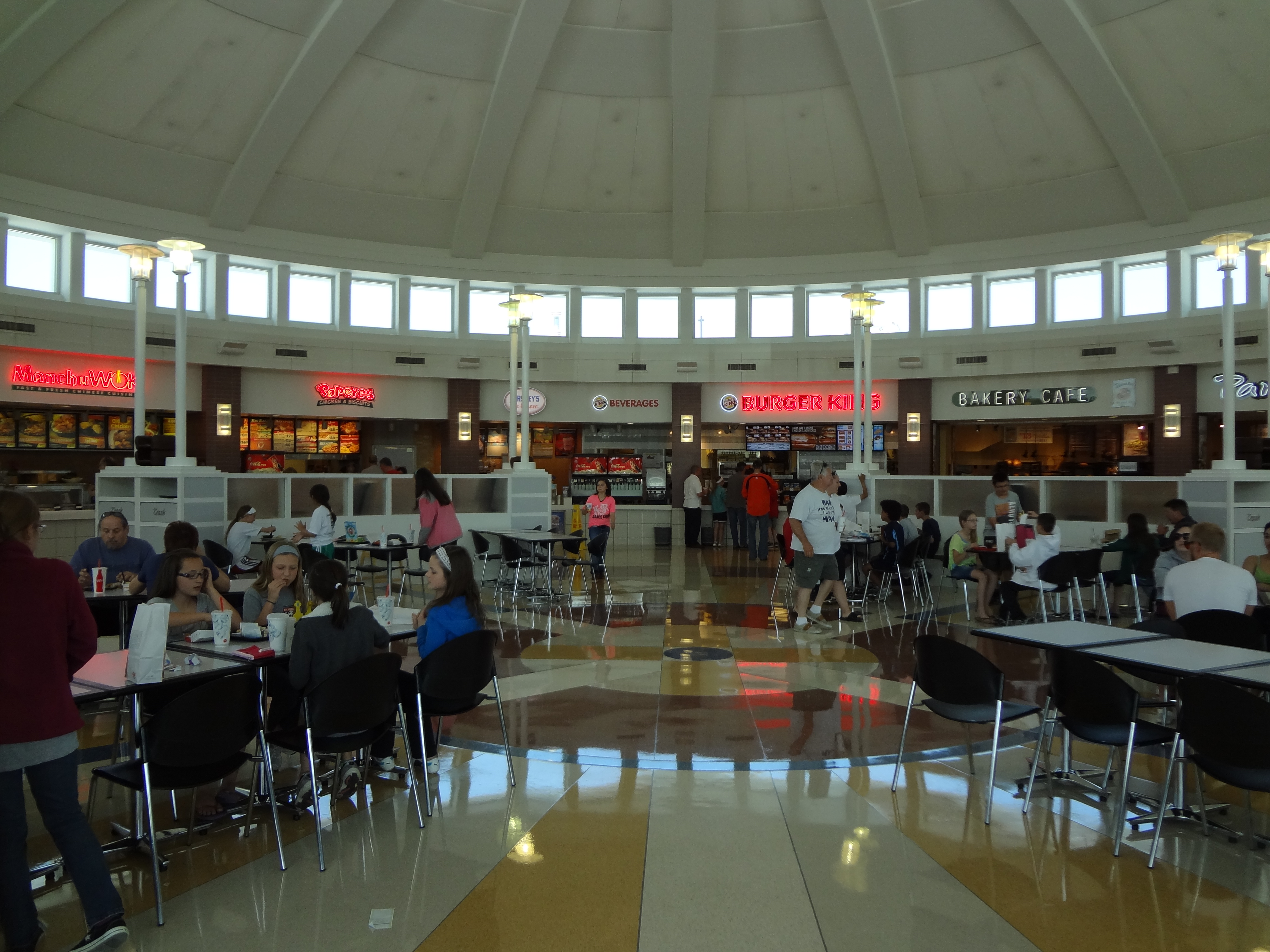
The parish near my college had a very similar design. It wasn't terrible; the building was bright, airy, and impressive. The altar was indeed the focal point. But it also felt cold and cavernous sitting under so. much. white. My guy friends called it "The Mothership." I couldn't help comparing it to these highway rest areas on the Ohio Turnpike, which at least jazz up their floors with contrasting tile colors.
So yeah, based on my own liturgical experience this is not my favorite scheme. I'm confused by some of the Berlin plan's catchy descriptions. "The floor remains a visible and palpable constitutive, fundamental element of the architecture" How? Because it's there? Sure it's ubiquitous and essential, but so is the cement in your garage. "Unlike in rigid rows, one can look around the circle of the gathered community in which one feels secure." Yes, that's exactly why I love making eye contact with the people across my subway car. It makes me feel so secure!
This isn't to say that church decorative styles can't progress past the 19th century, though. Fr. Dwight Longenecker recently wrote a very nuanced view of modern design in his assessment of the plans for California's Christ Cathedral. He pointed out that "the problem with traditional churches is that they can sometimes be no more than copies of earlier churches." Modern churches often deny continuity with the past, but that doesn't mean we can never leave the past, either. I especially liked his hypothesis that medieval Gothic architects would have gladly used steel beams if that material had been available to them. Praising the clean lines of Christ Cathedral's floating sanctuary canopy, he notes that it would certainly "be wrong to plonk down a baroque altarpiece or a gothic pulpit" in such a modern space.
This mis-matching of styles is sometimes an occupational hazard of traditional piety revival. Just as you wouldn't put a geometric Matisse painting in a gold rococo frame, you can't just slap more gilded columns on a modern church and call it a day.
For example, I ran into some interesting architectural combinations last weekend on the first leg of my Three Weddings and a Conference trips. First stop was the alumni chapel at Niagara University. This historic church at a Vincentian school blended old and new very well. You could tell which stained glass windows were from the 19th century and which were post-Vatican II, but there was still subtle continuity. The glass rood screen separting the main sanctuary from the smaller daily mass area was obviously a recent addition, but it featured traditional iconography of the four Evangelists and scenes from scripture. Sitting in its "rigid rows", I still felt secure and inspired, and not just because my friend was a gorgeous bride.
The next day I ventured to the parish closest to our hotel that fit our traveling schedule. It was a typical 1980s generic church design, with exposed brick, angular stained glass saints, and that wood beam tent/barn ceiling that was popular for a decade or so. The funny unexpected twist was the abundance of traditional devotional items scattered all around. These were probably inherited from a nearby parish that closed. It's great that these sacramentals still have a home, but boy, was it jarring. Pastel baroque curlicues do not mesh well with big blocks of brown and primary colors.This was one time where a little modernist restraint would have helped.
Most interesting were the huge paintings hanging in the sanctuary, dating to the 1950s. One depicted the Holy Family, and the other showed the Catholic version of the Cleavers praying the rosary in their living room. It was a great piece of American Catholic material culture, but it clashed with the building overall. Thanks to the blinding morning sunlight coming through the windows, my little iPhone camera couldn't capture a good image of the paintings. In this mash-up of competing decorative styles, the best of both worlds got drowned out.

 |
| Rendering of the proposed St. Hedwig redesign. Trash bins for your Burger King wrappers are located on the perimeter. |
 |
| "Our Lady of Blessed Acceleration, don't fail me now!" |
This isn't to say that church decorative styles can't progress past the 19th century, though. Fr. Dwight Longenecker recently wrote a very nuanced view of modern design in his assessment of the plans for California's Christ Cathedral. He pointed out that "the problem with traditional churches is that they can sometimes be no more than copies of earlier churches." Modern churches often deny continuity with the past, but that doesn't mean we can never leave the past, either. I especially liked his hypothesis that medieval Gothic architects would have gladly used steel beams if that material had been available to them. Praising the clean lines of Christ Cathedral's floating sanctuary canopy, he notes that it would certainly "be wrong to plonk down a baroque altarpiece or a gothic pulpit" in such a modern space.
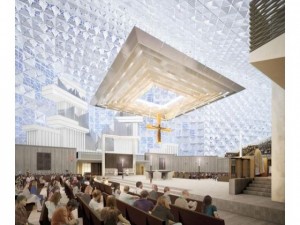 |
| Rendering of Christ Cathedral sanctuary. |
 |
| Niagara University alumni chapel, above. Divine Mercy parish, below. |
The next day I ventured to the parish closest to our hotel that fit our traveling schedule. It was a typical 1980s generic church design, with exposed brick, angular stained glass saints, and that wood beam tent/barn ceiling that was popular for a decade or so. The funny unexpected twist was the abundance of traditional devotional items scattered all around. These were probably inherited from a nearby parish that closed. It's great that these sacramentals still have a home, but boy, was it jarring. Pastel baroque curlicues do not mesh well with big blocks of brown and primary colors.This was one time where a little modernist restraint would have helped.
Most interesting were the huge paintings hanging in the sanctuary, dating to the 1950s. One depicted the Holy Family, and the other showed the Catholic version of the Cleavers praying the rosary in their living room. It was a great piece of American Catholic material culture, but it clashed with the building overall. Thanks to the blinding morning sunlight coming through the windows, my little iPhone camera couldn't capture a good image of the paintings. In this mash-up of competing decorative styles, the best of both worlds got drowned out.
Wednesday, May 21, 2014
An Open Letter to the Archdiocese of New York About Holy Innocents
Dear Cardinal Dolan,
Greetings in Christ! Like you, I am a transplant to the NYC area with Midwestern roots. It was an honor to attend the young adult Mass you celebrated at St. Patrick's Cathedral last December. Your joyful witness to our Catholic faith is such an inspiration.
It's come to my attention that the Archdiocese of New York is considering closing several churches. It's always a shame to see a parish go, but I get it. Neighborhood demographics change, and we're no longer in an era where multiple ethnic parishes need to co-exist within blocks of each other. Urban dioceses now find themselves with more real estate than they can handle. New York is an old city full of historic buildings, but it's also constantly evolving.
Among the parishes under consideration for closure is Holy Innocents on West 37th Street. Its closure would be a great loss to the spiritual life of the this city and a regrettable mistake.
I've gotten to know the parishes of Midtown West because of my daily commute from New Jersey to Brooklyn through Penn Station. Once Penn was a magnificent landmark, a beautiful space carefully designed by a famous architect. But Manhattan changed, as it always does, and the old Penn was deemed unnecessary. You know the rest - good design was demolished and replaced with a smaller dungeon. Today that unnecessary, beautiful old station is sorely missed and needed. The new Penn is too overcrowded to meet commuters' needs, let alone elevate their daily lives.
When I get weary from spending two hours a day in crowded underground metal boxes, I know there are refuges of peace and grace not far away. At first glance, consolidating the parishes of Midtown West might seem like an obvious practical move. There are three churches within five blocks of Penn Station, an embarrassment of religious riches. The largest of these, St. Francis, offers an impressive array of sacrament times and ministries, seemingly enough to serve the area. Both St. Francis and Holy Innocents have been godsends on bad days. St. Francis is like the department store of sacraments - it's big, convenient, and offers a wide selection to suit your needs. Mass, adoration, and confession happen nonstop during rush hour. I'm eternally grateful for the kind wisdom offered by Franciscan friars willing to get up early so we can sleepily stare each other down in a confessional at 8am.
Greetings in Christ! Like you, I am a transplant to the NYC area with Midwestern roots. It was an honor to attend the young adult Mass you celebrated at St. Patrick's Cathedral last December. Your joyful witness to our Catholic faith is such an inspiration.
It's come to my attention that the Archdiocese of New York is considering closing several churches. It's always a shame to see a parish go, but I get it. Neighborhood demographics change, and we're no longer in an era where multiple ethnic parishes need to co-exist within blocks of each other. Urban dioceses now find themselves with more real estate than they can handle. New York is an old city full of historic buildings, but it's also constantly evolving.
Among the parishes under consideration for closure is Holy Innocents on West 37th Street. Its closure would be a great loss to the spiritual life of the this city and a regrettable mistake.
.JPG) |
| The parish entrance on West 37th. |
When I get weary from spending two hours a day in crowded underground metal boxes, I know there are refuges of peace and grace not far away. At first glance, consolidating the parishes of Midtown West might seem like an obvious practical move. There are three churches within five blocks of Penn Station, an embarrassment of religious riches. The largest of these, St. Francis, offers an impressive array of sacrament times and ministries, seemingly enough to serve the area. Both St. Francis and Holy Innocents have been godsends on bad days. St. Francis is like the department store of sacraments - it's big, convenient, and offers a wide selection to suit your needs. Mass, adoration, and confession happen nonstop during rush hour. I'm eternally grateful for the kind wisdom offered by Franciscan friars willing to get up early so we can sleepily stare each other down in a confessional at 8am.
If St. Francis is Macy's, Holy Innocents is an independent boutique. Its building is smaller and more intimate, marked by a small neon cross peeking out between wholesale clothing shops and a kosher falafel/shwarma place. It has fewer Mass times, but what it does offer is superb. The reverent liturgies there are exquisite and even better, accessible. Attend any of their Latin masses, and you'll see everyone from commuters in business attire to the kid in a plastic vest who was hawking tour bus tickets outside. Getting to know the extraordinary form of the Mass can be challenging. To us born after Vatican II, this part of our Catholic heritage feels like a foreign country. Holy Innocents makes our liturgical patrimony feel one of the rich cultural experiences available here in NYC, ready for new explorers to dive right in. At other homes of the EF I've felt like an outsider, but at Holy Innocents I've only found a warm welcome with humility, not snobbery.
.JPG) |
| The Constantino Brumidi mural at Holy Innocents |
The EF Mass could happen at any parish, but there are two more reasons not to close this gem of a church.
1. Closing Holy Innocents would mean the loss of an important artist's work. The mural behind the altar is an historic fresco by Constantino Brumidi, the same Italian immigrant who decorated the rotunda of the US Capitol building in the 1860s. Brumidi is so significant, he posthumously received the Congressional Medal of Honor in 2012. He left Italy because he was on the outs with Pope Gregory XVI, so a painting he did for the Church is an ironic rarity. Much as I love the Apotheosis of Washington, the sacrifice of Calvary is even more valuable. The parish has already invested a good deal of time and money to restore the mural's original brilliance. The scaffolding currently surrounding St. Patrick's Cathedral demonstrates the Archdiocese's commitment to historic preservation, so I know the Church can continue to keep up with the federal government in promotion of great art.
1. Closing Holy Innocents would mean the loss of an important artist's work. The mural behind the altar is an historic fresco by Constantino Brumidi, the same Italian immigrant who decorated the rotunda of the US Capitol building in the 1860s. Brumidi is so significant, he posthumously received the Congressional Medal of Honor in 2012. He left Italy because he was on the outs with Pope Gregory XVI, so a painting he did for the Church is an ironic rarity. Much as I love the Apotheosis of Washington, the sacrifice of Calvary is even more valuable. The parish has already invested a good deal of time and money to restore the mural's original brilliance. The scaffolding currently surrounding St. Patrick's Cathedral demonstrates the Archdiocese's commitment to historic preservation, so I know the Church can continue to keep up with the federal government in promotion of great art.
 |
| Brumidi's Apotheosis of Washington mural in the Capitol rotunda (Via Architect of the Capitol) |
2. On a more practical note, Midtown West is just too crowded for just one parish. The soon-to-open 7 subway line extension and Hudson Yards redevelopment are only going to bring more traffic to the West Side. (My job involves transit news, so I have subway construction on the brain.) If there's a Duane Reade every ten feet in this town, surely one busy neighborhood can handle multiple churches.
For example, on Good Friday my husband and I initially planned to attend the 3 pm liturgy at St. Francis since it was earlier than other nearby offerings. Arriving at 2:45, we found It was already standing room only with packed aisles. So we walked up six blocks to the 3:30 at Holy Innocents, which was also well attended. If St. Francis is that busy now, imagine the crowds with two more parishes' worth of attendees.
For example, on Good Friday my husband and I initially planned to attend the 3 pm liturgy at St. Francis since it was earlier than other nearby offerings. Arriving at 2:45, we found It was already standing room only with packed aisles. So we walked up six blocks to the 3:30 at Holy Innocents, which was also well attended. If St. Francis is that busy now, imagine the crowds with two more parishes' worth of attendees.
Please, don't make the same mistake the railroads did with Penn Station. Holy Innocents is cherished now and elevates the lives of many New Yorkers. It may be even more needed in the future.
God bless,
Sarah D.
God bless,
Sarah D.
Tuesday, February 18, 2014
St. Joseph Church, Maplewood NJ
Since the Southern Baron and I both enjoy being church tourists, we've had fun scoping out weekday masses at some of the parishes nearby. These pictures of St. Joseph parish in Maplewood are from earlier this winter, back when the sight of snow on the ground was actually a novel idea. Please forgive the iPhone blurriness - I didn't think to grab a "real" camera on our way out for diner breakfast food. (New Jersey diners are practically a religious tradition in themselves, but that's another story for another day ;)
St. Joseph was founded in 1914, so they're celebrating their 100th anniversary this year! The parish complex includes a 1930 brick school building, which is currently up for rent. The current church building dates to 1970, and its design is a good example of the way churches built just after Vatican II were a hybrid of tradition and modern style.
The exterior features simple modernist geometry but still looks "churchy" and pays homage to the patron saint. Brick and concrete are more affordable materials often used by suburban parishes trying to keep up with population growth. The chunky stained glass is rather abstract, but will get more literal inside.

The interior is also heavy on unadorned building materials. Heavy ceiling beams are often a prominent feature in churches of the 70s and 80s, lending gravitas with modernist simplicity. Still, the basic layout is not too different from a gothic cathedral; there are pews facing inward from the side "transepts," and a reredos behind the altar features the crucifixion. The tabernacle is still in the center of the sanctuary, suggesting that separate Eucharistic chapels hadn't caught on yet when this church was built. My overall impression of the space was uncluttered reverence.

The really unique thing about St. Joseph was its stained glass windows. They told stories from saints and scriptures with a contemporary flair. I really loved these scenes from the life of St. Joseph:
One of the transepts featured St. Paul, St. Therese, and maybe Pope St. Pius X? Facing them were Moses, King David, and Abraham, uniting the Old Testament with the New.

Our favorite though, was this window about the papacy. We're pretty sure that's Pope Paul VI (the current pope in 1970) next to St. Peter. Note the papal tiara above his head, another tradition that still lingered. These windows show a parish aware of its place in the wider Church and in salvation history.

St. Joseph was founded in 1914, so they're celebrating their 100th anniversary this year! The parish complex includes a 1930 brick school building, which is currently up for rent. The current church building dates to 1970, and its design is a good example of the way churches built just after Vatican II were a hybrid of tradition and modern style.
The exterior features simple modernist geometry but still looks "churchy" and pays homage to the patron saint. Brick and concrete are more affordable materials often used by suburban parishes trying to keep up with population growth. The chunky stained glass is rather abstract, but will get more literal inside.
The interior is also heavy on unadorned building materials. Heavy ceiling beams are often a prominent feature in churches of the 70s and 80s, lending gravitas with modernist simplicity. Still, the basic layout is not too different from a gothic cathedral; there are pews facing inward from the side "transepts," and a reredos behind the altar features the crucifixion. The tabernacle is still in the center of the sanctuary, suggesting that separate Eucharistic chapels hadn't caught on yet when this church was built. My overall impression of the space was uncluttered reverence.
The really unique thing about St. Joseph was its stained glass windows. They told stories from saints and scriptures with a contemporary flair. I really loved these scenes from the life of St. Joseph:
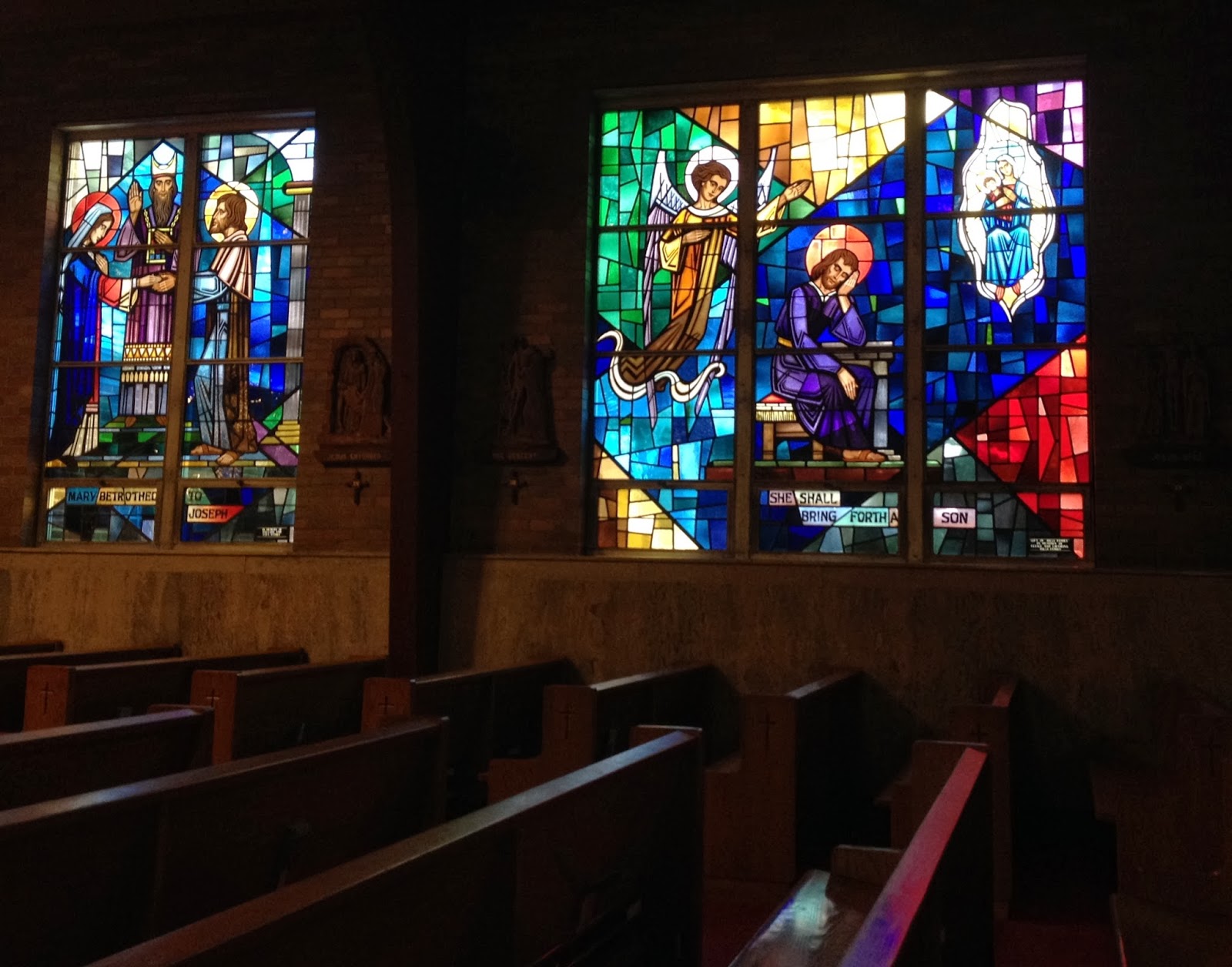 |
| Betrothal of Mary and Joseph, then the angel visiting Joseph in a dream. |
One of the transepts featured St. Paul, St. Therese, and maybe Pope St. Pius X? Facing them were Moses, King David, and Abraham, uniting the Old Testament with the New.
Our favorite though, was this window about the papacy. We're pretty sure that's Pope Paul VI (the current pope in 1970) next to St. Peter. Note the papal tiara above his head, another tradition that still lingered. These windows show a parish aware of its place in the wider Church and in salvation history.
Sunday, December 8, 2013
Welcome to the new blog!
As this blog celebrates its fourth birthday tomorrow, I've decided it's time to change things a bit. The old layout needed some jazzing up and my obscure literary reference title was too much of a tongue-twister. Writing museum newsletters is forcing me to learn to be concise! I also wanted to describe what inspires my writing - even if I'm not doing intense research anymore, I always think and observe like an historian. I want to know how things got the way they are today, and I can't get enough of contextual backstories. And if I come across really smart discussions of how America's crazy religious potpourri evolved, I'm basically like:

So A Beaten Copper Lamp of Deplorable Design is now Catholic History Nerd! (New URL coming soon.) Don't worry, I'll still keep referencing Brideshead Revisited as much as humanly possible. I'll also keep posting pictures of cool churches I visit. I'm working in a museum while my husband finishes his history dissertation, and we're doing our best to take lots of field trips around New Jersey and New York.The pew pictured in my header is from the Basilica of St. Louis, King of France aka the Old Cathedral of St. Louis, MO.

So A Beaten Copper Lamp of Deplorable Design is now Catholic History Nerd! (New URL coming soon.) Don't worry, I'll still keep referencing Brideshead Revisited as much as humanly possible. I'll also keep posting pictures of cool churches I visit. I'm working in a museum while my husband finishes his history dissertation, and we're doing our best to take lots of field trips around New Jersey and New York.The pew pictured in my header is from the Basilica of St. Louis, King of France aka the Old Cathedral of St. Louis, MO.
 |
| Standing at the gateway to the west since 1834 |
Over my past few years in the blogosphere, I've been blessed to meet some inspiring people and take part in some exciting discussions about what it means to be a young adult Catholic in this post-post Vatican II era. Spiritual topics that are are on my mind a lot include: Catholic culture, liturgy, love and marriage, feminism, the Pope, what makes for good church architecture, how to be a person of faith engaged with the modern world. There will also be gluten-free food, Sunday church outfits, and goofy pop culture references. Thanks so much for reading!
Thursday, February 28, 2013
Changing Popes
Losing a Vicar of Christ feels like a kick in the gut, a punch in the chest. It's like saying a final goodbye to a grandfather or your favorite teacher/mentor. It makes the Bark of Peter feel like a rickety canoe in a hurricane. It makes you want to call your family, and hug your friends. You can't help feeling a little abandoned. Suddenly, the symbol of your identity is gone, and you don't know how to go forward.
The day Pope Benedict announced his retirement all I wanted to do was run into every church in New York City. "I need to be with my people!" my heart cried. On my way to the office I stopped at St. Peter's at 22 Barclay in lower Manhattan. (Greek revival 1834, oldest parish in New York.) I couldn't find the words to pray, so I just sat there with Jesus and pondered the papal tiara above the altar. Christ is the One who put it there, and He's the only man who will ever need to be the Church's savior.
The departure of a pope is also exciting. This only happens a few times in a century. If the Easter Vigil is the Super Bowl of Catholicism, a conclave is the World Cup. Better start gearing up on your College of Cardinal stats. If you are as enterprising as my friend Steve, you can make a bracket. Nothing beats the absolute thrill of hearing "Habemus Papam!"
It's eerie how The Betrothed and I just spent an evening sorting through his box of World Youth Day mementos. (We were both at Toronto 2012, but sadly there is no secretly prophetic photo where one of us obliviously walks past the other.) As we decided which things to keep in our future home, we talked about what it was like going to see the Pope, and how we had changed since then. Pope John Paul II was the pope of my childhood. For us kids of the 80s and 90s, he and Mother Teresa were Catholicism. During his papacy I was baptized, received my first communion, and was confirmed (in the Year of the Holy Spirit for an added bonus). I attended Catholic school for 8 years. I traveled to see him at World Youth Day, the longest and farthest I had ever been away from my family at that point. John Paul II told my generation that the Church loved us, that Christ needed us for His epic plan, and we leaped to the task. His love, joy, and compassion made me proud to be Catholic.
When JPII died, my own health came crashing down with him. I spent the sede vacante period going through medical tests trying to decipher the chronic illness that eventually forced me to drop out of college for a year. The day Benedict XVI was elected, I ran campus errands until a parish staffer found me collapsed from exhaustion in the campus ministry office. My life would never be the same, and that period of suffering would prove to be one of the best things that ever happened to me. Pope Benedict XVI was the pope of my transition to adulthood. During his papacy I bounced from one temporary stage to another - homebound invalid days, finishing college, a volunteer year, graduate school, long underemployment, and finally a real job. I met my future husband and prepared for marriage.
Through these changes, I often felt restless, rootless, and unsure of God's plan. Attending two public universities gave me lots of opportunities to wrestle with how the Church could relate to the questioning modern world. Luckily the Church's leader turned out to be not an attack dog, but a gentle nerd with an amazing analytical mind and stellar footnotes. His writings are always a revelation of eloquent clarity. Pope Benedict has urged my generation to reconsider our religious heritage, and we realized we were hungry for symbolic meaning, not just youth group catch phrases. If you had told my 17-year-old self that the "new springtime" of the Church would involve a revival of the Pre-Vatican II mass, I would not have believed it. The scandals and trials of recent years sometimes make it painful to be Catholic, but Benedict XVI has reminded us how true joy comes from the deep truths of the faith. As The Betrothed often says about him, "What a boss!"
Now this next pontiff will be the pope of my adult married life. Once again, I'll spend the sede vacante period adjusting to major new realities - I just moved 250 miles away from my hometown to start a job in a New York and am living out of boxes in a bare apartment. I don't know what the coming years will bring for me and the Church, but I know God will be with us.
The changing of popes is a reminder that Jesus is all that matters. No one person is the Church. She already found the man who meets all her many needs - the One who redeemed her. All the other vicars are just taking care of the place for a while until He gets back. Was Jesus like all of these men at once? Was He the perfect combination of Peter's passion, John XXIII's kindness, and Pius V's tenacity? He knows the right person for the right time, including this next conclave.
So godspeed, dear Papa Benny. Thank you for your generous service, your great humility, your deep wisdom, and for putting the papacy on social media. I'll be reading one of your books on the subway today. Stopping in one of New York's many churches sounds like a good idea too.
The day Pope Benedict announced his retirement all I wanted to do was run into every church in New York City. "I need to be with my people!" my heart cried. On my way to the office I stopped at St. Peter's at 22 Barclay in lower Manhattan. (Greek revival 1834, oldest parish in New York.) I couldn't find the words to pray, so I just sat there with Jesus and pondered the papal tiara above the altar. Christ is the One who put it there, and He's the only man who will ever need to be the Church's savior.
 |
| St. Peter, St. Paul, and a crucifix painting that St. Elizabeth Seton prayed before |
It's eerie how The Betrothed and I just spent an evening sorting through his box of World Youth Day mementos. (We were both at Toronto 2012, but sadly there is no secretly prophetic photo where one of us obliviously walks past the other.) As we decided which things to keep in our future home, we talked about what it was like going to see the Pope, and how we had changed since then. Pope John Paul II was the pope of my childhood. For us kids of the 80s and 90s, he and Mother Teresa were Catholicism. During his papacy I was baptized, received my first communion, and was confirmed (in the Year of the Holy Spirit for an added bonus). I attended Catholic school for 8 years. I traveled to see him at World Youth Day, the longest and farthest I had ever been away from my family at that point. John Paul II told my generation that the Church loved us, that Christ needed us for His epic plan, and we leaped to the task. His love, joy, and compassion made me proud to be Catholic.
When JPII died, my own health came crashing down with him. I spent the sede vacante period going through medical tests trying to decipher the chronic illness that eventually forced me to drop out of college for a year. The day Benedict XVI was elected, I ran campus errands until a parish staffer found me collapsed from exhaustion in the campus ministry office. My life would never be the same, and that period of suffering would prove to be one of the best things that ever happened to me. Pope Benedict XVI was the pope of my transition to adulthood. During his papacy I bounced from one temporary stage to another - homebound invalid days, finishing college, a volunteer year, graduate school, long underemployment, and finally a real job. I met my future husband and prepared for marriage.
Through these changes, I often felt restless, rootless, and unsure of God's plan. Attending two public universities gave me lots of opportunities to wrestle with how the Church could relate to the questioning modern world. Luckily the Church's leader turned out to be not an attack dog, but a gentle nerd with an amazing analytical mind and stellar footnotes. His writings are always a revelation of eloquent clarity. Pope Benedict has urged my generation to reconsider our religious heritage, and we realized we were hungry for symbolic meaning, not just youth group catch phrases. If you had told my 17-year-old self that the "new springtime" of the Church would involve a revival of the Pre-Vatican II mass, I would not have believed it. The scandals and trials of recent years sometimes make it painful to be Catholic, but Benedict XVI has reminded us how true joy comes from the deep truths of the faith. As The Betrothed often says about him, "What a boss!"
Now this next pontiff will be the pope of my adult married life. Once again, I'll spend the sede vacante period adjusting to major new realities - I just moved 250 miles away from my hometown to start a job in a New York and am living out of boxes in a bare apartment. I don't know what the coming years will bring for me and the Church, but I know God will be with us.
The changing of popes is a reminder that Jesus is all that matters. No one person is the Church. She already found the man who meets all her many needs - the One who redeemed her. All the other vicars are just taking care of the place for a while until He gets back. Was Jesus like all of these men at once? Was He the perfect combination of Peter's passion, John XXIII's kindness, and Pius V's tenacity? He knows the right person for the right time, including this next conclave.
So godspeed, dear Papa Benny. Thank you for your generous service, your great humility, your deep wisdom, and for putting the papacy on social media. I'll be reading one of your books on the subway today. Stopping in one of New York's many churches sounds like a good idea too.
Tuesday, January 22, 2013
Confessions of a Parish-hopper
In the past five years, I've lived in four different states. This has made me a little commitment-phobic about joining a parish. Should I volunteer for things when I'm just going to leave in a few months? What if there is something better across town? It's helpful to know all the local Mass and Confession times, after all. For better or worse, this has made me into a parish-hopper.
When I lived in Delaware I ached for Catholic camaraderie. There weren't really any young adult groups to speak of. I went to Mass at the cute historic church up the road, and all the senior citizens gave me the side-eye.
Then I moved back to my hometown in the Diocese of Arlington, where there are more YA events going on than you can shake a stick at. For every weekly listserve I received, there was some other parish hosting a book club holy/happy hour. It was great, but overwhelming. Sometimes I felt like this:

The activities at my parish usually didn't fit my schedule, so I found myself exploring other options. There was the Holy Thursday 7 church pilgrimage from my old parish, the young professionals lectures in DC, the packed Theology on Tap that made me feel old, and the random wine and cheese that a friend invited me to. After a while I felt like Goldilocks trying on all these fellowship groups.
It wasn't until I started working on Capitol Hill that I found a place that felt just right. I could see the steeple of St. Peter's from my Metro stop. After long days dealing with tourist questions, the lovely, peaceful church was a place to relax and think. The parish activities were perfect too! Holy hour with confession took place every weeknight, and the friendly priests hosted wine-and-cheese receptions in their historic house rectory. (19th century furniture remains the way to my heart.) The bulletin featured a perfect blend of devout spirituality and social justice service opportunities.
I hopped onto the Monday evening Bible study and Saturday morning food pantry deliveries. By far my favorite outing was a hike in Great Falls Park. On the feast of my patron St. Elizabeth of Hungary, we checked out waterfalls, clambered over rocks, and attended Mass said on a picnic table. Best of all, the young adults group welcomed me without any awkwardness. Even though I technically lived an hour away, no one pointed at me and yelled:

Sadly, all good things must come to an end. Just when I was settling in at St. Peter's and learning about all the Latin Mass options in Alexandria, I got a job in New York. See! I knew I was too transient to get on anyone's lector schedule!
So here I am at square one again, without a church home. The Betrothed has a wonderful parish in central Jersey, also named St. Peter's, but it's just too far from my job to be our permanent place. For now I'll hang out there while I shop around. Hey look! There are two parishes within walking distance of my office in Brooklyn, not to mention the historic ones in lower Manhattan....
When I lived in Delaware I ached for Catholic camaraderie. There weren't really any young adult groups to speak of. I went to Mass at the cute historic church up the road, and all the senior citizens gave me the side-eye.
Then I moved back to my hometown in the Diocese of Arlington, where there are more YA events going on than you can shake a stick at. For every weekly listserve I received, there was some other parish hosting a book club holy/happy hour. It was great, but overwhelming. Sometimes I felt like this:

The activities at my parish usually didn't fit my schedule, so I found myself exploring other options. There was the Holy Thursday 7 church pilgrimage from my old parish, the young professionals lectures in DC, the packed Theology on Tap that made me feel old, and the random wine and cheese that a friend invited me to. After a while I felt like Goldilocks trying on all these fellowship groups.
 |
| Maybe this one... |
.JPG) |
| Traveling Mass kits are always so nifty. |

Sadly, all good things must come to an end. Just when I was settling in at St. Peter's and learning about all the Latin Mass options in Alexandria, I got a job in New York. See! I knew I was too transient to get on anyone's lector schedule!
So here I am at square one again, without a church home. The Betrothed has a wonderful parish in central Jersey, also named St. Peter's, but it's just too far from my job to be our permanent place. For now I'll hang out there while I shop around. Hey look! There are two parishes within walking distance of my office in Brooklyn, not to mention the historic ones in lower Manhattan....
Wednesday, December 12, 2012
Mary, Mary Everywhere
Happy Feast of Our Lady of Guadeloupe! The history nerd in me loves that this is a feast day with such strong ties to American history. Mary left behind a textile artifact that clearly references native culture, how cool it that?
I also consider today my New York City anniversary. Three years ago The Betrothed and I went exploring at the Guggenheim and did some Christmas-y sightseeing. We went to Mass at St. Patrick's and saw some feast day processions getting underway.
.JPG) |
| Flowers for Our Lady at St. Patricks, 2009 |
Last week I went to New York for an interview and had a similarly magical day. Just a few blocks over from St. Patricks is a similarly imposing Episcopal church, St. Bartholmew's. (Next to the Waldorf-Astoria, at 51st and Park Avenue) I had noticed St. Bart's the last time I met my friend Laura near her office there, and so decided to check out the inside. You can too in this virtual tour.
 |
| Photo courtesy of Museum Planet |
It was amazing. I kicked myself for forgetting my camera. The whole building was like a Gilded Age who's who - James Renwick and Stamford White designed aspects of it, the Vanderbilts were parishioners. There were Art Deco mosaics and the best angel holy water fonts I have ever seen. As an added bonus, I had walked in upon the Mt. Holyoke women's chorus rehearsing for a concert, so my poking around had a festive soundtrack.
 |
| Photo courtesy of Museum Planet |
The whole place was lovely and inspiring, but didn't feel the same as a Catholic church. God was there, but He wasn't Eucharistically There. My old vestment thesis intimidation was coming back too. Several times Anglican clerics practically patted me on the head when they learned I was a Papist girl. They basically told me "There, there, I'm sorry you follow a Church that doesn't get the Arts like we do."
Then I turned down a side hallway, where a rack of votive candles stood flickering. What to my wondering eyes should appear, but a Madonna and Child icon with plenty of pre-dieu kneelers. Episcopalians lighting candles to Mary? Count me in!! On my way to buy a candle, I also found this:
 |
| Photo courtesy of Museum Planet |
The south chapel's gorgeous Adoration of the Magi was painted by a female artist, Ethel Parsons Paullin, in 1919. The thirteen medallions around the arch depict scenes from the Nativity. It took my breath away as I thought about how far-reaching Mary's story can be.
I don't like to think of Mary as some docile, silent person who never raised her voice, if only we could be like her. She was humble, but she was also the woman clothed with the sun and crowned with the stars in Revelation. Her Magnificat is her declaration of her confidence in God's blessings. She is the comforting mother wrapping us in the folds of her mantle, and the warrior striking at the head of the serpent. Christians build shrines of admiration because she is one classy lady, and she walked alongside Christ with dignity and joy.
I don't like to think of Mary as some docile, silent person who never raised her voice, if only we could be like her. She was humble, but she was also the woman clothed with the sun and crowned with the stars in Revelation. Her Magnificat is her declaration of her confidence in God's blessings. She is the comforting mother wrapping us in the folds of her mantle, and the warrior striking at the head of the serpent. Christians build shrines of admiration because she is one classy lady, and she walked alongside Christ with dignity and joy.
 |
| Lady Chapel in St. Patrick's Cathedral. Stamford White was here too. Photo courtesy of Flickriver.com |
Monday, November 19, 2012
What I Wore Sunday, Vol. 5

Sweater - Target, white tee - Kohl's, skirt - Anne Taylor outlet, tights - Target, shoes - Aerosoles
Back in 1991, I performed in a riveting first grade play entitled "The Gumby Shop." We kids dressed as the various nonsensical things you could buy at the shop. My line was "Some eggs, some eggs, with purple legs!" My Mom shouted that line when she saw my church outfit. Maybe I am subconsciously getting excited for advent?


For more Sunday outfits, check out Fine Linen and Purple!
Friday, May 25, 2012
St. Vincent Ferrer Church, New York City
When The Betrothed came back from England a few weeks ago, we spent a day wandering around New York City. On our walk between The Frick Collection and meeting a college friend for cupcakes at Sprinkles, we peeked at a church at the corner of Lexington Avenue and E 63rd Street. Janitors were sweeping up rose petals from an afternoon wedding procession.
.JPG)
.JPG)
St. Vincent Ferrer parish began in 1867, and its current building dates to 1918. Architect Bertram Grosvenor Goodhue designed the church, which is the most elaborate Gothic revival building I've seen since our field trip to the Newark Cathedral.
The sanctuary was just glorious. I've never seen seven lamps like that in a church that wasn't Anglo-Catholic. The altarpiece topped with Christ the King was carved in Belgium.
You can take a virtual tour of all the church's features and symbolism here. St. Vincent Ferrar is a peaceful oasis in a busy city. From the abundance of votive candles ($4 at the front desk, we bought one), you can tell many New Yorkers bring their intentions there. St. Vincent and St. Dominic, pray for us!
.JPG) |
| This reminds me of a medieval church I did a middle-school report on. |
.JPG) |
| I wonder if the little dog/fox/wolf on top of the pew is a shoutout to the Dominicans as God's dogs (Domini canes.) |
.JPG) |
| The rood screen. |
.JPG) |
| Immaculate Conception shine |
.JPG) |
| Side altar with tons of saints, plus Mary giving St. Dominic the rosary. |
Friday, May 18, 2012
7 Quick Takes, Summer Break Edition
Thanks to Jen at Conversion Diary for hosting!
- It really feels like summer break has started. My sister is home from college, my temp job has ended and I have ton of free time, and Brother #2 has finished his master's thesis. Let the movie marathons and outdoor frolicking commence! In the morning, I'm making waffles.
- One of my goals for my time off is to work on the church architecture research that I hope to publish. There are so many interesting new churches with traditional flair in the Arlington diocese.
- The Betrothed and I have set our wedding date! June 15, 2013 will be exactly 3 years and 10 months since we met on the Feast of the Assumption.
- Before I started all this marriage paperwork I had no idea how Catholic churches keep track of their membership. Did you know that the parish where you were baptized keeps the official record of all your sacraments for the rest of your life? The archival nerd in me is excited about how nationally organized this is. So I had to call a church across the country in Arizona where I have not been in 26 years. "Ok we'll call you when your baptismal certificate is ready and you can pick it up!" Umm, yeah, about that.
- Speaking of wedding prep, I signed up for Weight Watchers online this week. Cliche bride activity, I know. But I have a big goal to reach, and it's nice to someone else calculate things for me. Anyone have advice about how to succeed with the program?
- Last week I went to the Young Professional's Happy Hour at the Catholic Information Center downtown. It's a bookstore and chapel run by Opus Dei, and it has by far the best Catholic book selection I've seen in the area outside of a shrine gift shop. As an added bonus, Dr. Helen Alvare was the speaker. She pretty much knocked my socks off with her legal arguments about religious freedom. I kind of want to be her when I grow up. Listen to a podcast of her talk here - you will not be disappointed.
- Thank you for all of the great comments on my post about being underemployed. It's good to know other people are dealing with the same challenges of trusting God's plan. Speaking of which, while wandering from the Metro to the CIC, I passed this banner on a Christian Scientist building. It made me smile.
 |
| St. Raymond of Penafort, one of favorites from my last round of photography. |
.JPG)
Wednesday, February 1, 2012
St. Monica Church, New York City
Whenever I'm traveling, I enjoy the chance to check out churches I've never seen before.

During my upper east side adventure visiting a friend last weekend, I went to Sunday Mass at a parish that was conveniently located literally around the corner. St. Monica's church building was begun in the 1880s and completed in 1906. It's in a pretty standard Gothic revival style, but the decorative elements are exceptionally good.

Thanks to recent renovations, the interior really sparkles. The freestanding altar is obviously a post-Vatican II addition, but it complements the original nicely.

The stained glass windows were one of my favorite parts. They seemed very L. C. Tiffany-esque, with their intricate detailing and the soft edges of the pictures. I wish I had had time to photograph all of them.


During my upper east side adventure visiting a friend last weekend, I went to Sunday Mass at a parish that was conveniently located literally around the corner. St. Monica's church building was begun in the 1880s and completed in 1906. It's in a pretty standard Gothic revival style, but the decorative elements are exceptionally good.

Thanks to recent renovations, the interior really sparkles. The freestanding altar is obviously a post-Vatican II addition, but it complements the original nicely.

The stained glass windows were one of my favorite parts. They seemed very L. C. Tiffany-esque, with their intricate detailing and the soft edges of the pictures. I wish I had had time to photograph all of them.

Sunday, January 8, 2012
And All Flesh Shall See It Together
 |
| The Nativity scene at my parish church, Christmas 2011. Note legit swaddling on baby Jesus. |
Thursday, December 22, 2011
Advent Wreaths Take 3

Last weekend The Beau and I took a field trip to the Cathedral Basilica of the Sacred Heart in Newark, NJ. It was worth the 45 minute drive. The fifth largest basilica in the United States, it was by far one of the most magnificent churches I've seen in this country. I haven't been this bowled over since I spent a year exploring the Cathedral Basilica of St. Louis.

Planned in 1859, the cathedral was the brainchild of Newark's first bishop, Rev. James Roosevelt Bayley. He was a nephew of St. Elizabeth Seton and a Roosevelt on his mother's side. Like his aunt, he converted from the Episcopal and was subsequently cut out of his parents' will. Bayley grew the fledgling Newark diocese into a flourishing Catholic community, introducing religious orders and encouraging education. He was also history buff who organized church archives and wrote some histories of early American Catholicism. My kind of guy.

Construction began in 1899, and the French Gothic style cathedral hosted its first mass in 1928. It wasn't until the 1950s that the final interior decorations of stained glass windows and carved oak screens appeared.

In 1995 Pope John Paul II visited the cathedral and elevated it to a minor basilica. While he was in town he presided over evening prayer, with President Clinton in attendance.

It's the attention to detail that makes this cathedral so incredible. Every time I turned around I found something new to marvel at. Why yes, that is Judith holding the head of Holofernes in the center of that pediment over a side door.

The myriads of stained glass windows depict more saints than you can count, giving the impression that you are surrounded by the "great cloud of witnesses." I was excited to find one of my patrons in an apse side chapel.

So if you ever find yourself flying into the Newark airport, see if you can make your way to this American Gothic gem. It's not in the greatest neighborhood, but that makes its splendor all the more astonishing. The product of generations of hard work, it stands as a testament to the Communion of Saints we all hope to join in eternity.

Subscribe to:
Posts (Atom)