Wednesday, December 17, 2014

Exodus: Dumb and Dumber

Ridley Scott's Exodus: Gods and Kings rounds out this year's Bible movie offerings with the most inexplicable adaptation yet. Nobody was really clamoring for another Moses adaptation, let alone one released nowhere near Passover. Despite some pretty palaces, sweeping landcapes, and impressive plague special effects, this Exodus adaptation remains both entertaining and uninspiring.

Scott takes some interesting takes on supporting characters, like Miriam living as a servant in the palace, but then abandons them with no meaningful development. His research is equally thin. For every flashy monument there are other inaccuracies. Were there really that many beards among Egyptian nobility? Was hanging really the preferred method of public execution, if used at all? Is Ramses channeling Britney Spears in that scene with the cobras?

Most glaring is some very 19th century rhetoric about the nature of slavery. Moses literally argues that Israelites have "the same rights as other Egyptian citizens" and "should be paid for their labor." Ramses counters that freeing them would have "dramatic economical impact" and that he needs more time to phase out his peculiar institution.

Steven Lloyd Wilson at Pajiba put this scene in its place in his awesome review. "Forget the white privilege of casting only white dudes in a movie about ancient Africa, let’s consider a bit about the historical privilege of thinking that all of human history is populated by literate middle class Americans with rights and constitutions. Historical privilege means not having to believe in peasants."

Privilege is at the heart of Ridley Scott's entire story. The subtitle Gods and Kings is apt because he has created an old school "great men" historical narrative, where leaders and their dramatic conquests are the only things that matter. The "Let my people go!" second act dwells heavily on the horror of plagues, showcasing human and divine pyrotechnics while the collateral damage literally piles up. (Note to parents: don't take your kids to see this unless they are ok with watching people be hanged, lit on fire, or eaten by crocodiles.) In Darren Aronofsky's Noah this year, the wholesale destruction of human life was seen as a tragedy; in Exodus, it's just an excuse for more action sequences.

Despite the lip service to political rights yet unborn, ordinary people do not matter much except as scenery. There are no Israelites grumbling about Moses' leadership or insisting God will save them. Instead, they blindly follow Moses, I guess because he's a child of privilege and has flashier accessories than they do. I'm outraged on behalf of my ancestors that they are reduced to a beige mob, showing zero agency outside of wide-eyed gapes and a training montage.

The supposed climax of the film, the parting of the Red Sea, is where its impact really dissolves. Moses decides to throw off Pharaoh's approaching army by going through the Mines of Moria, but ends up taking some wrong turns and missing his exit to the straits of the Red Sea. Luckily, the mountain pass does slow down the chariots, as does the holy sharknado that appears at the edge of the sea. The sea parts as a seeping tide that rises into a tsunami. Lest we be too awed by God's power, however, Moses lingers behind so he can have one last vanity grudge match showdown with Ramses. That they both emerge alive is the bigger miracle in my book.

Every Moses adaptation takes on the ideas of its time. Cecil B DeMille's The Ten Commandments portrayed the Exodus as a Cold War-esque showdown between constitutional law and autocratic tyranny, yet painted a rich tapestry of motivations and personalities in the children of Israel. Beautifully scored and animated, The Prince of Egypt focused on 1990s self esteem rhetoric: "Look at your life through heaven's eyes; there can be miracles when you believe." Now Exodus exhibits a Millennial ambivalence towards God not unlike its contemporary Noah. In the 21st century, the Creator seems elusive yet demanding, appearing only to cause destruction that defies humanist rationality. But Noah still marveled at the spiritual forces in the world bigger than ourselves. Christian Bale's Moses seems only to appreciate God because that creepy choir boy at the burning bush provided his best military general gig yet. Ultimately, Gladiator II: Egypt Edition is just a flashy, clumsy attempt to tell a story with centuries of significance.

Monday, December 8, 2014

The Immaculate Conception in the Modern World

Esquilache Immaculate Conception, Bartolomé Esteban Murillo (1645-1655)
Today is the feast of the Immaculate Conception, the patron feast of the United States. At mass tonight, the
priest mentioned how the American bishops petitioned Pope Pius IX to approve Mary's patronage assignment in 1847. This request predated Pius IX's formal dogmatic decree of the Immaculate Conception in 1854. The same year, St. Catherine Laboure introduced the Miraculous Medal, featuring the prayer "Oh Mary, conceived without sin, pray for us who have recourse to thee." Later, in 1858, the apparitions to St. Bernadette Soubirous at Lourdes further affirmed the dogma, with Mary stating"I am the Immaculate Conception."

What exactly was it that made the people of the 19th century so fixated on Mary's conception without original sin? Was this the OMGJPIITOB of its time? America was even at the cutting edge of the trend. Perhaps Europe was too preoccupied prepping the many revolutions of 1848 to really get contemplative. The Church in France had a particularly precarious relationship with their country's government at this time, as evidenced by St. Bernadette's clashes with government officials about her visions. (If those CCC Marian apparition cartoons taught me anything, it's that visionary peasant children always have a municipal nemesis.)

I'm also curious what made American Catholic choose this particular patron. Was a sinless spokeswoman their answer to the colonial concept of America as a "City on a Hill"? Were they just riding the tide of trending spirituality? Or did Mary's sinlessness give them in hope in an uncertain time when their country was facing frontier dangers and experiencing increasing discord over slavery?

Looking at the state of our country today, we're in need of that same hope. Racism is still very real, and many people doubt that our criminal justice system treats all Americans fairly. But Mary's hymn of praise reminds us that the kingdom of God promises mercy for the marginalized and an end to unjust authority. It's our duty as Christians to work to make our own country more like that kindgom.
[God] has shown the strength of his arm; He has scattered the proud in their conceit.He has cast down the mighty from their thrones and has lifted up the lowly. He has filled the hungry with good things while the rich he has sent away empty. 

Tuesday, November 11, 2014

Taylor Swift, Nostalgia Machine

Have you seen the viral video mashup of Taylor Swift's "Shake It Off" with a 1989 aerobics video? In the worlds of my sister "Stop whatever you are doing and watch this right now." The tempo has been sped up a bit to avoid copyright issues, but you can still see all its spandex glory.

These were my reactions when I first watched it:
  • Of course Crystal Light sponsored a national aerobics championship
  • This opening number resembles a beauty pageant opening; Miss America was still relevant then. 
  • As kid in 1990, I would watch aerobics shows when I came home from kindergarten. They convinced me I needed those white cross-trainers or I would never be good at sports. 
  • Those hi-cut leotards feel super dated, but so do the exercises. Any current fitness guide will tell you that relying on cardio arm flailing will not get you ripped - you have to lift too, bro. Our concept of health changes as often as our clothes. For example, I just heard a conference paper about how pale, thin tuberculosis patients exactly fit early 1800s standards of beauty.
  • Taylor Swift really did capture the cadence of 80s pop music in her new album
I  have to admit, I listened to all of 1989 on a road trip with friends this weekend, and I really liked it. I also couldn't help over-analyzing the throwback theme she chose for it. The cds even come with Polaroid picture inserts! The name is her birth year, a time she literally cannot remember. Ironically, many of her fans weren't even alive then. They don't have Michael Jackson and Gloria Estefan lodged in their subconscious they way I do. 

Does this signal that the 80s have aged enough to move from big hair jokes to serious heritage? After all, the 1970s are no longer just a funny sitcom premise. Instead, wide lapel period dramas like Argo and American Hustle are Oscar nominees and X-Men prequels are set during the Nixon administration. To my siblings and me, this setting feels as exotic as the 1950s. Look at the people back then! Their clothes were so colorful and their music so lively! Now there's a generation coming into adulthood that feels the same way about the Reagan years. 

"Welcome to my house museum."
I'm both pleased and terrified that Swift might be an arbiter of how The Kids Today think about the past. Onthe one hand, she makes fun music and has a good eye for fashion and art direction. Her new video for "
Blank Space" is gorgeous, creepy, and packed with references to everything from Dorian Grey and Gone With the Wind to Mean Girls and Lady Gaga's "Paparazzi."

On the other hand, she's no historian. Her recent interview with Rolling Stone reveals how she cherry picks cute things from the past. For example, the living room of her TriBeCa penthouse displays a "fish tank filled with vintage baseballs ('I was like, 'That's so cool, they're so old!')  ... Against another wall, there's a rack full of white nightgowns. 'This is a thing me and Lena [Dunham] have,' says Swift ... 'We wear them during the day and look like pioneer women, fresh off the Oregon Trail.'"

Is this farb kidding me? Did she never even play the game Oregon Trail? Pioneer women wore petticoats and bonnets in the noonday sun, and white would be impractical for the rugged tasks of wagon travel, let alone attacks of dysentery. Somewhere Ma Ingalls is rolling in her grave.

Bigger things happened in 1989 than God's gift of Taylor to the world. The fall of the Berlin Wall and a presidential inauguration that year actually comprise some of my earliest political memories. Taylor Swift has shown herself to be capable of reflection, whether she's taking a break from the dating scene or re-examining what feminism means. I hope her new role as NYC ambassador will lead her to understand that the past isn't just a pretty backdrop for modern adventures, but a complex component of who we are today.

Thursday, October 16, 2014

Being a (Mostly) Shiksa in Brooklyn

A Pedi Sukkah in Downtown
Brooklyn last year
More than any place I've ever worked, New York City is very aware of Jewish holidays. Last month I had to meet deadlines before colleagues took time off for Rosh Hoshanah. During the high holy days parking for the synagogue on my street spilled down the block. Now it's time for Sukkot, and the Pedi Sukkah guys are out in force again. It's really an ingenious setup: they pedal portable booths around Brooklyn and offer passersby the interwoven tree branches and citron for the traditional Sukkot blessing.

"Are you Jewish?" The question is inevitable if I make eye contact, and sometimes even if I don't. I always feel like I'm letting them down when I say no.

I try for an ecumenical encounter instead. "Hey cool, religious devotion in public! I like Psalms too. High five!" But they're interested in member retention, not evangelization. Chabad-Lubavitch groups remind me of Opus Dei at times - well funded, well connected, trying to inspire their coreligionists to embrace traditional devotions. Likewise, the Hasidic schoolgirls I sometimes see on the subway are always clad in the universal homeschooler uniform of long skirts and layered tops.

For the record, I'm not entirely a shiksha. By blood I'm 25% Jewish, but on my Dad's side so it doesn't really count. My paternal grandfather grew up a very secular Jew and then embraced Catholicism when he met my grandmother and her devout Italian parents. Probably the most Jewish things about my LaVigne great-grandparents were that they ate schmaltz as children and eventually retired to Boca Raton. Still, my relatives and I have never completely lost those roots. Our surname looks French because an Ashkenazi ancestor was trying to avoid persecution, so the story goes. We throw around Yiddish expressions and talk loudly with our hands. My grandpa loves lox and keeps his freezer stocked with blintzes. He grew up in his parents' grocery stores, and the family passion for finding good deals is deep in my DNA.

Especially before I took my husband's name, acquaintances have often assumed I'm not a goy. Almost everyone on my dad's side has this problem. When I worked at history camp the teenage boys called me "Jew Hair." There have been awkward moments when someone wishes me L'shanah Tovah or asks what I'm doing for Hanukkah. Last Good Friday I had literally been in Penn Station five minutes when a beaming Orthodox woman told me "Happy Pesach!" (I was wearing sensible black shoes with tights and a modest dress, should have seen that one coming.)

So I can "pass," so what? At the risk of sounding presumptuous, I feel a kinship with the children of Israel that I cannot shake. Perhaps my sadness at declining a Sukkot blessing comes from a desire for unity. I wish I knew the Hebrew alphabet and all the holy day traditions and we could pray together to the God we both believe. We already read the same scriptures.

Even if I'm not really part of the club, the Jewishness of NYC gives me hope. In a cosmopolitan city so often associated with secular excess and iniquity, one of the world's most persecuted religious groups has made a home, flourished, and left an indelible mark. The men in sidelocks and yarmulkes boldly striding down the street remind me I don't have to be ashamed of being a religious person. If New York has room for them, it can welcome a "nice Catholic girl" too, even if her life is far less exciting than Carrie Bradshaw's. You might seem wicked, Gotham, but deep down you are holy.


Thursday, October 9, 2014

That Time the Pope Went to the World's Fair

This year marks the 50th anniversary of the 1964 World's Fair in New York City. Not unlike the modern
The Unisphere on my visit in June
Olympics, the Fair didn't turn a profit, but it hosted months of culturally significant spectacles. The Ford Mustang was introduced, Walt Disney launched the It's a Small World ride, Andy Warhol mocked politicians with some controversial pop art, civil rights activists staged protests blocking highway ramps, the Beatles played in Shea Shadium, and Bob Dylan infamously used an amp.

Like the New York's first World's Fair in 1939, this was the brainchild of infamous urban planner Robert Moses. (Cue chorus of boos from historic preservation fans.) Fading from political power towards the end of his career, he hoped hosting another World's Fair and turning Queens garbage dumps into the Flushing Meadows fairgrounds and park would cement his legacy.

Even though Moses was a jerk to tear down the old Penn station, I'll admit Flushing Meadows is a great park. Some of the fair buildings are still open as museums. The '64 Fair also gave Queens the amazingly topographic Unisphere, which has become an icon of the borough. It's a great example of space age public art that can belong to everyone, not unlike my old boyfriend the St. Louis arch. Plus, you can buy the world a Coke and keep it company while you're there. 

Vatican Pavilion at Flushing Meadows.
Collection of the NYPL
For Catholics, the '64 fair has special significance because it brought the United States its first papal visit ever! We have Robert Moses' ambition to thank for it. The Vatican had a pavilion at the Fair, and even shipped over Michaelangelo's Pieta to display there. Moses hoped his friend Cardinal Spellman could convince the Pope to stop by in a clutch PR move for the World's Fair.

And so on October 5, 1965, Pope Paul VI became the first pope to set foot on American soil. He spent only fourteen hours in NYC, establishing the usual cathedral-stadium-political arena template for future papal visits. After landing at the new JFK Airport in Queens, he spent most of his time in Manhattan at a mixture of modern and old-school locations. He visited St. Patrick's Cathedral and met with President Johnson at the Waldorf Astoria hotel. The Holy Father also addressed the United Nations, warning that "Politics do not suffice to sustain a durable peace." Later he said Mass at Yankee Stadium, not Moses' brainchild Shea Stadium (ooh burn!).Finally, on his way out of town, Paul VI did stop at the Flushing Meadows fairgrounds. Today a marble bench marks where he stood.

Pope Paul VI's whirlwind tour wasn't as substantial as later papal visits, but it was surely a landmark moment
Pope Paul VI window in St. Philomena church,
Livingston, NJ.
for American Catholics. Only a few years before, John F.Kennedy had become the first Catholic president and a beloved political figure. Seeing the Church's leader welcomed as an international dignitary must have cemented the fact that "papists' had been accepted as true Americans, not a dangerous superstitious group swearing loyalty to a foreign power. Also, American Catholicism was no longer just mission territory; it was a major wing of the Church garnering Vatican attention! Eleven years later Paul VI would canonize New Yorker Elizabeth Ann Seton as the first American-born saint, further establishing the United States' role in Catholic history.

I found evidence of this papal euphoria in a parish near me in New Jersey. With its simple yet vaguely colonial style, St. Philomena was probably built in the early 1970s before post-Vatican II modernism had really caught on. The ample stained glass windows depict mysteries of the rosary, local bishops, and ... Pope Paul VI's NYC visit. The window is amazing and bordering on souvenir-store kitch: Paul VI raises his hands in blessing amidst the Stars and Stripes, St. Patrick's, the UN, the Empire State Building, and the Statue of Liberty. (Sadly, the Unisphere did not make the cut.) A panel at the bottom notes the date of the pontiff's visit. Perhaps some parishioners fondly remembered attending the Mass in Yankee Stadium and donated the window? I'll be on the lookout for more Paul VI commemorations in the area. American Catholicism: if it can make it here, it can make it anywhere.

If you want to learn more about the 1964 World's Fair, I highly recommend Joseph Tirella's new book Tomorrow-Land: The 1964-65 World's Fair and the Transformation of America, from which I got much of the information in the post. If you find yourself in Grand Central this fall, you should also check out this free exhibit.

Friday, October 3, 2014

Church Architecture: Balancing Tradition and Modernity

There has been some fascinating coverage lately of new cathedral plans and the modern design elements in them. First, the New Liturgical Movement discussed re-wreckovating the Cathedral of Berlin. The church was damaged in WWII and its mistreatment appears to have continued. A mid-century renovation decided to unite the upper church and crypt via a pillar and gaping hole, for some reason. The irony of managing to displease traditionalists by adding more railings is an impressive achievement.

St. Hedwig Cathedral's current open pit state. 
Fortunately the cathedral wants to shed this logistically bizarre floor plan. Unfortunately, the new design chooses to downplay the building's heritage and go as modernist as possible. The church's cylindrical shape will take precedence, with simple chairs and a minimalist altar playing an understated supporting role.

Rendering of the proposed St. Hedwig redesign.
Trash bins for your Burger King wrappers are located on the perimeter.
The parish near my college had a very similar design. It wasn't terrible; the building was bright, airy, and impressive. The altar was indeed the focal point. But it also felt cold and cavernous sitting under so. much. white. My guy friends called it "The Mothership." I couldn't help comparing it to these highway rest areas on the Ohio Turnpike, which at least jazz up their floors with contrasting tile colors.

"Our Lady of Blessed Acceleration, don't fail me now!"
So yeah, based on my own liturgical experience this is not my favorite scheme. I'm confused by some of the Berlin plan's catchy descriptions. "The floor remains a visible and palpable constitutive, fundamental element of the architecture" How? Because it's there? Sure it's ubiquitous and essential, but so is the cement in your garage. "Unlike in rigid rows, one can look around the circle of the gathered community in which one feels secure." Yes, that's exactly why I love making eye contact with the people across my subway car. It makes me feel so secure!

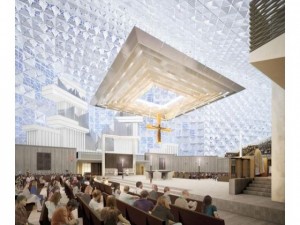
This isn't to say that church decorative styles can't progress past the 19th century, though. Fr. Dwight Longenecker recently wrote a very nuanced view of modern design in his assessment of the plans for California's Christ Cathedral. He pointed out that "the problem with traditional churches is that they can sometimes be no more than copies of earlier churches." Modern churches often deny continuity with the past, but that doesn't mean we can never leave the past, either. I especially liked his hypothesis that medieval Gothic architects would have gladly used steel beams if that material had been available to them. Praising the clean lines of Christ Cathedral's floating sanctuary canopy, he notes that it would certainly "be wrong to plonk down a baroque altarpiece or a gothic pulpit" in such a modern space.

Rendering of Christ Cathedral sanctuary.
This mis-matching of styles is sometimes an occupational hazard of traditional piety revival. Just as you wouldn't put a geometric Matisse painting in a gold rococo frame, you can't just slap more gilded columns on a modern church and call it a day.

Niagara University alumni chapel, above.
Divine Mercy parish, below.
For example, I ran into some interesting architectural combinations last weekend on the first leg of my Three Weddings and a Conference trips. First stop was the alumni chapel at Niagara University. This historic church at a Vincentian school blended old and new very well. You could tell which stained glass windows were from the 19th century and which were post-Vatican II, but there was still subtle continuity. The glass rood screen separting the main sanctuary from the smaller daily mass area was obviously a recent addition, but it featured traditional iconography of the four Evangelists and scenes from scripture. Sitting in its "rigid rows", I still felt secure and inspired, and not just because my friend was a gorgeous bride.

The next day I ventured to the parish closest to our hotel that fit our traveling schedule. It was a typical 1980s generic church design, with exposed brick, angular stained glass saints, and that wood beam tent/barn ceiling that was popular for a decade or so. The funny unexpected twist was the abundance of traditional devotional items scattered all around. These were probably inherited from a nearby parish that closed. It's great that these sacramentals still have a home, but boy, was it jarring. Pastel baroque curlicues do not mesh well with big blocks of brown and primary colors.This was one time where  a little modernist restraint would have helped.

Most interesting were the huge paintings hanging in the sanctuary, dating to the 1950s. One depicted the Holy Family, and the other showed the Catholic version of the Cleavers praying the rosary in their living room. It was a great piece of American Catholic material culture, but it clashed with the building overall. Thanks to the blinding morning sunlight coming through the windows, my little iPhone camera couldn't capture a good image of the paintings. In this mash-up of competing decorative styles, the best of both worlds got drowned out.


Friday, September 26, 2014

7 Quick Takes Vol. 28

I'm linking up with Jen Fulweiler for 7 Quick Takes once again this week.
  1. I've spent the past two weeks getting over strep throat, so there has been much laziness on the couch in sweatpants. The Southern Baron proved once again that Louisianans make excellent husbands by cooking me gumbo and gallantly fetching me all the seltzer my feverish heart desired.
  2. The one upside to being sick is that it gave me lots of time to catch up on online television like Ken Burn's new documentary The Roosevelts. It has a mellow vibe but is also fascinating, with lots of Aaron Copeland piano in the background. I learned all kinds of new facts, like how Teddy lost both his mother and his first wife on the same day, and how FDR wrote Hitler in the 1930s saying "Hey, here's a list of countries I'd really rather you didn't invade." Hitler's response was "Can you believe this idiot?"
    Thanks to cable TV, there are a lot of mediocre history shows out there that just recycle the same re-enactment footage and try to hook you at commercial breaks with salacious teasers. I was most impressed with how much detail and effort went into Burns' work. He features hundreds of archival photos, historic video clips, and shots of different Roosevelt homes. There's a reason he's the king of documentaries. If you missed the broadcasts, there's still time to marathon all 14 hours of it this weekend before PBS takes the videos down!
  3. To make things even nerdier, my household has gotten addicted to all the brain training game apps out there. The free versions all give you access to only a selection of games, but they mix up the roster daily so you never get bored. Lumosity is the elder statesman of the bunch, with a web counterpart. I really like Peak, which has basically the same puzzle games as Lumosity, plus a few more. It also gives you four games a day rather than just two. and they seem to be more difficult. And then there's Elevate, which favors practical skills over brain teasers. It pairs story-like animation with challenges of skills like listening, reading comprehension, and discount calculation. Basically if you wish you could do SAT problems on your phone while making a cartoon ship sail across the ocean, this is the app for you.
  4. This time last year we were new kids in our town and didn't know a soul. Now we have suddenly found ourselves deep into volunteering at our parish down the street. He's on the pastoral council, I lector and lead the fledgling Young Adult group. Oh, and we also agreed to take over the Advent Giving Tree. I have to admit, after years of parish-hopping and being commitment-phobic, it's nice to feel useful.
  5. At the parish picnic last weekend, we got caught up chatting with a Polish seminarian and were the last people to leave. Then we found ourselves at the priests' afterparty on the rectory deck, listening to some man's stories about being in the air force in the 70s. I guess we're in now! As Time Hawkins would say, "Start stackin' chairs."


  6. This recent Slate article about the insanity and uncertainty of the academic hiring process is some real talk that needed to be shared with the world. Please, for the love of Thomas Aquinas, do not EVER suggest that a grad student should send their resume to an ivy league school or ask where they are going to raise their future kids. They already know they made a terrible life choice by buying into a broken pyramid scheme.
  7. On a happier note, this week kicks off our month of Three Weddings and Conference. First stop: a mini reunion with my housemates from my Vincentian volunteer year. Niagara Falls, here we come!


Thursday, September 4, 2014

Fun Museum Finds

Summer's winding down, but I can't bear to think about long sleeves yet. It's been too much fun hanging out in the sunshine and taking road trips to new museums. Before we pack away the sundresses and sandals for good, here are some fun images of outdoor festivity that I've seen recently. 

To start off, here are two paintings from the series Apollo and the Muses at the Cleveland Museum of Art. 

Erato, the muse of Lyric Poetry on the left, is basically Taylor Swift's spirit animal. She's all billows and curls, sitting in a romantic grove with Cupid while she literally writes with one of his arrows. I imagine this is how Swift's Wall Street Journal article was also composed. "[People] are buying only the [albums] that hit them like an arrow through the heart ... and I'd also want a nice garden."

Meanwhile check out the epic side eye Clio, the muse of History is giving her. "Are you serious girl? I'm over here writing about wars and plagues and fallen empires, and you're sitting under a billowing canopy? I hope the Persians get you with a spear." The two paintings really are displayed like this, with Apollo between them.

I'm not exactly sure what the artist Charles Meynier meant here. Clio's expression is pretty hilarious - but hey wait, is he saying female scholars are all ice cold? Does he think history is just dust and monuments? I do like the suggestion that maxi dresses and serious business can go together, though. 

Speaking of summer fashions, lest you think flower crowns are a new trend, check out this etching from the print collection of Washington's Headquarters in Morristown, NJ. George Washington is entering Trenton victorious after  crossing the Delaware River to defeat the British. The city's daughters have turned out for the parade in their best music festival apparel. 


George Washington also spent some time in Brooklyn, although he wasn't as successful there. NYC wasn't quite as built up back in the 1770s, as you can see in this 18th century map from Morristown. I love the little soldiers marching along the palisades.


See Charles Meynier, even military history isn't completely humorless.


Friday, August 22, 2014

Is Courtship Fundamentally Catholic?

The current courtship resurgence is an interesting facet of the Christian "purity culture" that has sprung up in reaction to the sexual revolution and and divorce trends of the 20th century. Joshua Harris' I Kissed Dating Goodbye came out in 1997, and its spouse-finding philosophy has been a cultural and spiritual force ever since. I was 12 when Harris burst into the scene, and his writing influenced me and my friends in our teen years. Harris' antidote to hook-up culture has been around so long that there is now some backlash as my generation assesses its results.

Recently, former courtship advocate Thomas Umstattd wrote Why Courtship Is Fundamentally Flawed, arguing that the system misinterprets scripture and does not safeguard against divorce. Even Harris himself has warned against excessive courtship legalism that makes young couples afraid to even speak to each other. For every couple whose courtship resulted in a happy marriage, there are stories of overly controlling fathers or jerk suitors who masked their toxic personalities with lip service to "biblical marriage."

On the other hand, courtship is more visible than ever, with People magazine covering the Duggars' strict courtship rules. Fundamentalist groups host "purity balls" where girls in formal dresses promise their dads that they will remain virgins until marriage. These father-daughter dances and chastity pledges have garnered much media attention for being "like a wedding, except to your dad."

Swedish photographer David Magnusson's exhibit of father-daughter purity ball portraits is one recent example of courtship in the spotlight. Documenting families in Louisiana, Texas, Colorado and Arizona, he photographed fathers and daughters near their homes in their ceremony clothes. Portraits were done in the early morning, with subjects choosing their poses “in the light of the decisions you have made.” Magnusson's purpose isn't just curiosity, but cultural analysis. "I wanted to create portraits that were beautiful; images that the girls and their fathers would like to see hanging on their walls at home, while someone from another cultural background might experience the very same portraits in an entirely different way."
Pierce and Jasmine Nunley, Grand Cane, Louisiana.
By David Magnusson
At first, the portraits are off-putting. Seeing a gallery of grown men embracing young girls in wedding-like dresses feels really creepy. It's like an incestuous combo of a quincenera or debutante ball. But when you look closer, each pair has unique expressions of their relationship and motivations. You can see determination, courage, tenderness, trust, and protection. Magnusson has successfully worked with his subjects to create a complex work of art.

The Catholic Church doesn't have official dating policies, so the way Catholics view courtship is not unlike the possible reactions to Magnusson's portraits. Some people cringe at the strict rules, some find inspiration to create more boundaries in their dating life, and others are enchanted by the promise of purity and parental love. There's no one best way for finding your spouse, but Catholics should be careful to examine the theology of courtship more closely. Some weird idolatry can lurk under the surface.

To many, the concept of courtship is just shorthand for "pursuing an exclusive, chaste relationship with the intention of discerning marriage while consulting parental wisdom." At its most strict and biblically literal, though, courtship regards marriage as the transfer of a woman from her father's authority to her husband's. A father's permission is required for both courtship and marriage because he has the final say over his daughter's life. By doing so he reflects the role of God the Father giving Eve to Adam in Eden. The will of the dad is the will of God.

Frankly, my brothers and sisters, that is wack. Here are a few reasons why such scrupulosity isn't compatible with Catholicism.

Scripture does not depict strict courtship as mandatory or foolproof. As Umstattd points out, "Just because Jacob had two wives and a seven-year engagement does not mean that God wants all men to have two wives and seven-year engagements." In fact, Rachel and Leah's father abuses his authority to cheat Jacob. In the Book of Tobit, Sarah's father approves her marriage to seven different husbands, but each one ends in disaster anyway. Ruth bypasses courtship by pursuing Boaz, while Esther is sent to the king's harem against her male guardian's will.

The lives of the Saints don't embrace this type of parental control; in fact they often defy it. There are so many examples of holy women whose fathers opposed their desire for a life of celibacy. St. Catherine of Siena even chopped off her hair to keep her parents from marrying her off. The Catechism of the Catholic Church states, "Parents should respect [a child's call to the religious life] and encourage their children to follow it. They must be convinced that the first vocation of the Christian is to follow Jesus." (CCC 2232) Did Mary ask her dad's permission before she agreed to bear the Messiah? Nope, she said yes and then ran off to consult her female relative instead.

The Church teaches that girls should be taught "the right use of their reason and freedom," not protected from the world at all costs. (2228) At baptism, parents make promises of faith on behalf of their kids, but from then on children must cooperate with God's grace on their own. Elders can and should offer and advice and guidance, but your vocation is ultimately between you and God. As the Catechism states:
"Obedience towards parents ceases with the emancipation of the children; not so respect, which is always owed to them ... When they become adults, children have the right and duty to choose their profession and state in life. They should assume their new responsibilities within a trusting relationship with their parents, willingly receiving their advice and counsel. Parents should be careful not to exert pressure on their children either in the choice of a profession or in that of a spouse." (2217 & 2230)
The rite for the sacrament of marriage does not ask the father of the bride to "give this woman," a patriarchal moment that courtship fundamentalists often cite. The father does not take the place of God; we already have ordained priests to act in persona christi. In fact, the couple themselves are the ministers of the sacrament of marriage. "The Church holds the exchange of consent between the spouses to be the indispensable element that 'makes the marriage.'" (1627) Their covenant reflects the wedding feast of the Lamb in heaven, where the victory of Christ the new Adam is complete. 

Even though it appears charmingly old-fashioned and wholesome, strict courtship is neither a magic bullet against sin nor an oracle of God's will. If you need a framework of bureaucratic oversight and final veto power to prevent your daughter from making a bad choice in marriage, then her adult conscience is poorly formed.This doesn't mean that fathers don't have a role in their daughters' choice of a husband. Good male role models are essential to help a girl learn what to look for in a spouse.

I'm grateful for my own dad's example as a smart, generous, hardworking, tender-hearted husband and father. He's one of the people I admire most in the world, and I respect his opinion. I know if I had dated a guy who was a jerk, my dad would have told me his concerns. But after spending the first 18 years under the care of a man who loved me selflessly, why would I settle for anything less in my adult life?

One of my favorite memories of my dad is how he put up with my shy temperament as a little girl. I was too scared to enter school alone, so he would walk with  me to my 1st grade classroom every morning. He knew this couldn't go on forever, though, and he kept encouraging me to have confidence. "Maybe today I can walk with you just until the lobby tile ends, how about that?" he'd say. He took good care of me, but knew part of that care was teaching me to walk out on my own.

Thursday, August 14, 2014

Of Museums, Monsters, And Men

Last week my cousin got married in Chicago, so we road tripped back to the Midwestern motherland for a family reunion. Along the way we found lots of cool history nerd places to visit, including thefor a Field Museum, which has great lakefront views, and the Cleveland Museum of Art, which has a gorgeous building and amazing new interactive technology displays. If you're ever driving through Ohio it's definitely worth a stop!


As I walked through halls of dinosaurs, ancient artifacts, and taxidermy specimens, verses from the Book of Job kept floating through my mind. Somewhere in Pennsylvania I had read its last few chapters aloud as part of the Office of Readings. Have you ever read the whole story of Job? It's way crazier than the usual summary of "Man loses everything but trusts God." There are pages and pages of esoteric speeches about the meaning of life while Job's knucklehead friends tell him he's suffering because of his sins. Finally God speaks and shuts up those morons. He tells Job to "Gird up your loins now, like a man," and then, frankly, He gets a little sarcastic. (In the King James translation Chapter 38 sounds like a string of Shakespearean insults.) Basically He's got a lot on his plate and you don't even know the half of what His job entails.
Have you ever in your lifetime commanded the morning and shown the dawn its place
For taking hold of the ends of the earth, till the wicked are shaken from it? ...
Have you comprehended the breadth of the earth? Tell me, if you know all...
Has the rain a father; or who has begotten the drops of dew?
Out of whose womb comes the ice, and who gives the hoarfrost its birth in the skies? 
Seriously, God is busier than Mufasa.
Do you hunt the prey for the lioness or appease the hunger of her cubs
While they crouch in their dens or lie in wait in the thicket?
Mountain goats, ostriches, wild oxen and asses, hawks, and noble steeds - God directs them all. He even created some mammoth monsters.

Behemoth "carries his tail like a cedar; the sinews of his thighs are like cables. 
His bones are like tubes of bronze; his frame is like iron rods."

Sue the T. Rex, Field Museum

When Leviathan "rises up, the mighty are afraid; the waves of the sea fall back ...
He regards iron as straw, and bronze as rotten wood ...
Who can force open the doors of his mouth, close to his terrible teeth?

Jonah Cast Up, 3rd Century, Cleveland Museum of Art
I'm still pondering what God's speech to Job exactly means. Its purpose is to debunk the loser friends' claim that Job's sufferings are punishment for his sins. So what is the real reason? Are our human problems puny compared to the wide cosmic actions of the universe? Should we trust that God is in control because He makes the sun rise and set every day? Or is the world so vast and mysterious that we can never fully understand why things happen the way they do?

Either way, it's clear that humanity has been marveling at the power of nature since the world began. Pondering these things is part of who we are. And honestly, I've found some comfort in thinking about those mountain goats crouching down in the desert and the "storehouses of the snow."