Friday, May 18, 2012

7 Quick Takes, Summer Break Edition

Thanks to Jen at Conversion Diary for hosting!
  1. It really feels like summer break has started. My sister is home from college, my temp job has ended and I have ton of free time, and Brother #2 has finished his master's thesis. Let the movie marathons and outdoor frolicking commence! In the morning, I'm making waffles. 

  2. One of my goals for my time off is to work on the church architecture research that I hope to publish. There are so many interesting new churches with traditional flair in the Arlington diocese. 
  3. St. Raymond of Penafort, one of favorites from my last round of photography. 

  4. The Betrothed and I have set our wedding date! June 15, 2013 will be exactly 3 years and 10 months since we met on the Feast of the Assumption.  

  5. Before I started all this marriage paperwork I had no idea how Catholic churches keep track of their membership. Did you know that the parish where you were baptized keeps the official record of all your sacraments for the rest of your life?  The archival nerd in me is excited about how nationally organized this is. So I had to call a church across the country in Arizona where I have not been in 26 years. "Ok we'll call you when your baptismal certificate is ready and you can pick it up!" Umm, yeah, about that. 

  6. Speaking of wedding prep, I signed up for Weight Watchers online this week. Cliche bride activity, I know. But I have a big goal to reach, and it's nice to someone else calculate things for me. Anyone have advice about how to succeed with the program?

  7. Last week I went to the Young Professional's Happy Hour at the Catholic Information Center downtown. It's a bookstore and chapel run by Opus Dei, and it has by far the best Catholic book selection I've seen in the area outside of a shrine gift shop. As an added bonus, Dr. Helen Alvare was the speaker. She pretty much knocked my socks off with her legal arguments about religious freedom. I kind of want to be her when I grow up. Listen to a podcast of her talk here - you will not be disappointed. 

  8. Thank you for all of the great comments on my post about being underemployed. It's good to know other people are dealing with the same challenges of trusting God's plan. Speaking of which, while wandering from the Metro to the CIC, I passed this banner on a Christian Scientist building. It made me smile. 

Wednesday, May 9, 2012

How Not to Talk About Underemployed People

There's been a lot of backlash to the Obama campaign's "The Life of Julia." This slick little slideshow shows a woman going through life relying on government funding, even though mean ol' Mitt Romney wants to rip those benefits from her hands. Like all campaign literature, it oversimplifies things and sounds slightly condescending.

One recent response to it really burned me up, though. Sure, I agree with "The Life of Emily" as a rebuttal of government paternalism. I bet if I met the author, Emily Stimpson, in person, we'd have a lot in common. Her story of success as a professional young woman is inspiring. Making it as a free-lance writer is hard, and she's totally convinced me to open a health savings account.

But her tales of job success hit too close to home for me. It felt like the name-dropping and insensitive boasting of a smug class valedictorian. Sure, she's smart and diligent, but she also got many lucky breaks. One of those was being born 7 years before I was. Right now, there aren't enough merit scholarships and entry-level jobs to go around for even the hard-studying A-students. This sentence in particular burned: "It would never occur to her to still be on her parents’ plan, even if she could. After all, she’s 26—an adult." Well yahoo. I guess that makes me an infant.

Via Economic Policy Institute
To top it off, Emily's readers decided that I and other underemployed people who commented were whiny morons lacking American values. Their kids could pay for insurance straight out of school, what's wrong with us? "A master's degree does not entitle you to a job with benefits," scolded one person. He implied I should have gone to trade school instead. The flurry of "dislikes" felt like a spit in the face. These pharisees pointed at me, the 27-year old living with her parents, and said "I thank you, O Lord, that I am not like that."

I know, I'm talking about internet comments from strangers here. It doesn't really matter. But this was on a Catholic website. For the first time, I felt attacked personally by my own kind. I couldn't believe the ignorance and lack of compassion.


The "American Dream" is not in the Apostles' Creed, people. Our economy is in flux right now - a college degree doesn't ensure a job anymore. People are relying on their parents for longer into adulthood. The recession is not over. Who knows what career path advice kids will get in five or ten years.

If I were to write "The Life of Sarah," it would read like Emily's, but with more ups and downs. Mine is just one story, and I know there are many people worse off than I. But I am an example of how fortunes can unexpectedly change, and how hard work and good grades don't always win you success. My odyssey into adulthood also shows how sometimes, you need a helping hand.

I went to a state university for the lower tuition, taking out loans and working part-time jobs. At age 20 I contracted a chronic circulatory condition and had to take a year of leave from school. For the next 5 years, this "pre-existing condition" would prevent me from getting coverage outside of my parents' insurance plan. If I didn't have insurance, I couldn't get the medication I needed to function. So yes, I relied on my parents into adulthood.

At age 23 I spent a year with the Vincentian Service Corps in St. Louis. There I saw firsthand how government aid could help some people, like the mom of 5 who used housing assistance money to move away from her abusive meth-addict husband. I also saw the heavy costs of family decline and sexual irresponsibility. I learned how some people just wanted a handout, but all the money in the world couldn't replace the value of caring, challenging mentors. All this time I made $300 a month, so obviously I wasn't building a nest egg. It was worth it.

Source
At age 25 I was in a competitive master's program that provided a tuition fellowship and stipend. I could not have afforded grad school any other way. When my Dad lost his job, I emptied my "wedding dress slush fund" savings into COBRA fees to extend my insurance coverage. A generous gift from a relative helped me pay these fees and buy a very sensible, very used car. My cardiologist declared me mostly free of symptoms, and so I could finally purchase basic insurance through my university.

At age 26 I got my master's, but not a job like most of my classmates. I moved back in with my parents and worked odd jobs all summer. In a stroke of luck I got an entry-level temp job, replacing an accounting department's college intern. My hourly wage job allows me to pay for my insurance, as well as out-of-pocket treatments for a back injury.

Now at age 27 I know I must help pay for my wedding, but have no idea where I'll be working in a month. A lot of my peers save money by shacking up with significant others, but obviously we won't do that. I'm determined to have Depression-era pluck, looking for whatever gigs I can find. Substitute teaching? Museum volunteering? A temp agency? I'm also going for the novena mother-load, the 54-day rosary. My path is not what I envisioned at age 20, and I do not wish it for my younger siblings. But I refuse to condemn myself for circumstances in some part beyond my control.

So if you want to talk to the Kids Today about their jobs, realize that it's always more complicated than it looks. Here are a few tips.

  • Don't conflate individuals with economic trends. Should we have a national conversation about how college is overpriced and maybe not worth it for everyone? Absolutely. But that doesn't mean you should point at a deep-thinking liberal arts major and tell him he should have been a mechanic instead. Don't grill him about whether it's time to "give up" on his field. 
  • Read this recent piece about the surprising number of PhDs on public assistance.  Realize that not everyone on food stamps is a welfare queen - sometimes ambitious, intelligent people turn to welfare as a last resort. 
  • Don't tell a recent grad "Oh, but aren't there lots of companies in your field where you live?" Yes, we know, as does everyone else with our degree. This is like telling a single woman "Oh, but there are lots of cute guys in your area. Have you tried going to bars?"
  • Don't yap about how you or your kids or cousin or brother was a wild success right out of school. 
  • Do refer underemployed young adults to job openings or to people who might be good professional connections. Whom you know matters, more than ever. 
  • Do offer practical interview advice based on your own experience. Express sympathy when they get turned down after an interview. Assure them that they are just as capable as their peers; that a lot of this is mysterious luck.
  • Do cheer them on with small successes, like part-time retail jobs. Don't lecture them about counting their blessings. They know. 
  • Do tell them about sales on professional wear at the local outlet mall. 
  • Do offer to pray for them. Only God knows how we'll get out of this recession mess. 
Any other job-seekers reading this? What would you add to my list? 


Tuesday, May 1, 2012

St. Joseph the Worker

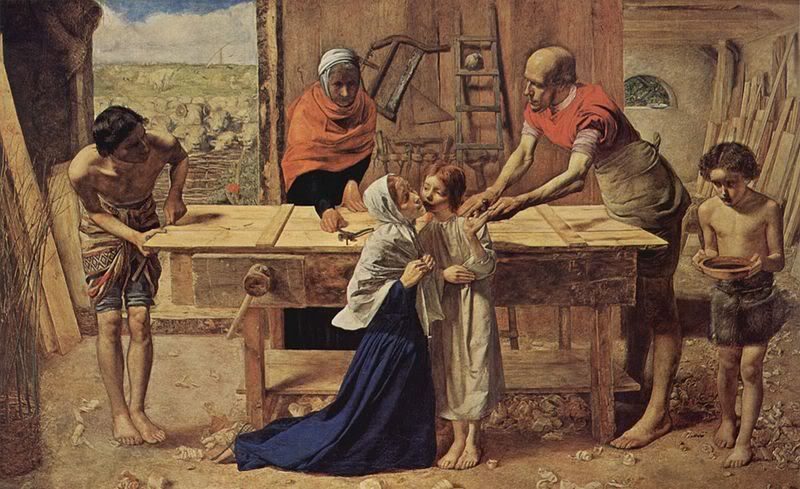
Teaching young Jesus how not to lose a finger to a plane.
Today is the feast of St. Joseph the Worker. This is a young saint day, established by Pope Pius XII in 1955 in response to Communist "May Day" celebrations. Other countries still observe May Day/International Worker's Day. (This includes my Romanian colleagues, lucky ducks.) Dear St. Joseph really does deserve extra days dedicated to his awesomeness. His wife has about a bazillion, after all. His vocation as spouse, parent, and laborer is something anyone can relate to.

Those are some legit clamps on that work bench. Source
I really could use some help in the labor department these days, since I'm still an underemployed twenty-something. The museum of my dreams liked me a lot, but decided to hire a good friend of mine instead. This one hurts. I hope that place and I can "still be friends," but this does feel an awful lot like a prom love triangle. To top it off, my awesome temp job is finally ending.

I feel terribly adrift, but really this change is the best thing to happen in a while. It's time for something new. Despite all the uncertainty, I have a feeling that God wouldn't let me lose my job unless He had something better in store. Guess I'll fire up the novenas again.

By John Collier. Via Terry Nelson at Abbey Roads

Last weekend I went to confession at a nearby church named for Jesus' foster father. As I knelt before his statue, I looked up and noticed the hatchet in Joseph's hands. And realized I'm an idiot.

Who better to ask for help in my job search than the patron saint of workers? Wouldn't Joseph love to examine some historic furniture with me? I'm sure he'd be great at identifying wood types or tool marks. Did he, like me, make a mess of things the first time he tried to use a gouge? Did he sneeze from all the wood shavings in his nose? I wonder what he would have thought of Thomas Chippendale's Director.

I tried some planing in Colonial Williamsburg last year. Photo courtesy of JRG. 
So St. Joseph the Worker, please pray for me to find a job. And pray for everyone adrift in this messy economy of ours, whether they are new graduates or old veterans hoping to retire. Remind us that no work is pointless if it's done for God.


Sunday, April 29, 2012

Can Motherhood and Graduate Degrees Mix?


I'm late to the party for this week's Bright Maidens topic, but I've really been enjoying everyone's contributions. The dilemma of stay-at-home mom vs. working mom is one that I wrestle with. I'm still asking God to show me the proper balance between my scholarly goals and my desire for motherhood.

Source
I'm blessed to have a mother who left her physical therapy career to raise her children full-time. My mom hasn't been formally employed for 27 years, but I've always known that she works as hard as any CEO. Creating a loving home and family is her mission in life, and I admire her dedication to it. As the oldest of 5 kids, I was her assistant from an early age. I'm proud of the skills I've learned at home. I can cook for a crowd, grocery shop strategically, hem pants, plant flowers, paint a living room, and jump-start a car.

On the other hand, I can identify with some women's professional angst . Grad school messes with your head in many ways, and that includes how you think about parenthood. After spending years of blood, sweat, and tears on an advanced degree, all you can think about is getting a job that will let you use it. When you make the "terrible life choice" of grad school, you make a commitment to a field you are passionate about. I didn't set out to follow a different path than my mom, it just happened that way.

When I graduated from college with no marriage prospects, I figured I might as well pay the bills doing something I loved. Thanks to Divine Providence, I started a competitive master's program ... and met my future husband two weeks into the school year. The Betrothed's love for history and Catholic family life both made me fall in love with him. I had happy daydreams of us being one of those faculty couples beloved around campus for their dinner parties, cute kids, campus ministry involvement, and banter-filled joint lectures. Here was someone who understood all the things that I valued, both sacred and secular.

It's sad to see how children can be a professional afterthought for academics. Some people in our fields would say to delay kids until tenure or several job promotions. (Waiting for pregnancy until your late 30s always works out well, right?)


That kind of attitude looks at just half the picture. Scholarly publications can feel like birthing a child, but they don't really go on to have developing lives of their own. They sit on shelves collecting dust until someone makes future grad students read them. Academia doesn't love me back, or need me to teach it what life is about. Sitting alone in an archive is cold and lonely. No one coos about how adorable your Chapter 6 footnotes are. (If they do, they need help.)


When I see examples of women writing dissertations while pregnant, I feel like there is hope in the world. It may not be possible to have it "all," but I would love to try to have at least some. I deeply desire to have a family with my historian fiance, but I have also been fighting long and hard to break into the museum field. Both parts of my life are valuable to me.

Making family a priority might be a counter-cultural choice that will keep me from becoming a super-famous and powerful curator, but I'm ok with that.When I freak out the logistics of my future motherhood, The Betrothed is always level-headed. He reassures me that his professor schedule won't be a typical 9 to 5 gig. Sometimes he'll gently chide me, saying "Hey, you're forgetting that there's another adult in the equation here!" It's so encouraging to know that raising a family is a project we'll tackle together. As Jen Fulweiler recently pointed out, fatherhood is a man's vocation, not his career.

So what kind of mom will I be? I have no idea.  Will The Betrothed and I be able to balance our work schedules so one of us is always home? Will I chase after little ones during the day and then work on a journal article after they're in bed? Will I leave my field altogether, or will I go back for a PhD once the kids are school-aged? It's too soon to tell. For now I just have to keep asking God how I'm supposed to serve him with all my abilities.

Any over-educated moms out there? I'd love to know how/if you balance scholarship and parenthood.

Tuesday, April 17, 2012

Florence + The Machine + Divine Mercy

Somewhere in between thesis chapters I got hooked on the ethereal power-ballads of Florence + The Machine last year. Florence Welch's lyrics get more interesting with each listen. In particular, the song "Blinding" from her first album can have several different interpretations. At first glance, it's about a girl realizing she needs to break free of a toxic relationship. But one line tipped me off that it could also reference Mary Magdalene on Easter Sunday.
 "No more dreaming of the dead, as if Death itself was undone.
No more crying like a crow, for a boy, for a body in a garden

Noli Me Tangere, Lambert Sustris, late 16th century

In the song, realization of truth overwhelms the subject both emotionally and physically.
Felt it in my fist, in my feet, in the hollows of my eyelids
Shaking through my skull, through my bones, and down through my ribs.

Like a repentant sinner freed from the seven demons that plagued her, the song's subject has rejected her past ways forever.
No more dreaming like a girl, so in love with the wrong one...

And I could hear the thunder and see the lightning crack
All the world was waking, I never could go back. 

Mary Magdalene's encounter with Jesus, both during the thunderstorm at the foot of the Cross and then at His Resurrection in a garden, gave her the strength to change her life and brought her into a new reality of redemption.
Noli Me Tangere, Martin Schongauer, 15th century
Their meeting on Easter Sunday is one of the most poignant scenes in literature. Her heartbreak, confusion, and final joyful surprise get me every time. Jesus' line of "Woman, why do you weep?" is so succinct and compassionate. He doesn't tell her she's wrong or that she should shut up and stop crying. Instead, he gently reveals the redemptive truth that things are better than they seem. Those words were a great comfort to me on one spiritually difficult day in my teens, and they still are.

This is how I imagine Divine Mercy working. We come to God contrite, sorrowful, and He saves and forgives us with great Love. In the past year I've lost sight of that somewhat. I've let discouragement over my job search wear me down, and I've listened to the lying voices that tell me I'll never be good enough, that I have accomplished pathetically little in my 27 years, that God has forsaken me and the people I love. That is not the truth, and I have been slowing waking up to the reality that God's plan is always good, even if it's not my own.

Continuing my novena addiction, I prayed the Divine Mercy novena this past week. On day 4 I got an interview with one of my favorite museums, and on day 9 another company asked to interview me.I don't deserve it, but God has been very merciful, and I feel rich in Faith, Hope and Love.


Friday, April 6, 2012

Wounded

I am forgotten like the unremembered dead; I am like a dish that is broken
Psalm 31 


"The 5 Wounds of Our Lord" from The Glossary of Ecclesiastical Ornament &Costume
by A.W.N. Pugin, 1844. March "Print of the Month" at the Victoria and Albert Museum. 

 My life is like a broken bowl,
 A broken bowl that cannot hold 
One drop of water for my soul 
Or cordial in the searching cold; 
Cast in the fire the perish’d thing; 
Melt and remould it, till it be 
A royal cup for Him, my King: 
O Jesus, drink of me.


Tuesday, April 3, 2012

Girl-Power Bible Movies

This Lent I've had less time for my traditional Jesus film festival, but I have managed to catch a few Biblical epics. Somehow they've all been about Old Testament  heroines. I realized this is completely appropriate considering how prominently women feature in the Good Friday and Easter Gospel accounts.

Giorgio Vasari,
Judith and Holofernes, c.1554.
St. Louis Art Museum.
Those are the ripped shoulders of
a woman saving her people. 
Women are everywhere in the story of Holy Week. For some reason most are named Mary, and they're always present. They have a lot of feelings - there's a lot of crying - but they also get. stuff. done. When they make big displays of foot-anointing emotion, Christ is appreciative, not dismissive.Whether wiping Jesus' pained face, anointing His body, or learning about the Resurrection while the guys cower in fear, these women serve God in powerful ways. Salvation history would not be the same without them.

The ladies of the Old Testament are the same way. It's a shame there aren't more movies about them, because their stories are laden with peril, drama, romance, and even comedic timing. That's Hollywood gold, people! I get why there are no R-rated films where Judith and Jael slaughtering enemy generals, but there's a lot of untapped cinematic potential.

At a church gathering last weekend, I was astonished how many people were unfamiliar with the story of Esther, another brave woman who rescued her people from destruction. So here are recaps of four movies that do exist about Ruth and Esther. Their books of the Bible involve women in unconventional families navigating assimilation, inter-cultural marriages, legal loopholes, family loyalty, deep devotion, and life-and-death situations.

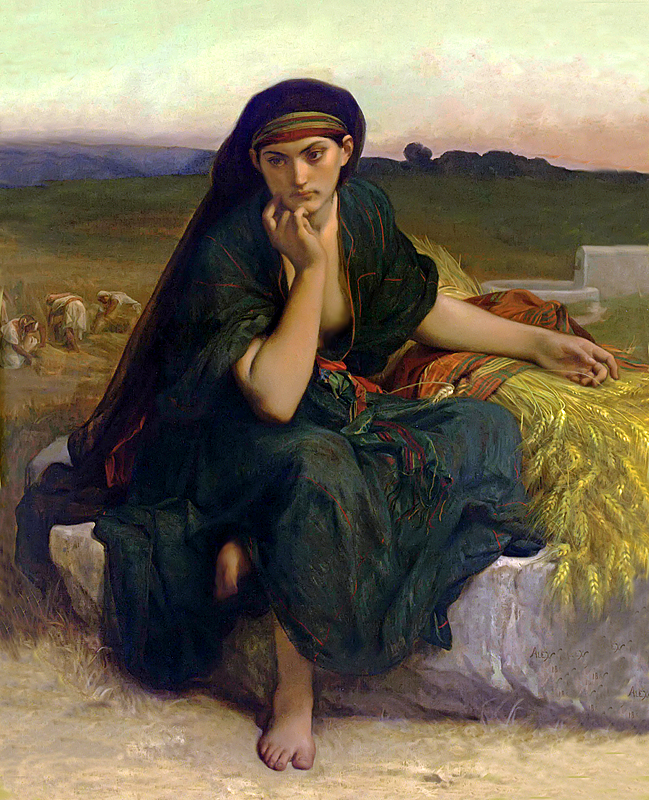
Alexandre Cabanel,
Ruth glanant dans les champs de Booz, (1886),
Musée Garinet, Chalon-En -Champagne.
Ruth dates back to the time of the Judges - she's King David's great-grandmother! She's also the first convert in the Bible. Born in Moab, she marries into an Israelite immigrant family. After famine kills all the men in the family, Ruth sticks by her mother-in-law Naomi, proclaiming "Your people will be my people, and your God will be my God." What are two widows to do? Head back to Bethlehem, where Ruth finds love with grain farmer Boaz. Another distant relative attempts to claim Naomi and Ruth's estate, but God's providence wins out in the end.


Creative License:
This film imitates the epic visual style of The Ten Commandments, and gets very creative with Ruth's backstory. Young Ruth is content living in the temple of Moab's Aztec-like child-sacrificing god, until she engages in some playful theological banter with Malon, a Jewish silversmith. He awakens her heart to God's law, but Moab's rulers are obviously not pleased by her new skepticism of their religion. After the authorities kill the men of Malon's family, Ruth and Naomi set out for Bethlehem. There, they find the kindness of Boaz but also a rival suitor and some neighbors who aren't crazy about the new pagan priestess next door.

Dramatic Themes: 
The Israelites in Moab have assimilated well, perhaps too well. Naomi's son Chilion boasts of how well he and his Moabite wife Orpah are accepted in society. Unfortunately, human sacrifice is accepted in that society. When Malon objects, his family literally says, "C'mon, you know the Moabites are sensitive about their human sacrifice."
The law and its demands are key. Malon gives Ruth a pendant of the 10 Commandments, but later the people of Bethlehem put her on trial for her pagan history. 

Huh? moments: 
Ruth spends her vestal virgin childhood in what is basically a glam convent. Seriously. She and the other girls wear matching outfits borrowed from Katy Perry. Women in long black veils oversee them and teach them to memorize prayers. Is this some anti-Catholic bias? Also, their god looks like a character from the Far Side.
Boaz is sadly less handsome than the ill-fated Malon. His tunics with thigh-high slits don't help matters.

The King of Moab inspects the glam convent. 
Overall rating: 
3.5 out of 5. 1950s silliness aside, the movie has a good pace and draws you in. If you overlook the creative additions, it's not a bad retelling of Ruth's story. I found it genuinely inspiring. 


Creative license:
Grandpa Obed narrates the story of Ruth and Naomi to a teenage David who just can't get his slingshot aim right. Naomi and her family continue to trust God, even though things look bleak and their Moabite neighbors say the gods are cursing them. (Orpah's mom is particularly obnoxious.) Both of Naomi's sons die onscreen, then Ruth and Orpah argue about whether to stay with their mother-in-law.

Dramatic Themes:
This is a matriarchal society, no doubt. Most lines are spoken by female characters, and their relationships are at the forefront. Naomi is the real protagonist of this adaptation, dispensing motherly life advice constantly. The action moves at a glacial pace, mostly because all the women take forever to finish talking about their feelings.
Huh? moments:
Costumes and sets are pretty amateur- a table is clearly a sheet of plywood, "grain" is a straw bale from a farmer's market, wooden spoons came in a 4-pack at Wal-Mart, women are all wearing mascara and mauve lipstick under their makeshift veils.
When Ruth goes off to woo Boaz at the harvest festival, Naomi gives her a "beautiful new dress" that looks like a hideous striped vest.
Pentecostal music artist Carman makes a "celebrity" cameo as Boaz. His 1980s "Sunday's On the Way" album is a cult favorite in my family, but here he looks like a skeezy lounge singer wearing Mardi Gras beads.
Overall rating:
1 out of 5. The sincerity and earnestness of this production cannot, unfortunately, hide its poor production values and bad acting. If I saw this production in a church hall, I'd be impressed; as a feature film it's unwatchable. I had to skip ahead in 20 minute increments so Naomi would get to the point. Maybe a Sunday school class could overlook the glaringly modern language and lip gloss, but they would still get bored. 

Edwin Long,
Esther, 1878,
Private Collection.
The book of Esther essentially tells two stories about Israel's Babylonian exile and diaspora. One involves political scheming and the other reads like a fairy tale.  ived a fairy tale-like story . The tale begins with some flat-out chauvinism: Queen Vasti refuses to appear before the King Ahasuerus' drunk friends, so his advisers have him divorce her. Jewish orphan Hadassah/Esther is among the young women chosen for the "find a new queen" beauty pageant. After a year-long makeover, she captures Ahasuerus' affections, but keeps her Jewish identity secret. 
Meanwhile, her cousin and foster father Mordecai has saved the king from an assassination attempt. Unfortunately, refusing to bow to ambitious courtier Haman has also won him a mortal enemy. For revenge, Haman orders extermination of all the Jews. Esther risks her life by going before Ahasuerus unbidden to expose Haman's plot and plea for mercy. She swoons, the king listens, Haman is defeated with some deliciously poetic justice, and the Jews are saved. The holiday Purim celebrates this every year.  

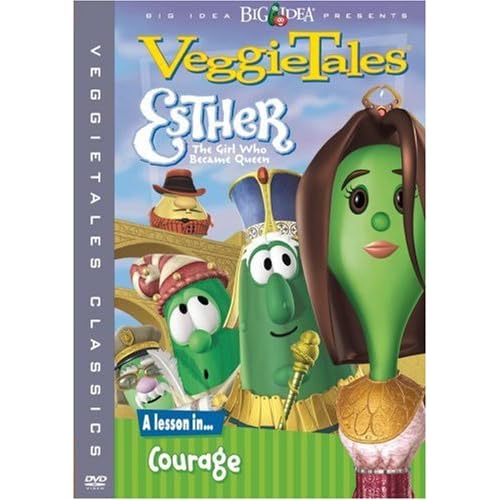
Esther: The Girl Who Became Queen (2000)

Creative license:
Yes, this is a Veggie Tales video. There are singing vegetables. Haman wears a pinstripe suit, Vashti gets thrown out for refusing to make the king a sandwich at 3 a.m, and traitors are banished to the Island of Perpetual Tickling. It's delightful.

Dramatic Themes:
The goodfella narrator starts off by talking about destiny and greatness. Young Esther is confused about her sudden destiny as queen, and begs God to show her what the point of all this is.
Since this is for young kids, the script downplays the romance. Esther is chosen because she sings well in the talent portion of the queen pageant. Her only affectionate moment with the doofus king is when he calls her "Queenie-poo."
Did I mention the gangster accents? Haman's beef with Mordecai is presented as a fight between two "families." The infamous Pea-oni brothers try to kill the King by dropping a piano on him.
Huh? moments:
Again, this is a Veggie Tales video. A scene of Haman and the King playing Trivial Pursuit while eating Chinese take-out at Esther's feast is just one of the apocryphal moments. If this bothers you, there is a chance you might take life too seriously.
Overall rating: 
4 out of 5. The colorful insanity is fun and good-natured, while the plot genuinely sticks to the main events of the Biblical account. The Book of Esther will sound very familiar to kids once they can read it for themselves.

One Night With the King (2006) 

Creative license:
This is a pretty faithful retelling of the Book of Esther that ramps up the political intrigue aspect. Minor characters get much more screen time, like the head eunuch who favors Esther. Many scenes were filmed in India, so there are lots of colorful textiles.
Despite its sensual-sounding title, this film tells a very G-rated love story fraught with the mis-communication common in romantic comedies. Esther longs to visit Jerusalem, but her priorities quickly change when she meets Fabio-like King Xerxes. Then he sees her sneaking off to meet Mordecai and assumes she's cheating, while she worries that he will cast her off like Vashti. (They should have addressed that in Pre-Cana.) Is their love doomed?

Dramatic Themes:
Again, Esther's story evokes musings on destiny and greatness. Our heroine is really named Hadassah, but Morcedai gives her a Persian name to disguise her Jewishness in the palace. Later she observes that Shadrach, Meshach, and Abednego, and even Jacob, were given new names.
The Persian Jews struggle with how much to adopt their country's ways. A visitor from Jerusalem even asks if Mordecai has sold out.
The script links Esther's secret Judaism to her necklace etched with anachronistic stars of David. It's a hokey plot device that distracts from the original drama of Haman's comeuppance.
Huh? moments:
In the biblical account Esther and Mordecai have a friend among the palace eunuchs who delivers messages for them. The script writers achieve this by having Esther's sort-of boyfriend get rounded up and castrated in a palace hiring surge. It's awkward when he begs her to escape with him and she shoos him away. (It's also incredibly awkward to explain eunuchs to your 12-year-old brother during a movie.)
Much is made of Persia's Greek enemies and their dangerous "democracy." Haman warns an angry mob that both Jews and Greeks claim "All men are created equal." I could go on all day about this historic oversimplification, but I'll spare you.
There are several notable cameos, including Omar Sharif and two LOTR alumni. Peter O'Toole gets top billing but only appears for about 30 seconds as the prophet Samuel. He spars with King Saul and then hacks the defeated King Agag apart offscreen. (It's in the Bible. Really.)
There are also some crazy hats. 
Overall rating: 3.5 out of 5. Its has a lower-budget indie feel, a cartoonishly evil villain, and too much narrative padding, but this film is still pretty to look at and heartwarming to watch. All the main elements of the Esther story are there. A confirmation class would not get bored watching.

So this Holy Week, as we sing the Stabat Mater and remember the women who mourned Christ, think of the long line of brave women who prefigured them. We daughters of Eve and of Mary have a rich heritage of love, devotion, and courage. That really ought to be on movie screens more often. 

Thursday, March 22, 2012

SIlent Retreat Reflections

A few weeks ago I went on a silent Ignatian retreat. The Betrothed is a big fan of such things, but had never tried one. To me, a retreat means campfire singalongs, craft projects, and talking about feelings. I  was a little skeptical about being trapped alone in silence, but the weekend ended up being fantastic. Even if I did get lost on the way there because I was so busy rocking out to Mumford and Sons that I missed my turn in the rainy dark. 

I was afraid of silence. I was afraid that I would go crazy with my own thoughts. Instead, it was the perfect break for an introvert like me. I didn't have to make awkward small talk over breakfast, I didn't have to worry about sitting in the wrong place and breaking up a conversation. It was great to just read, think, pray, and do whatever I felt like. 

Also, I was not in silence alone. The priest's talks throughout the day had wonderful insights about prayer, discouragement, and the desires God has placed in our hearts. Once we could talk on Sunday, I met some great people whom I may run into again. And of course, God was there the entire time. He was easier to hear than usual. 


I took some photos around the Arlington Diocese's lovely San Damiano Retreat Center. It was built as a Franciscan novitiate house in the 1960s, but has been renovated. One of my favorite parts was the collection of photos of Arlington churches that decorated the hallways. The cozy library with free books was just the icing on the cake. 

If you're curious about silent retreats, I highly recommend giving one a try. Bring a good map, but don't be afraid to crank the Mumford and Sons. Their lyrics can be quite appropriate. 

Don't leave me alone at this time/ For I'm afraid of what I will discover inside. 


Now let me at the truth/ Which will refresh my broken mind. 


Stars, hide your fires/ These here are my desires/ And I won't give them up to you this time around.


There is a design/ An alignment to cry/ At my heart you see/ The beauty of love as it was made to be. 


Get over your hill and see/ What you find there/ With grace in your heart/ And flowers in your hair.  


Lead me to the truth and I will follow you with my whole life. 


Sunday, March 18, 2012

7 Quick Takes Volume 19

I just realized I have been numbering these all wrong; I've done way more than I thought. Thanks, Jen for hosting. And for keeping the link-up open all weekend for procrastinators like me.

1. Yesterday I moved to a new desk at my job for the fourth time. Some people are annoyed that 7 of us are sharing a room, but I'm just happy to be within earshot of my department again.

2. I am determined not to pay full price for a gown from a bridal salon, but that didn't keep me from trying on dresses last weekend with my sister and mom in tow. It's funny how things I liked on paper look silly on me in person, and how my attitude toward wedding dresses has evolved now that I am engaged. With every dress, I pondered "Would I want to be the minister of a sacrament in this dress?" What I like to wear to a party and what I want to look like for a life-changing solemn moment are different. Textiles have meaning, you know ;-)

3. Still, wedding dress ads are pretty entertaining for their sheer ridiculousness alone. On my material culture blog I wrote about some that featured zombie models and classic Hollywood references.

4. I've been trying not to focus on the HHS mandate as much, because it's just stressing me out. But I couldn't help laughing at this juxtaposition of articles in my Facebook newsfeed: a piece from the feminist website Jezebel entitled "Law Will Allow Employers to Fire Women for Using Whore Pills." immediately followed by a Human Life International article, "The Assault on Femininity: Is Fertility the Next Down Syndrome?"
Both articles were not afraid of hyperbole, but obviously I'm more inclined to agree with the latter. The politics of fertility - it's a big deal, ya'll.

5. This year's gluten free Irish soda bread turned out pretty well. Baking with teff flour is always weird - things can come out dry and a little greenish. But this loaf is pretty tasty with butter and a schmear of marmalade.


6. I've been a little bummed that The Betrothed isn't around to go see the cherry blossoms, try new restaurants, go to daily Mass etc. But this afternoon I decided "Screw it, I'm going on adventure by myself." So I drove the 30 miles downtown to attend Gregorian chant vespers at St. Matthew's Cathedral. It was awesome. Then I took a long walk down 16th Street, which ends in...the White House! That was also awesome. As were the blossoming trees and the windows-down weather. Solo excursions can be fun.

7. It's the 4th week of Lent - Happy Laetare Sunday! I'll leave you with Matisyahu's reggaeton version of today's responsorial psalm.


Wednesday, February 29, 2012

How planning a wedding is sort-of like writing a master's thesis.

Via StyleMePretty.com
It's true, I met my future husband on only the second week of grad school. If I hadn't moved to Delaware, we would have never crossed paths on OK Cupid. Still, I don't like to think that the purpose of those two years in the library were just to get my Mrs. degree. When I applied to my grad program, I had never been so sure that God was calling me to a place where I could develop the gifts and talents He gave me. My M.A. helped me grow intellectually and aesthetically. Even if I haven't found a job in my field yet, the benefits of grad school go beyond the ring on my finger.

But, I have to admit, writing that vestment thesis was really good training for getting hitched. Sure I can do this wedding planning stuff; I spent an entire year on a massive project that required organization, calls to dozens of sites, and hundred of images for inspiration. As I told The Betrothed last week, it's like we have our thesis statement and rough outline, now we have to do background research.

Preliminary literature review = the pile of wedding and marriage-prep books on my mom's end table
Advisor meetings = Pre-Cana
Dozens of emails to Episcopal churches asking if they had any cool old vestments = the almighty Google docs spreadsheets of potential venues and caterers
Taking pictures of every potentially useful archives document = Pinterest, Pinterest, and more Pinterest (There are DRESS SPOILERS on that last one.)
Navigating the graduate office's page format template = figuring out if the parish music director will let us use the music we want
Footnotes that I fixed in the last month = what the table centerpieces will actually look like

Next week The Betrothed flies off to London for two months of dissertation research. I'll be here, writing him letters and hoping all these spreadsheets distract me from loneliness. Along the way I'll know we are both preparing for our life together, the greatest long-term project we could ever undertake. I'm sure God will continue to use our talents in unexpected ways.